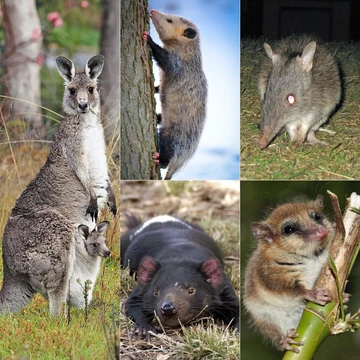
Potoroo
Small marsupials of the genus Potorous, threatened since colonisation.

The name "potoroo" refers to any species in the genus *Potorous*, a group of small marsupials related to kangaroos, wallabies, and other rat-kangaroos. This genus is the sole member of the tribe Potoroini. All three surviving species face threats from ecological changes that followed European settlement in Australia. The long-footed potoroo is endangered, and Gilbert's potoroo is critically endangered. The broad-faced potoroo went extinct soon after being scientifically described in the 1800s. Introduced predators, especially foxes, and habitat loss are the main dangers. Before colonization, potoroos were widespread, and early European settlers considered them major crop pests.
Gilbert's potoroo was first recorded in 1840 by naturalist John Gilbert. It was believed extinct until its rediscovery in 1994 at Two Peoples Bay Nature Reserve near Albany, Western Australia. Conservation work has raised the original wild population of 30–40 individuals to over 100. All *Potorous* species fall within the "critical weight range" for Australian mammals—animals weighing between 35 and 4,200 grams that tended to decline or vanish after British settlement.
The word "potoroo" comes from the Dharug word *badaru*. The genus *Potorous* belongs to the family Potoroidae. Because many species vanished or were heavily impacted soon after being described, the true diversity of the genus has been hard to determine. By 1888, five species had been described, but a revision by Oldfield Thomas reduced that to three. The genus was named *Potorous* by Anselme Gaëtan Desmarest in 1804, though Johann Illiger later replaced it with *Hypsiprymnus*, a name used by later authors despite Desmarest’s objections. Thomas saw no reason for the change and reinstated *Potorous* in 1888. Common names for these animals include rat-kangaroo, kangaroo rat, and potoroo.
The genus is closely related to the living *Bettongia* and *Aepyprymnus*, which together with the family Hypsiprymnodontidae are informally called "rat-kangaroos" within the suborder Macropodiformes. A conservative classification of modern and fossil relatives includes the family Potoroidae, with subfamilies †Palaeopotoroinae, Potoroinae, and †Bulungamayinae. Within Potoroinae are several extinct genera (†Borungaboodie, †Milliyowi, †Purtia, †Wakiewakie, †Gumardee) and two tribes: Bettongini (including *Aepyprymnus*, *Bettongia*, and the extinct †Caloprymnus) and Potoroini (including *Potorous*, †Purtia, †Wakiewakie, and †Gumardee).
When foraging, the long-nosed potoroo swings its head side to side near the ground, sniffing for food. Once it detects something by smell, it digs with its front paws. Potoroo skulls can be narrow and elongated (as in the living *P. gilbertii*, *P. longipes*, and *P. tridactylus*) or broad and flattened (as in the extinct *P. platyops*). Males have a strongly defined external occipital crest, but no sagittal crest is present. The auditory bullae are shallow and flattened. The teeth include sharp, strong canines; broad, long, low permanent premolars with serrated, concave, or horizontal cutting edges; and a long, narrow lower jaw tipped with a sharply pointed incisor. The dental formula is I3/1 C1/0 PM1/1 M4/4, the same as other potoroids. Juveniles have two premolars that are later replaced by a single permanent sectorial premolar.
The first known illustration of a potoroo appeared in 1790 in John White’s *Journal of a Voyage to Botany Bay*, with a caption calling the animal a "Poto Roo." The artwork was by Sarah Stone.
- Common name
- Potoroo
- Genus
- Potorous
- Extant species
- 3 (all threatened)
- Extinct species
- Broad-faced potoroo (P. platyops)
- Conservation status
- Endangered to critically endangered
- Key threat
- Predation by introduced species (especially foxes) and habitat loss
Lore & Background
Potoroo species are small marsupials that belong to the genus *Potorous*, which is the sole genus within the tribe Potoroini and is allied with kangaroos and wallabies in the suborder Macropodiformes. Their appearance varies by species: the skull may be narrow and elongated, as seen in the extant long-nosed, long-footed, and Gilbert's potoroos, or broad and flattened, a feature of the extinct broad-faced potoroo. A strongly defined external occipital crest is present, especially in males, while a sagittal crest is absent. The auditory bullae are shallow and flattened. The dentition includes sharp, strong canines and broad permanent premolars that are long and low, with a serrated, concave, or horizontal cutting edge. An acutely pointed incisor projects from the long, narrow lower jaw. The dental formula matches other potoroid taxa: I3/1, C1/0, PM1/1, M4/4, and juveniles have two premolars that are replaced by a single permanent sectorial premolar. In foraging, the long-nosed potoroo sniffs the ground side to side near food, then uses its forepaws to excavate. Historically, potoroos were very common across Australia, and early settlers considered them significant crop pests. All three surviving species are threatened by introduced predators like foxes and by habitat loss, with the long-footed potoroo endangered and Gilbert's potoroo critically endangered. The broad-faced potoroo went extinct after its 19th-century description. Gilbert's potoroo, first described in 1840, was thought extinct until rediscovered in 1994 at Two Peoples Bay Nature Reserve in Western Australia.
Reader's Guide
The potoroo genus Potorous holds significance as a group of small marsupials that have been greatly impacted since European colonisation of Australia. Their decline illustrates the broader ecological disruption caused by introduced predators such as foxes and by habitat loss. Conservation efforts have successfully increased its population from 30–40 to over 100 individuals, yet all three extant species remain threatened. The broad-faced potoroo disappeared after its first description in the 19th century, underscoring the vulnerability of these animals. Potoroos were once so common that early settlers considered them significant crop pests, a stark contrast to their current threatened status. Their place within the rat-kangaroo group of Macropodiformes connects them to kangaroos and wallabies, and their dental formula and cranial features distinguish them from other potoroid taxa. The genus remains the only one in the tribe Potoroini.
Did You Know?
- The name 'potoroo' comes from the Dharug word badaru.
- The broad-faced potoroo disappeared after its first description in the 19th century.
Frequently Asked Questions
What is a potoroo?
A potoroo is a small marsupial in the genus Potorous, the sole representative of the tribe Potoroini. It falls within the Macropodiformes suborder, placing it among the same broader group as kangaroos, wallabies, and rat-kangaroos.
How many living potoroo species are there?
Three extant species are currently recognized, and every one of them is listed as threatened. Their populations have been driven down by ecological shifts that followed European colonisation of Australia.
What happened to the broad-faced potoroo?
The broad-faced potoroo (P. platyops) is now extinct, having disappeared after its initial scientific description in the 19th century. It was never reliably re-observed after that early documentation, marking one of Australia's earliest marsupial losses.
Why are potoroos endangered or critically endangered?
All three surviving species have suffered severe population declines tied to habitat alteration and broader ecological disruption since colonisation. The long-footed potoroo is classified as endangered, while Gilbert's potoroo sits at the more severe critically endangered level.
More in Marsupials 1-24
Spotted an error? Know more?
This is a living reference — every entry is fact-audited, and reader corrections feed straight into our audit queue. Suggest an edit · See this site's audit record