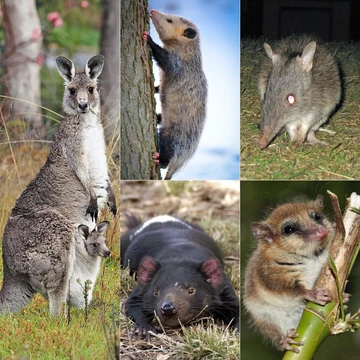
Common ringtail possum
Nocturnal Australian marsupial that reingests its own caecotropes.

The common ringtail possum (*Pseudocheirus peregrinus*) is an Australian marsupial whose scientific name combines the Greek for "false hand" and the Latin for "pilgrim" or "alien." It is one of two living species in the genus *Pseudocheirus*; other ringtail genera were once classified under this genus as well. Several subspecies have been described, including the type subspecies from Endeavour River, the eastern or southeastern ringtail, and the rufous ringtail. The western ringtail possum of southwestern Australia was formerly considered a subspecies but is now regarded as a separate species. The possum ranges along Australia’s east coast, in Tasmania, and in part of the southwest, favoring temperate and tropical forests with dense brush, particularly eucalyptus forests. It is less widespread than the common brushtail possum. Adults weigh between a modest range and reach a length roughly equal to their prehensile tail, which has a distinctive white tip over a quarter of its length. Its fur is grey or black with white patches behind the eyes and usually a cream belly; its back feet are syndactyl for climbing, and its molars have sharp, pointed cusps. Nocturnal and arboreal, it relies on its tail and sometimes descends to the ground, communicating with soft, high-pitched calls. It typically builds nests but occasionally rests in the open. The diet includes leaves, flowers, and fruits from Myrtaceae plants, as well as cypress pine, wattles, and plant gums. Young leaves are preferred over old ones. The digestive system is notable for caecotrophy: material fermented in the caecum is expelled as caecotropes during daytime rests and re-ingested, a behavior also seen in rabbits. This process allows the possum to gain more protein from low-nitrogen eucalyptus leaves, recycle 96% of its liver’s urea, conserve water, and reduce urination. Hard feces are produced at night and not eaten. The possum carries its young in a pouch for 120–130 days before they leave. It is negatively impacted by land clearing and predation by the introduced red fox.
- Scientific name
- Pseudocheirus peregrinus
- Length
- 30–35 cm (body), tail roughly same length
- Habitat
- East coast of Australia, Tasmania, southwestern Australia
- Diet
- Leaves, flowers, fruits, sap, caecotropes
- Conservation status
- Populations declined in 1950s but have since recovered
Lore & Background
The common ringtail possum is a nocturnal, arboreal marsupial that builds communal nests called dreys from branches and tree hollows. It communicates with soft, high-pitched twittering calls and uses its long prehensile tail, which has a white tip, for climbing. Its back feet are syndactyl, aiding in arboreal locomotion. Its diet consists of leaves from native and introduced plants, especially from the Myrtaceae family, as well as flowers, fruits, and sap. A distinctive feature is its consumption of caecotropes—material fermented in the caecum and expelled during daytime rest. This behavior, called caecotrophy, allows the possum to gain more protein and is similar to that seen in rabbits. Both sexes become sexually mature in the first mating season after birth.
Reader's Guide
The common ringtail possum is significant for its unique digestive strategy, which allows it to thrive on a low-nitrogen diet of eucalyptus leaves. By reingesting caecotropes, it recycles 96% of its liver's urea, conserves water, and meets its daily maintenance nitrogen requirement. This adaptation is crucial during late lactation and enables survival in environments where other herbivores might struggle. Its communal nesting behavior and strong territorial attachment contribute to its social structure and juvenile survival. The species is affected by land clearing and predation by the introduced red fox, though populations have recovered since the 1950s. The common ringtail possum occupies a niche similar to that of lemurs, monkeys, and squirrels in other forests, highlighting its ecological role in Australian temperate and tropical forests.
Did You Know?
- The common ringtail possum recycles 96% of its liver's urea, which is transferred into the caecum and made into bacterial protein.
- It produces hard faeces at night while feeding and caecotropes during the day, which it eats.
- The possum can use facultative hyperthermia to temporarily raise its body temperature between 29 and 39 °C to conserve water.
- Its molars have sharp and pointed cusps that slice leaves into pieces during feeding.
More in Marsupials 1-24
Spotted an error? Know more?
This is a living reference — every entry is fact-audited, and reader corrections feed straight into our audit queue. Suggest an edit · See this site's audit record