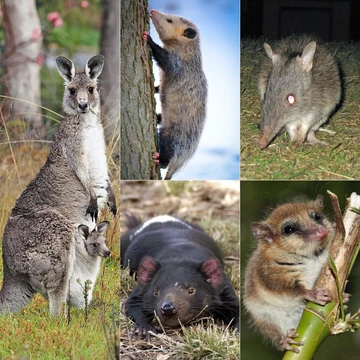
Bilby
Desert marsupial omnivore with rabbit-like ears and backward-facing pouch.

Bilbies are desert-dwelling marsupial omnivores belonging to the genus *Macrotis*, a name derived from Greek words meaning "big-eared," a direct reference to their notably large, long ears. They are also known as rabbit-bandicoots and are members of the order Peramelemorphia. At the time of European colonisation of Australia, two species existed: the greater bilby, which survives today as a vulnerable species, and the lesser bilby, which became extinct in the 1950s. The term "bilby" itself is a loanword from the Yuwaalaraay Aboriginal language of northern New South Wales, meaning "long-nosed rat," though it is known by other names such as dalgite in Western Australia and pinkie in South Australia. The genus name *Macrotis* was first proposed as a subgeneric classification, but after a century of taxonomic confusion, it was stabilised as the accepted name in a 1932 revision by Ellis Troughton. The family name Thylacomyidae comes from an invalid synonym *Thylacomys*, meaning "pouched mouse."
Bilbies have the characteristic long muzzle of a bandicoot, but compared to bandicoots, they possess a longer tail, larger ears, and softer, silkier fur. Their ears help radiate heat and provide excellent hearing. They are nocturnal omnivores that obtain all necessary moisture from their food, which includes insects and larvae, seeds, spiders, bulbs, fruit, fungi, and very small animals. They find most of their food by digging or scratching in the soil and using their very long tongues. Unlike bandicoots, bilbies are expert burrowers, using their strong forelimbs and well-developed claws to build extensive tunnel systems. A bilby typically maintains up to about a dozen burrows within its home range, moving between them for shelter from predators and daytime heat. The female’s pouch faces backward, preventing it from filling with dirt while she digs. Bilbies have one of the shortest gestation periods among mammals, lasting about 12 to 14 days. Their appearance has led to them being called "Australia’s answer to the Easter rabbit." The bilby lineage extends back 15 million years, with a 2014 fossil discovery of a 15-million-year-old jaw showing shorter teeth likely used for eating forest fruit, in contrast to modern bilbies’ long teeth adapted for digging in the desert to eat worms and insects. It is thought the bilby diverged from its closest relative, an originally carniv
- common_name
- Bilby
- scientific_name
- Macrotis
- species
- Greater bilby (Macrotis lagotis) and extinct lesser bilby (Macrotis leucura)
- status
- Greater bilby listed as vulnerable; lesser bilby extinct since 1950s
- average_length
- 55 cm (22 in) excluding tail; tail about 29 cm (11 in)
- gestation
- 12–14 days
- known_for
- Long ears, backward-facing pouch, burrowing, and as an Australian alternative to the Easter Bunny
Lore & Background
The genus name *Macrotis* means 'big-eared' in Greek, referring to the animal's large ears. The family name Thylacomyidae derives from an invalid synonym *Thylacomys*, meaning 'pouched mouse'. The term 'bilby' is a loanword from the Yuwaalaraay Aboriginal language of northern New South Wales, meaning long-nosed rat; it is also known as *dalgite* in Western Australia and *pinkie* in South Australia. Bilbies are desert-dwelling marsupial omnivores of the order Peramelemorphia. At European colonisation, two species existed; the lesser bilby became extinct in the 1950s, while the greater bilby survives as a vulnerable species. The greater bilby averages a certain length excluding its tail, which is also of a notable length. Its fur is grey or white, with a long, pointed nose and very long ears that radiate heat, giving it a rabbit-like nickname. Compared to bandicoots, bilbies have a longer tail, larger ears, and softer, silkier fur. They are nocturnal and do not need to drink water, obtaining moisture from food such as insects, larvae, seeds, spiders, bulbs, fruit, fungi, and very small animals. Food is found by digging or scratching in the soil, using their long tongues. Unlike bandicoots, bilbies are excellent burrowers, using strong forelimbs and claws to build extensive tunnel systems. A bilby typically makes up to about a dozen burrows within its home range, moving between them for shelter from predators and heat. The female’s pouch faces backwards to prevent dirt entering while digging. Gestation lasts about 12–14 days, one of the shortest among mammals.
Reader's Guide
Bilbies are desert-dwelling marsupial omnivores, members of the order Peramelemorphia. At European colonisation, two species existed; the lesser bilby became extinct in the 1950s, while the greater bilby remains endangered and is listed as vulnerable. The greater bilby averages 55 cm in length, with a tail of about 29 cm. Its fur is grey or white, and it possesses a long, pointed nose and very long ears, which radiate heat and enhance hearing. As nocturnal omnivores, they obtain all moisture from food—insects, larvae, seeds, spiders, bulbs, fruit, fungi, and very small animals—and do not need to drink water. They locate food by digging or scratching in soil, using their long tongues. Unlike bandicoots, bilbies are excellent burrowers, constructing extensive tunnel systems with strong forelimbs and claws. A bilby typically maintains up to a dozen burrows within its home range, moving between them for shelter from predators and daytime heat. The female’s pouch faces backward to prevent dirt from entering while digging. Gestation lasts about 12–14 days, among the shortest of any mammal. The bilby lineage extends back 15 million years; a 2014 discovery of a 15-million-year-old fossil jaw showed shorter teeth suited for eating forest fruit, whereas modern bilbies have evolved long teeth for digging desert soil to find worms and insects. The bilby is thought to have diverged from a carnivorous bandicoot ancestor 20 million years ago. Conservation efforts include a national recovery plan involving captive breeding, population monitoring, and reintroduction into former habitats, such as the Arid Recovery Reserve in South Australia (2000) and Currawinya National Park in Queensland (2019). Reintroductions have also succeeded on the Peron Peninsula in Western Australia and at sanctuaries like Scotia and Yookamurra. A breeding program at Kanyana Wildlife Rehabilitation Centre near Perth has been highly successful. The bilby has become a cultural symbol as a native alternative to the Easter Bunny, with chocolate Easter Bilbies sold, sometimes with profits directed to protection and research.
Did You Know?
- The bilby's gestation period of 12–14 days is one of the shortest among mammals.
- The female bilby's pouch faces backwards to prevent dirt from entering while she digs.
- The lesser bilby became extinct in the 1950s.
Frequently Asked Questions
What is a bilby?
A bilby is a small, burrowing marsupial native to Australia's arid interior, classified in the genus Macrotis under the order Peramelemorphia. Fans often nickname them 'rabbit-bandicoots' because of their oversized ears and slender, pointed snout.
How big is a bilby?
The body of a greater bilby stretches roughly 55 cm (about 22 inches) from nose to the base of the tail, with the tail adding another 29 cm or so. Overall, they're a compact, low-slung animal built for digging rather than sprinting.
How many species of bilby are there?
Two species have been formally described: the greater bilby (Macrotis lagotis), which still survives in the wild, and the lesser bilby (Macrotis leucura), which disappeared in the 1950s. The greater bilby is the sole remaining representative of the genus.
What makes bilby reproduction unusual?
Pregnancy lasts only 12 to 14 days, one of the shortest gestation periods in the marsupial world. After that brief window, the newborn crawls into a pouch that opens toward the tail—an adaptation that keeps the young safe while the mother digs and forages head-first.
Why is the greater bilby considered vulnerable?
Predation by introduced foxes and feral cats, combined with habitat degradation and prolonged drought, has driven the species to a vulnerable conservation status. The earlier loss of the lesser bilby in the 1950s underscores how fragile these small desert populations are.
More in Marsupials 1-24
Spotted an error? Know more?
This is a living reference — every entry is fact-audited, and reader corrections feed straight into our audit queue. Suggest an edit · See this site's audit record