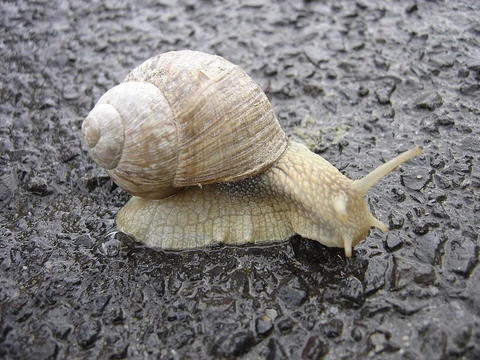
Chlorodiloma crinita
A marine gastropod mollusk in the family Trochidae.

Chlorodiloma crinita is a marine gastropod mollusk belonging to the Trochidae family, commonly known as top snails. Its solid, globose-conic shell reaches 15 mm in length and is narrowly perforated. The shell has a light grayish background marked by many narrow, evenly spaced olive lines running lengthwise. The early whorls are bright orange, while the conical spire appears eroded. The sutures between whorls are linear and impressed. There are five convex whorls, each with shallow spiral grooves—about five on the penultimate whorl. The aperture is oblique, with a smooth, thickened inner lip. The columella is not very thick, arcuate, white-edged, and has an obtuse tooth below. The area around the umbilicus and columella is bright green. This species is found off the coast of Western Australia.
Quick Facts
- Taxon
- Chlorodiloma crinita
Facts from the source article.
Lore & Background
The shell of Chlorodiloma crinita is globose-conic, narrowly perforate, solid, and light cinereous. It is longitudinally marked with numerous narrow regularly spaced olive lines, while the first whorls are bright orange colored. The spire is conic and eroded, with linear and impressed sutures. The five whorls are convex and spirally grooved; these grooves are shallow, with about 5 on the penultimate whorl. The aperture is oblique, the lip smooth and thickened within. The columella is not very thick, arcuate, white edged, and obtusely dentate below. The umbilico-columellar area is bright green.
Reader's Guide
Chlorodiloma crinita is documented in several malacological references, including works by Philippi (1852), Fischer (1877), Thiele (1930), and Wilson (1993). These sources establish its place within the Trochidae family and describe its shell morphology in detail. The species occurs off West Australia, as noted in the distribution. Its significance lies in its contribution to the understanding of trochid diversity in Australian waters, with its shell features—such as the bright green umbilico-columellar area and orange first whorls—providing diagnostic characteristics for identification. The species is listed in external databases like the Encyclopedia of Life and the World Register of Marine Species, and genetic data (2 nucleotides; 0 proteins) are available in GenBank, indicating ongoing taxonomic interest.
Did You Know?
- The shell grows to a length of 15 mm.
- This marine species occurs off West Australia.
More in Marine Snails, Part 2 1-24
Spotted an error? Know more?
Reader corrections go straight into our review queue. Suggest an edit · How this site is sourced