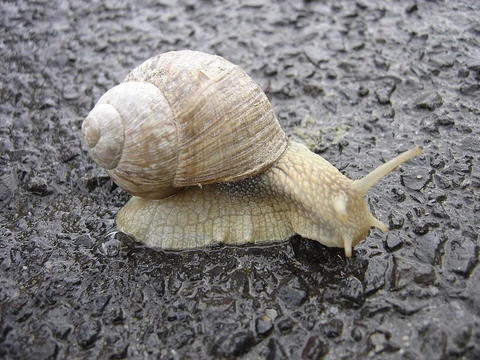
Pomaulax
A genus of turban snails with distinctive opercular ribs.

Pomaulax is a genus of marine gastropod mollusks, commonly known as turban snails, belonging to the family Turbinidae. Members of this genus have a large, solid, cone-shaped shell that lacks an opening at the apex. The shell's outer edge is keeled, and its base is flat. A strong, curved rib marks the area of the umbilical tract. The operculum, or trapdoor, is shaped like an inverted egg, tapering toward the lower end, with its nucleus at the tip. On its outer surface, four thick, grainy ribs radiate outward from the nucleus.
Species in the genus include *Pomaulax gibberosus*, *Pomaulax japonicus*, and *Pomaulax spiratus*. Two former species, *Pomaulax turbanicus* and *Pomaulax undosum*, are now considered synonyms of species in the genus *Megastraea*.
Quick Facts
- Taxon
- Pomaulax
- Type Species
- Trochus japonicus
- Type Species Authority
- Dunker, 1845
Facts from the source article.
Lore & Background
The genus Pomaulax is described as having a large, solid, imperforate shell with a conic shape and a carinated periphery. The base of the shell is flattened, and the umbilical tract shows a strong curved rib. The operculum is obovate, narrower toward the proximal extremity, with its nucleus terminal and its outside bearing four strong granulose ribs radiating from the nucleus.
Species within the genus include Pomaulax gibberosus, Pomaulax japonicus, and Pomaulax spiratus. Two species once placed in Pomaulax—Pomaulax turbanicus and Pomaulax undosum—have been brought into synonymy with the genus Megastraea, as Megastraea turbanica and Megastraea undosa, respectively.
The article provides references to works by Williams (2007) on the origins and diversification of Indo-West Pacific marine fauna, and by Alf & Kreipl (2011) on the family Turbinidae, but does not elaborate further on the genus's history or context.
Reader's Guide
The significance of Pomaulax lies in its placement within the family Turbinidae, the turban snails, and its distinctive morphological features as described in the source article. The genus is characterized by a large, solid, imperforate conic shell with a carinated periphery and a flattened base, along with a unique operculum that is obovate with a terminal nucleus and four strong granulose ribs. These traits help distinguish Pomaulax from related genera. The article lists three accepted species—Pomaulax gibberosus, Pomaulax japonicus, and Pomaulax spiratus—and notes that two former species have been synonymized with Megastraea, indicating taxonomic revisions within the group. The references cited, including Williams (2007) and Alf & Kreipl (2011), provide broader context on turban snail evolution and systematics, though the article itself does not elaborate on the genus's ecological or biogeographic legacy. The entry serves as a concise taxonomic and morphological record for this genus of marine gastropods.
Did You Know?
- The shell of Pomaulax is large, solid, imperforate, and conic with a carinated periphery.
- The operculum of Pomaulax has four strong granulose ribs radiating from a terminal nucleus.
- Two species once assigned to Pomaulax—Pomaulax turbanicus and Pomaulax undosum—are now considered synonyms of Megastraea species.
- The genus Pomaulax belongs to the family Turbinidae, the turban snails.
Taxonomic Identity & Classification
Pomaulax occupies a position as a subgenus nested within the broader Astraea genus, a group of medium-to-large marine gastropod mollusks belonging to the family Turbinidae, the turban snails. This placement firmly situates Pomaulax within the sea snail lineage rather than among terrestrial gastropods. The parent genus Astraea takes its name from the Latin word for star, a direct reference to the star-shaped silhouette of its shells, which has earned these creatures the common moniker of star shells. As a subgenus, Pomaulax represents a recognized taxonomic subdivision that sets apart certain fossil lineages from the living members of Astraea. The sole extant species in the parent genus is Astraea heliotropium, originally described by Martyn in 1784, while every Pomaulax representative is known exclusively through fossil remains, marking the subgenus as entirely a product of deep geological time.
Morphological Heritage of the Lineage
Members of the Astraea genus, including those classified under the Pomaulax subgenus, are defined by a smooth conical shell form that can reach a maximum length of roughly sixty millimetres. The coiled whorls exhibit notably flattened outer edges, and the shell surface carries prominent axial sculpture, meaning visible ridges run along the axis of each coil. The base of the shell is described as widely umbilicate and concave, indicating a broad, hollowed depression on the underside. These morphological traits are consistent across the genus and would have characterized the Pomaulax species as well. The overall body plan is that of a medium-to-large sea snail, fitting the general architecture of turban snails within Turbinidae. The star-shaped appearance alluded to in the genus name is a visual hallmark produced by this particular combination of conical form, flattened whorl margins, and axial ridging.
Deep-Time Fossil Record
The Astraea genus, encompassing the Pomaulax subgenus, possesses a fossil record stretching from the Paleocene through the Quaternary, spanning approximately 61.7 million years to the present. This extraordinary temporal persistence indicates the lineage endured across numerous geological epochs and major environmental upheavals. The two recognized Pomaulax species, Astraea (Pomaulax) gradata named by Grant and Gale in 1931 and Astraea (Pomaulax) morani described by Loel and Corey in 1932, are both extinct and known only from fossil specimens. The wider Astraea fossil assemblage includes numerous other extinct species assigned to additional subgenera such as Liotiastralium and Vitiastraea, highlighting the considerable diversity this genus once encompassed before the present-day lineage was reduced to a single surviving species.
Geographic Reach & Paleobiogeography
Fossils of Astraea species, including those nested within the Pomaulax subgenus, have been recovered from sedimentary deposits across a remarkably wide geographic range. Documented find locations span Europe, Australia, the United States, Japan, Venezuela, Colombia, and Brazil. This transcontinental distribution suggests the genus and its constituent subgenera inhabited diverse marine environments on multiple continents throughout their 61.7-million-year history. The presence of Astraea fossils in South American localities reflects the broad paleogeographic reach of the lineage within which Pomaulax was embedded. Broader scientific investigations into the evolutionary history and biogeography of turban shells, including studies examining the origins and diversification of Indo-West Pacific marine fauna, provide the contextual framework for understanding how these gastropod lineages dispersed and diversified across ocean basins over deep geological time.
Frequently Asked Questions
What is Pomaulax?
Pomaulax is a genus of marine gastropod mollusks classified within the family Turbinidae, the group commonly called turban snails. It is recognized by its robust, cone-shaped shell and a uniquely ribbed operculum.
What does a Pomaulax shell look like?
The shell is large, solid, and conic with no perforation at the apex, a keeled outer periphery, and a flattened base. A prominent curved rib traces the umbilical tract, giving the lower interior a distinctive ridge.
What makes the Pomaulax operculum distinctive?
The trapdoor is obovate—shaped like an inverted egg—and tapers toward its proximal end with the nucleus positioned at the tip. On the outer face, four thick, grainy ribs fan outward from that nucleus, a feature that sets the genus apart from other Turbinidae.
Which species are included in the genus Pomaulax?
Recognized members include Pomaulax gibberosus and Pomaulax japoni, among others described within the genus. Taxonomic revisions may add or reassign species as new material is examined.
How is Pomaulax different from other turban snails?
While many Turbinidae share a sturdy conic shell, Pomaulax is set apart by the combination of its carinated periphery, the single strong curved rib in the umbilical region, and especially the four radiating grainy ribs on the operculum's outer surface. Together these traits give the genus a recognizable silhouette even at a glance.
More in Marine Snails, Part 2 1-24
Spotted an error? Know more?
Reader corrections go straight into our review queue. Suggest an edit · How this site is sourced