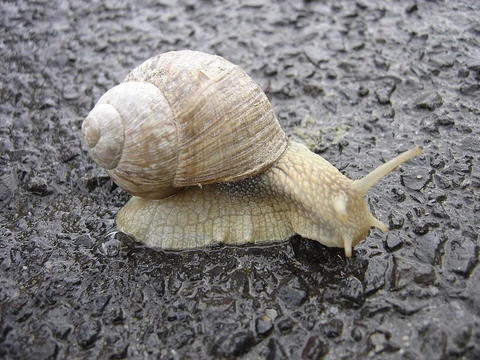
Astraea (gastropod)
A genus of star-shaped sea snails in the family Turbinidae.

Astraea is a genus of sea snails, specifically medium-to-large marine gastropod mollusks belonging to the family Turbinidae—commonly known as turban snails. The Latin name *Astraea* translates to "star," a reference to the star-like shape of these animals, which are often called star shells.
The shells of species in this genus can grow to roughly 60 millimeters (2.4 inches) in size. They feature a smooth, conical form. The outer edges of the coiled whorls are notably flattened and bear prominent axial sculpture. Beneath, the shell is wide, umbilicate, and concave.
Living species in this genus include *Astraea heliotropium* (Martyn, 1784). The genus also has a fossil record spanning from the Paleocene to the Quaternary (approximately 61.7 million to 0.0 million years ago). Fossils have been found in Europe, Australia, the United States, Japan, Venezuela, Colombia, and Brazil. Extinct species include †*Astraea (Liotiastralium) venezuelana* Weisbord 1962, †*Astraea (Pomaulax) gradata* Grant and Gale 1931, †*Astraea (Pomaulax) morani* Loel and Corey 1932, †*Astraea (Vitiastraea) holmesi* Ladd 1966, †*Astraea bicarinata* Suter, 1917, †*Astraea fimbriata* Borson 1821, †*Astraea granifer* (K. Martin, 1884), †*Astraea hickmanae* Kiel & Bandel, 2002, †*Astraea holmesi* Ladd, 1966, †*Astraea hudsoniana* (R. M. Johnston, 1888), †*Astraea pseudomodesta* Nomura, 1935, †*Astraea stellare* Gmelin 1791, †*Astraea stirps* Laws, 1932, and †*Astraea tentoriiformis* Jonas, 1844. Some species have been brought into synonymy.
Quick Facts
- Taxon
- Astraea
- Type Species
- Trochus imperialis
- Type Species Authority
- Gmelin, 1791
Facts from the source article.
Lore & Background
The genus Astraea comprises medium to large sea snails with shells reaching about 60 mm. Their shells are smooth and conical, with flattened outer edges of the coiled whorls and prominent axial sculpture. Below, the shell is widely umbilicate and concave. The Latin name Astraea means star, reflecting the star-like shape of these snails, which are commonly called star shells. Extant species include Astraea heliotropium. The genus is known in the fossil record from the Paleocene to the Quaternary, with fossils found in Europe, Australia, the United States, Japan, Venezuela, Colombia, and Brazil. Extinct species include †Astraea bicarinata, †Astraea fimbriata, and many others listed in the source.
Reader's Guide
Astraea is notable as a genus of marine gastropod mollusks within the family Turbinidae, the turban snails. Its significance lies in its distinctive star-shaped shell, reflected in its Latin name, and its long fossil record spanning from the Paleocene to the Quaternary, approximately 61.7 million years to the present. Fossils have been recovered from diverse regions including Europe, Australia, the United States, Japan, Venezuela, Colombia, and Brazil, indicating a wide historical distribution. The genus includes both extant species, such as Astraea heliotropium, and numerous extinct species, many of which are documented in the fossil record. The shell morphology—smooth, conical, with flattened whorls and an umbilicate concave base—characterizes the group. The genus contributes to understanding the evolutionary history of turban snails and their biogeography, as referenced in works like Williams (2007) on the origins and diversification of Indo-West Pacific marine fauna.
Did You Know?
- The genus name Astraea means star in Latin, referring to the star-shaped shells.
- Shells of Astraea species can reach about 60 mm (2.4 in) in size.
- The fossil record of Astraea spans from the Paleocene to the Quaternary (61.7 to 0.0 million years ago).
Naming and Identity
Astraea derives its name from the Latin word for star, a direct nod to the distinctive star-shaped profile that these particular sea snails display on their shells. This visual characteristic is so defining that members of the genus are widely recognized by the common name "star shells" in everyday usage. Despite this celestial-sounding moniker, Astraea belongs firmly to the world of marine gastropod mollusks, specifically within the family Turbinidae, better known as the turban snails. The genus encompasses medium to large species, placing them among the more substantial members of their family. The combination of the star-like silhouette and the conical turban-snail body plan gives Astraea a unique identity within the broader landscape of marine snails, one that has made it recognizable to collectors and taxonomists alike since its formal description in the scientific literature.
Shell Morphology
The shells produced by Astraea species present a striking architectural form. Reaching a maximum length of roughly sixty millimetres, or about two and a quarter inches, they occupy the medium-to-large end of the turban snail spectrum. The overall silhouette is that of a smooth cone, yet closer inspection reveals considerable textural complexity. The outer margins of each coiled whorl are notably flattened, giving the shell a faceted, almost geometric quality rather than a purely rounded one. Along the surface, prominent axial sculpture runs in raised ridges, adding a tactile dimension to what might otherwise appear as a simple conical shape. Viewed from the underside, the shell reveals a broad umbilicus, a deep concave depression at the center of the base. This combination of a flattened-whorl profile, strong axial ridging, and a wide central opening distinguishes Astraea shells from the more uniformly rounded forms seen in other turban snail genera.
Fossil Record and Deep Time
One of the most remarkable aspects of Astraea is its extraordinary depth in the geological record. Fossils attributed to this genus span from the Paleocene through to the Quaternary, covering an interval of roughly sixty-one and a half million years down to the present day. This means the basic body plan we recognize today, the star-shaped conical turban snail, has persisted in recognizable form across multiple major geological epochs. The geographic spread of these fossil finds is equally impressive. Sedimentary deposits in Europe, Australia, the United States, Japan, Venezuela, Colombia, and Brazil have all yielded specimens of Astraea. This wide distribution across both Northern and Southern Hemisphere continents suggests the genus was not confined to a single ocean basin but had established populations in diverse marine environments. The continuity of the fossil record stretching back to the early Cenozoic underscores the evolutionary stability of this lineage over tens of millions of years.
Taxonomic Diversity and Extinct Lineages
While only a single extant species, Astraea heliotropium, described by Martyn in 1784, survives today, the fossil record reveals a far more diverse genus. Dozens of extinct species have been formally named, many of them assigned to informal subgenera such as Liotiastralium, Pomaulax, and Vitiastraea, reflecting morphological variation that taxonomists once considered significant enough to warrant intermediate classification. Descriptions of these extinct forms span more than two centuries of malacological work, from Gmelin's 1791 naming of A. stellare to Kiel and Bandel's 2002 description of A. hickmanae. Some species, such as A. holmesi, appear in the literature under slightly different authorship and year, while others have been folded into synonymy with previously described taxa. This long history of description, revision, and synonymy illustrates how our understanding of Astraea's diversity has been built incrementally, with each new fossil discovery or re-examination reshaping the genus's taxonomic boundaries.
Frequently Asked Questions
Who is Astraea (gastropod)?
Astraea is a genus of medium-to-large marine gastropod mollusks classified in the family Turbinidae, the same family that houses turban snails. Its Latin name means "star," a nod to the star-like silhouette that has earned these animals the common nickname "star shells."
What are Astraea (gastropod)'s powers/role?
Members of this genus construct smooth, conical shells reaching roughly 60 mm (about 2.4 in) in length, with flattened outer whorl edges marked by prominent axial ridges. The underside is broad, concave, and umbilicate, giving the shell a distinctive structural signature among turban snails.
Why is Astraea (gastropod) important?
Astraea provides a long, well-documented thread for tracking the evolution and biogeography of star-shaped marine snails across the Turbinidae. Fossils found on at least seven continents—Europe, Australia, the United States, Japan, Venezuela, Colombia, and Brazil—make it a cornerstone reference for paleontological and taxonomic work.
Where can you find Astraea (gastropod)?
Fossil shells of the genus have been recovered from Paleocene-through-Quaternary deposits in Europe, Australia, the United States, Japan, Venezuela, Colombia, and Brazil. Living species are marine, inhabiting ocean environments where they build their characteristic conical, star-shaped shells.
More in Marine Snails, Part 2 1-24
Spotted an error? Know more?
Reader corrections go straight into our review queue. Suggest an edit · How this site is sourced