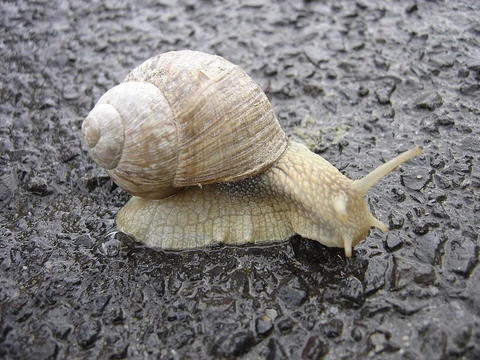
Cantharidus opalus
A marine gastropod endemic to New Zealand with iridescent green nacre.

Cantharidus opalus, known as the opal top shell or matangongore in Māori, is a marine gastropod mollusc in the family Trochidae. This large sea snail is endemic to New Zealand, living subtidally in kelp beds down to at least 15 metres on semi-exposed to exposed coasts.
The shell ranges from 23 mm to 45 mm in length. It is large, imperforate, and elevated conical in shape, with an angular periphery. The shell is solid but not very thick. Its spiral sculpture is not conspicuous and is nearly obsolete, with about seven indistinct, distant spiral grooves on the penultimate whorl. These are crossed by more or less distinct oblique growth lines. The base has about five narrow, often inconspicuous, separated spiral ridges. The colour is whitish, tinged with blue on the body whorl and yellowish or pinkish on the spire, all over closely marked with longitudinal purple zigzag patterns that are often interrupted into spiral series of articulations. The thin, shiny epidermis rubs off easily.
The spire is elevated conic, with straight or slightly concave sides that are often eroded, revealing iridescent green nacre at the tip. The protoconch is conical, small, acute, and consists of 2½ convex, smooth, pinkish-brown whorls. The shell has 8 to 10 whorls; the first increase very slowly, then rapidly. The whorls are straight or slightly convex, and the body whorl is distinctly angled at the periphery. The base is flatly convex. Sutures are well impressed, sometimes subcanaliculate on the lower whorls. The oblique aperture is ovate-rhomboidal, lined with iridescent green nacre with red reflections. The outer lip is thin and slightly sulcate within, often with a broad opaque white callosity following a greenish edge inside. The columella is subvertical, generally straight in the middle or slightly projecting. The inner lip spreads as a broad white callus a little beyond the columella and over the parietal wall.
Quick Facts
- Taxon
- Cantharidus opalus
Facts from the source article.
Lore & Background
The shell of Cantharidus opalus is large, imperforate, and elevated conical in shape, angular at the periphery, solid but not very thick. Its spiral sculpture is subobsolete, with about 7 indistinct spiral grooves on the penultimate whorl, crossed by oblique growth lines. The base has about 5 narrow, often inconspicuous ridges. The colour is whitish, tinged with blue on the body whorl and yellowish or pinkish on the spire, all over closely marked with longitudinal zigzag purple markings that may be interrupted into spiral series. The thin, shining epidermis is easily rubbed off.
The spire is elevated conic with straight or slightly concave sides, often eroded, showing iridescent green nacre at the tip. The protoconch is conical, small, acute, with 2½ convex smooth pinkish-brown whorls. The shell contains 8 to 10 whorls, increasing slowly at first then rapidly. The body whorl is distinctly angled at the periphery, and the base is flatly convex. The sutures are well impressed, sometimes subcanaliculate on lower whorls. The oblique aperture is ovate-rhomboidal, lined with iridescent green nacre with red reflections. The outer lip is thin and slightly sulcate within, often with a broad opaque white callosity following a greenish edge. The columella is subvertical, generally straight or slightly projecting, and the inner lip spreads as a broad white callus over the parietal wall.
Reader's Guide
Cantharidus opalus is a species of large sea snail endemic to New Zealand, found subtidally in kelp beds down to at least 15 m on semi-exposed to exposed coasts. Its notable features include the iridescent green nacre lining the aperture, which gives the shell a distinctive opalescent quality reflected in its common name. The shell's purple zigzag markings and variable colouration—whitish with blue, yellow, or pink tints—make it visually striking. The species is part of the family Trochidae, the top snails, and is known in Māori as matangongore. Its distribution is restricted to New Zealand waters, where it inhabits kelp bed environments. The shell's thin, easily rubbed epidermis and the frequent erosion of the spire tip, revealing the nacre, are characteristic. The species has been documented in works such as Powell's New Zealand Mollusca and Marshall's 1998 study of New Zealand Cantharidus and Micrelenchus species.
Did You Know?
- The shell length varies between 23 mm and 45 mm.
- The species is endemic to New Zealand and found subtidally in kelp beds down to at least 15 m.
- The Māori name for this snail is matangongore.
More in Marine Snails, Part 2 1-24
Spotted an error? Know more?
Reader corrections go straight into our review queue. Suggest an edit · How this site is sourced