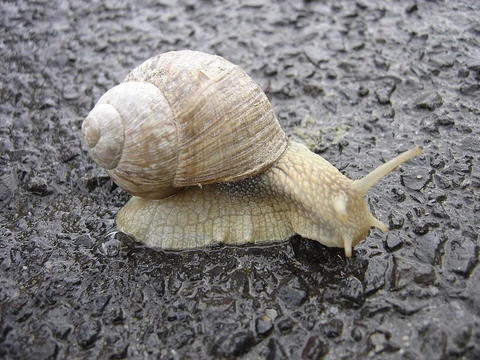
Austrocochlea constellata
A marine top snail of uncertain taxonomic status from New Caledonia.

Austrocochlea constellata is a marine gastropod mollusk in the Trochidae family, commonly known as top snails. Its taxonomic status is uncertain, making it a species inquirenda.
The shell reaches 9 mm in height and 10 mm in diameter. It is obliquely shaped, imperforate, orbiculate-conic, and slightly elevated, with a very wide base. The surface is subtly striated longitudinally and marked by a few spiral lines that may be faint or absent, leaving it smooth. The color is leaden ash, sometimes with a pinkish tint, closely dotted with white and encircled by two dark bands broken by larger white spots. The sutures are impressed, and the five whorls are slightly convex, with the last whorl making up most of the shell; they are compressed, bluntly angled, and depressed below the suture. The base is largely covered by the parieto-columellar area. The aperture is very oblique, pearly, and iridescent inside. The outer lip is thin and acute, continuing onto the base at an angle that borders the columellar area. The columella is thin, white, subhorizontal, very wide, and slightly concave, bounded externally by a narrow brown streak. Color patterns vary considerably. Unlike most species in this genus, the base lacks a white thickened continuation of the columella.
This marine species occurs off New Caledonia.
Quick Facts
- Taxon
- Austrocochlea constellata
Facts from the source article.
Lore & Background
The shell of Austrocochlea constellata attains a height of 9 mm and a diameter of 10 mm. It is obliquely, imperforate, orbiculate-conic, and slightly elevated, with a very wide base. The surface is longitudinally very obliquely subtly striate, marked with a few spiral subimpressed lines that are sometimes obsolete, leaving the surface smooth. The color is plumbeous ashen, often with a pink tinge, closely speckled with white dots, and encircled with two dark bands articulated with larger white spots. The sutures are impressed, and the five whorls are subconvex, with the last forming the greater portion of the shell; they are compressed, obtusely angulated, and depressed below the suture. The base is almost entirely occupied by the parieto-columellar area. The aperture is very oblique, pearly and iridescent inside, with a thin acute outer lip continued on the base in an angle bounding the columellar area. The columella is thin, white, subhorizontal, very wide, subconcave, and bounded by a narrow brown streak outside. There is considerable variation in the color pattern. Unlike most species in this genus, the base is not lined with a white thickened continuation of the columella.
Reader's Guide
Austrocochlea constellata is notable primarily as a species inquirenda, indicating that its taxonomic validity is unresolved. The species was described by Souverbie and Montrouzier in a 1863 publication in the Journal de Conchyliologie, based on material from the New Caledonian archipelago. Its shell characteristics, including the orbiculate-conic shape, color pattern with white dots and dark bands, and the absence of a white thickened columellar continuation on the base, distinguish it from most other members of the genus Austrocochlea. The species has been referenced in later phylogenetic and taxonomic work on austral monodontine topshells, but its status remains uncertain. The entry in the World Register of Marine Species and other biodiversity databases reflects this unresolved classification. For collectors and malacologists, the species represents a taxonomic puzzle that may be clarified with further study of its anatomy or genetic material.
Did You Know?
- The shell height is 9 mm and diameter is 10 mm.
- The species is considered a species inquirenda, meaning its taxonomic status is uncertain.
- It occurs off New Caledonia.
- Unlike most Austrocochlea species, its base lacks a white thickened continuation of the columella.
More in Marine Snails, Part 2 1-24
Spotted an error? Know more?
Reader corrections go straight into our review queue. Suggest an edit · How this site is sourced