West
One of the four cardinal directions, opposite east.
Last updated
West is a cardinal direction, one of the four main points on a compass. It lies directly opposite east and marks the point on the horizon where the Sun goes down each day.
Etymology
The term "west" comes from a Germanic root that spread into several Romance languages—for example, ouest in French, oeste in Spanish and Portuguese, ovest in Italian, and vest in Romanian. This word traces back to the Indo-European root wes, a shortened form of wes-pero, meaning "evening" or "night." It is related to the Ancient Greek hesperos (evening, evening star, western) and Latin vesper (evening, west). Other languages follow the same logic: Latin occidens comes from occidō (to go down, to set), and Hebrew maarav derives from erev (evening). West is often shortened to the letter W.
Navigation
For navigation, setting a compass bearing of 270° points west (assuming magnetic north matches true north). West is the direction opposite Earth’s rotation, so the Sun appears to move steadily westward until it sets.
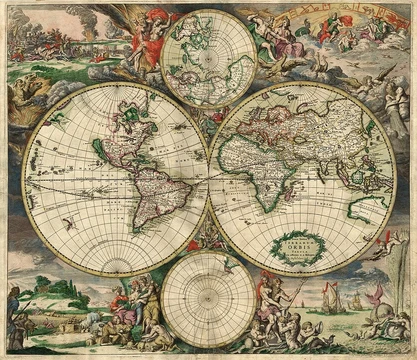
This is not the case on Venus, which rotates backward; there, the Sun would rise in the west and set in the east, though the planet’s thick clouds block any view. On a standard map with north at the top, west is on the left. Traveling continuously west follows a line of latitude.
Weather
In weather, Earth’s rotation causes prevailing winds in the middle latitudes (roughly 35 to 65 degrees) to blow from the west—these are called the westerlies.
Cultural
Culturally, "the West" often refers to the Western world: the European Union, EFTA countries, the United Kingdom, the Americas, Israel, Australia, New Zealand, and partly South Africa. This concept traces back to the Western Roman Empire and Western Christianity. During the Cold War, "the West" typically meant the NATO alliance, as opposed to the Warsaw Pact and non-aligned nations. The term continues to be used, though its meaning has become less clear.
Symbolically, in Chinese Buddhism, the west represents movement toward the Buddha or enlightenment, as in the classic tale Journey to the West. The ancient Aztecs saw the west as the realm of the great goddess of water, mist, and maize. In Ancient Egypt, the west was the gateway to the underworld, linked with death but not always negatively; the goddess Amunet personified this direction.
The Celts believed that beyond the western sea, off the edges of known maps, lay the Otherworld or afterlife. In Judaism, the west is associated with the Shekinah (God’s presence), because the Tabernacle and later the Jerusalem Temple faced east, with the Holy of Holies to the west. According to the Bible, the Israelites crossed the Jordan River westward into the Promised Land.
In Islam, cardinal directions are not given fixed symbolic meanings; instead, the Qur’an states (2:115): "To God belong the East and the West. Wheresoever you turn, there is the Face of God." This emphasizes that spiritual truth is not bound to any direction. In American literature, such as The Great Gatsby, moving west can symbolize gaining freedom, echoing the settlement of the Wild West and ideas like the American frontier and Manifest Destiny.
Quick Facts
- Type
- Cardinal direction
- Opposite direction
- East
- Etymology root
- Indo-European wes (evening, night)
- Cultural associations
- Western world
- freedom
- afterlife
Facts from the source article.
Lore & Background
West is one of the four cardinal directions, opposite east, and is defined as the direction in which the Sun sets on Earth. The word derives from the Indo-European root wes, related to the concept of evening and night, and is cognate with the Latin vesper and Ancient Greek hesperos, both meaning "evening" or "west." In Latin, the term occidens also means "west," from the verb meaning "to go down" or "to set," and Hebrew maarav similarly stems from the word for "evening." West is abbreviated as W. On a compass, west corresponds to a bearing of 270°, and on a standard map with north at the top, west is on the left. Moving continuously west follows a circle of latitude.
Due to Earth's rotation, the prevailing winds in middle latitudes (between 35 and 65 degrees) often blow from the west, known as the westerlies. Culturally, "the West" refers to the Western world, including the European Union, the United Kingdom, the Americas, Israel, Australia, New Zealand, and parts of South Africa, with roots in the Western Roman Empire and Western Christianity. Symbolically, in Chinese Buddhism, west represents movement toward enlightenment; the Aztecs associated it with a goddess of water and maize; and in Ancient Egypt, it was the portal to the netherworld, personified by the goddess Amunet. The Celts placed the afterlife beyond the western sea.
In Judaism, west is toward the divine presence, as the Temple faced east with the Holy of Holies to the west. In Islam, the Qur'an states that east and west belong to God, emphasizing divine omnipresence over directional symbolism. In American literature, moving west has symbolized freedom, linked to the settling of the Wild West.
Reader's Guide
West holds significant cultural and symbolic meanings across civilizations. In Chinese Buddhism, it represents movement toward enlightenment. The ancient Aztecs associated it with the goddess of water, mist, and maize.
In Ancient Egypt, west was the portal to the netherworld, personified by the goddess Amunet. The Celts believed the Otherworld lay beyond the western sea. In Judaism, west is toward the Shekinah of God, as the Temple faced east with the Holy of Holies to the west.
In Islam, the Qur'an states that east and west belong to God, emphasizing divine omnipresence. In American literature, moving west has symbolized gaining freedom, linked to the settling of the Wild West. The phrase 'the West' also refers to the Western world, including the European Union, the United Kingdom, the Americas, Israel, Australia, New Zealand, and partly South Africa, with roots in the Western Roman Empire and Western Christianity.
Also in the Codexery
More in Map Projections & Cartography Foundations
Sources
Compiled from Wikipedia and the sources listed below. Text from Wikipedia is available under CC BY-SA 4.0; this entry is adapted from it.
- Wikipedia: West (CC BY-SA 4.0).
Spotted an error? Know more?
Reader corrections go straight into our review queue. Suggest an edit · How this site is sourced