Chinese Buddhism
Sinicized Mahayana Buddhism, largest religion in mainland China.

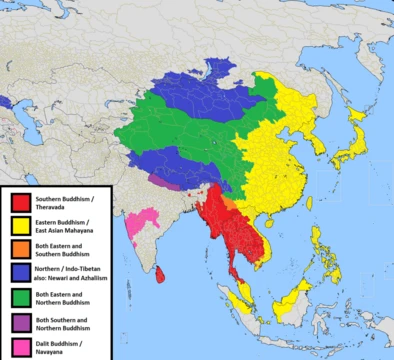
Chinese Buddhism, often called Han Buddhism, is a version of Mahayana Buddhism adapted to Chinese culture. It relies on the Chinese Buddhist canon and incorporates many local traditions. In mainland China, it is the largest organized religion, with roughly 42 to 53 million followers. It also plays a major role in Taiwan, Singapore, and communities of the Chinese diaspora.
Buddhism first reached China during the Han dynasty (206 BCE–220 CE). Several emperors, especially those of the Tang dynasty (618–907 CE), actively promoted it, helping it spread nationwide. Early missionaries translated Indian Buddhist scriptures into Chinese, and over time, Chinese writers added their own works shaped by Taoist and Confucian ideas. This collection became the Chinese Buddhist canon, which formed the basis for an indigenous Chinese Buddhism. By embracing local customs, rituals, and folk religion, this form of Buddhism had a lasting influence on East Asian countries like North Korea, South Korea, Japan, and Vietnam. Chinese Buddhism also gave rise to distinct schools of thought and practice, such as Tiantai, Huayan, Chan, Pure Land, and Zhenyan.
Buddhist missionaries brought the religion to China during the Han dynasty, using both the overland Silk Road through Central Asia and maritime routes. At first, Buddhism was poorly understood and often mixed up with Taoism, as the Chinese saw many similarities. Confucian elites criticized the foreign religion. Mahayana Buddhism arrived from India via the Silk Route in the 1st century CE, passing through Tibet. One of the earliest tasks was translating texts. The first surviving translations were done by the 2nd-century Parthian monk An Shigao in Luoyang. Later, the Kushan monk Lokakṣema produced extensive Mahayana translations, and Dharmarakṣa worked in the 3rd century. The Dharmaguptaka school was influential early on, and its monastic rules were adopted by all Chinese Buddhist schools.
In the 4th century, northern China faced political turmoil during the Sixteen Kingdoms period (304–439). Many non-Han rulers were drawn to Buddhism for its foreign elements. Monks like Fotu Cheng held high government positions, and common people could practice freely. Buddhism’s popularity spread south to the Eastern Jin dynasty (318–420). The arrival of the Kuchan scholar Kumārajīva (334–413) was a key event. Unlike earlier translators, he had state support and was named national preceptor. His disciples produced high-quality translations that deeply influenced Chinese Buddhism. He also introduced the Madhyamaka school, later called Sanlun, and helped establish an Indic foundation for Chinese Buddhist philosophy, which had previously been heavily Taoist-influenced.
By the 460s, Buddhism was a mainstream institution in China, with widely recognized art and iconography. The Dunhuang and Yungang cave complexes are notable examples of early Chinese Buddhist art. Another important translator, Paramārtha (499–569 CE), worked with Chinese disciples to translate texts on Abhidharma, Yogachara philosophy, and other Mahayana works. Translators like Bodhiruci and Ratnamati in the 6th century helped establish a Chinese Yogacara school, also called the Consciousness-Only school.
The 6th and 7th centuries saw the rise of unique Chinese Buddhist traditions. The Tiantai school was mainly founded by master Zhiyi (538–597 CE), based on the Lotus Sutra and his own works. The Huayan school, centered on the Avatamsaka Sutra, was developed by masters Dushun (557–640), Zhiyan (602–668), and Fazang (643–712). The Pure Land tradition focused on Amitabha veneration, with key figures like Tanluan (476–542), Daochuo (562–645), and Shandao (613–681). Chan Buddhism emerged from the teachings of masters such as Bodhidharma, Dazu Huike (487–593), Sengcan (d. 606), Dayi Daoxin (580–651), and Daman Hongren (601–674). During the Tang dynasty, the monk Xuanzang (602–664) traveled to India and back, writing extensively about his journey.
- origin
- Introduced during the Han dynasty (206 BCE – 220 CE)
- foundational_text
- Chinese Buddhist canon (Dàzàngjīng)
- major_traditions
- Tiantai, Huayan, Chan, Pure Land, Zhenyan
- key_translator
- Kumārajīva (334–413)
- peak_dynasty
- Tang dynasty (618–907 CE)
Lore & Background
Chinese Buddhism, also known as Han Buddhism, is a Sinicized form of Mahayana Buddhism that draws on the Chinese Buddhist canon and numerous indigenous traditions. It is the largest institutionalized religion in mainland China, with an estimated 42 to 53 million adherents in the People’s Republic, and is also a major faith in Taiwan, Singapore, and among the Chinese diaspora. Its appearance is marked by temples, statues, and cave complexes such as those at Dunhuang and Yungang, which reflect early Chinese Buddhist art. The religion’s range extends across China and into the East Asian cultural sphere, including North Korea, South Korea, Japan, and Vietnam, where its dissemination was shaped by local customs, rites, and folk religion. Defining characteristics include the development of unique traditions like Tiantai, Huayan, Chan, Pure Land, and Zhenyan Buddhism. Historically, Buddhism entered China during the Han dynasty via the Silk Road and maritime routes. Early translators like An Shigao and Lokakṣema worked in Luoyang, while the Dharmaguptaka school’s monastic rule was widely adopted. During the Sixteen Kingdoms period, non-Han rulers promoted the faith, and the scholar Kumārajīva, supported by the state, produced high-quality translations that introduced Madhyamaka philosophy and established an Indic foundation for Chinese Buddhist thought. Later, figures like Paramārtha and Bodhiruci contributed to the Consciousness-Only school. By the 6th and 7th centuries, indigenous schools such as Tiantai, Huayan, Pure Land, and Chan flourished, based on the works of masters like Zhiyi, Fazang, and Bodhidharma.
Reader's Guide
Chinese Buddhism's significance lies in its development of unique traditions such as Tiantai, Huayan, Chan, Pure Land, and Zhenyan, which shaped East Asian Buddhism. During the Tang dynasty, it became widely accepted across social classes, influencing literature and art, as seen in the Longmen Grottoes. The Great Anti-Buddhist Persecution (841–845) weakened institutions, but Chan Buddhism flourished during the Song dynasty, producing classic texts like the Blue Cliff Record. Its legacy includes the spread of Buddhism to Korea, Japan, and Vietnam, and its continued practice in China and the diaspora.
Did You Know?
- Chinese Buddhism draws on the Chinese Buddhist canon, known as the Dàzàngjīng or 'Great Storage of Scriptures'.
- The monk Xuanzang journeyed to India during the Tang dynasty and brought back texts that established the Yogachara tradition in East Asia.
- Empress Wu Zetian promoted Buddhism and depicted herself as a bodhisattva.
- The Great Anti-Buddhist Persecution under Emperor Wuzong of Tang (841–845) greatly weakened Buddhist institutions.
From the Silk Road to the Sutra: The Translation Century
Buddhism first reached Chinese soil during the Han dynasty, carried by missionaries who traveled both the overland Silk Road and maritime sea lanes. In its earliest decades the faith was poorly understood; many Chinese observers saw parallels between Buddhist and Taoist thought, while Confucian scholars voiced sharp criticism of this foreign import. Making the religion intelligible fell to translators. The Parthian monk An Shigao produced the first surviving Chinese renderings of Buddhist texts in Luoyang during the second century. He was followed by the Kushan monk Lokakṣema, whose extensive Mahayana translations between roughly 164 and 186 CE broadened the doctrinal landscape, and by the third-century figure Dharmarakṣa. The Dharmaguptaka school's monastic code became the standard Vinaya adopted across all later Chinese Buddhist communities. A watershed moment arrived with the Kuchan scholar Kumārajīva (334–413), who received the imperial title of national preceptor and produced translations of such quality that his disciples' work reshaped Chinese Buddhist philosophy. He introduced the Madhyamaka tradition, later called the Sanlun school, and anchored Chinese thought in Indic sources rather than its earlier heavy reliance on Taoist frameworks. Later still, Paramārtha and sixth-century figures such as Bodhiruci and Ratnamati laid the groundwork for the Consciousness-Only school.
The Flowering of Indigenous Schools
Between the sixth and seventh centuries, Chinese Buddhism shed its purely imported character and gave birth to several original schools of thought and practice. The Tiantai school, rooted in the Lotus Sutra, was shaped primarily by the master Zhiyi (538–597). The Huayan tradition drew on the Avatamsaka Sutra and was developed through the contributions of Dushun (557–640), Zhiyan (602–668), and Fazang (643–712). The Pure Land path, centered on veneration of Amitabha, was refined by monks including Tanluan (476–542), Daochuo (562–645), and Shandao (613–681). Chan Buddhism, perhaps the most globally recognized lineage, traces its early Chinese succession through Bodhidharma, Dazu Huike (487–593), Sengcan (d. 606), Dayi Daoxin (580–651), and Daman Hongren (601–674). The Zhenyan school also emerged as a distinct tradition. What made these schools genuinely indigenous was their willingness to absorb local customs, rites, and folk-religious elements, and to weave in Taoist and Confucian interpretive frameworks. The resulting body of scripture and commentary was compiled into the vast Dàzàngjīng, the Great Storage of Scriptures, which became the foundational canon for all subsequent Chinese Buddhist practice.
The Tang Golden Age and Cultural Saturation
The Tang dynasty (618–907) marked the period when sinicized Buddhism became the dominant spiritual force across the Chinese empire, attracting adherents from every social stratum and surpassing Taoism in popular following. Imperial patronage helped the faith spread to the farthest corners of the realm. One of the era's most consequential figures was the monk Xuanzang (602–664), who undertook a perilous journey to India and back, returning with a vast trove of Buddhist texts and detailed travel reports that remain vital sources for the study of seventh-century Indian civilization. He led a team of translators responsible for many of the most influential Chinese renderings of classic Mahayana works, and his efforts established the idealistic Yogachara, or Consciousness-Only, tradition across East Asia. Buddhist themes saturated Tang-era literature; the celebrated poets Wang Wei (701–761) and Bo Juyi (772–846) wove Buddhist imagery and philosophy into their verse. Monumental artistic complexes such as the Longmen Grottoes stand as enduring testaments to the era's devotion, while earlier cave sites at Dunhuang and Yungang, dating to the 460s, already demonstrate that by mid-fifth century Buddhism's iconography and art were widely recognized throughout China.
A Living Faith Across the East Asian Sphere
Today, Han Buddhism remains the largest institutionalized religion in mainland China, with an estimated forty-two to fifty-three million practitioners in the People's Republic as of 2020. Its reach extends well beyond the mainland: it is a major faith in Taiwan and Singapore, and it continues to anchor the spiritual lives of Chinese diaspora communities worldwide. The sinicized form of Mahayana that took root in China proved remarkably portable. Because it had already absorbed local customs, folk-religious rites, and indigenous philosophical vocabulary, it traveled naturally into the broader East Asian cultural sphere, taking deep hold in North Korea, South Korea, Japan, and Vietnam. The Chinese Buddhist open canon, which blends translated Indian scriptures with originally composed Chinese works shaped by Taoist and Confucian thought, provided the doctrinal backbone for these transmissions. In this way, the centuries of translation, scholastic innovation, and cultural adaptation that began in Han-dynasty Luoyang produced not merely a national religion but a shared spiritual architecture for much of East Asia, one that continues to shape ritual, philosophy, and daily practice across the region.
Frequently Asked Questions
What is Chinese Buddhism and how does it differ from other Mahayana traditions?
Chinese Buddhism, commonly called Han Buddhism, is the Sinicized branch of Mahayana Buddhism built around the Dàzàngjīng (Chinese Buddhist canon). It weaves Indian sūtra teachings into indigenous Chinese philosophical language, setting it apart from the Tibetan and Southeast Asian Mahayana lineages.
When and how did Buddhism first arrive in China?
Buddhist monks and texts began entering Chinese territory during the Han dynasty (206 BCE–220 CE), traveling along early trade routes. Over the next several centuries the teachings were gradually translated, adapted, and absorbed into local culture before reaching full institutional maturity.
What are the five major schools of Chinese Buddhism?
The principal lineages are Tiantai, Huayan, Chan (the root of Japanese Zen), Pure Land, and Zhenyan, each foregrounding a different facet of Mahayana soteriology and meditation. Among lay practitioners, Chan and Pure Land have historically been the most widely followed.
Who is considered the most influential translator in the Chinese Buddhist canon?
Kumārajīva (334–413 CE) is widely credited as the pivotal figure, producing elegant classical-Chinese renderings of dozens of Sanskrit sūtras that still serve as the standard recitation texts in East Asian monasteries. His literary style helped make Mahayana doctrine feel native to Chinese readers.
How many people practice Chinese Buddhism today and where is it strongest?
An estimated 42 to 53 million adherents in mainland China (as of 2020) make it the country's largest institutionalized religion. It also remains a major faith in Taiwan, Singapore, and across the broader Chinese diaspora.
More in Buddhist Traditions 1-21
Related in Buddhist Traditions
Links follow this subject's own source article.
Spotted an error? Know more?
This is a living reference — every entry is fact-audited, and reader corrections feed straight into our audit queue. Suggest an edit · See this site's audit record