South
One of the four cardinal directions, opposite north.
Last updated
South is one of the four cardinal directions, directly opposite north and perpendicular to both east and west. Its name derives from the Old English sūþ, which traces back to the Proto-Germanic sunþaz, a term possibly linked to the same Proto-Indo-European root as the word for the sun.
This connection is reflected in many languages: in Latin, meridies means both "noon" and "south," combining medius (middle) and dies (day), referencing the sun’s position at midday in the Northern Hemisphere. Other languages describe south as the right-hand side of the rising sun, as seen in Biblical Hebrew teiman (from yamin, "right"), Aramaic taymna, and Syriac taymna—the latter giving rise to the name Yemen, meaning the land to the south of the Levant. South is commonly abbreviated as S.
Navigation
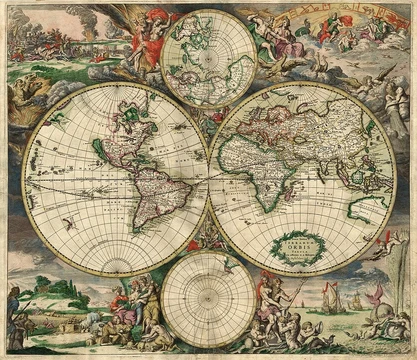
In navigation, a compass bearing of 180° indicates true south. In the Northern Hemisphere outside the tropics, the sun is roughly in the south at noon. By convention, the bottom of most maps is south, though reversed maps exist that defy this norm.
South Pole
True south is defined by the Earth’s rotational axis, ending at the South Pole in Antarctica. Magnetic south, however, points toward the south magnetic pole, which is offset from the geographic pole. The first person to reach the South Pole was Roald Amundsen of Norway, on 14 December 1911, after Ernest Shackleton of the UK was forced to turn back short of the goal.
Geography
Geographically, the term "Global South" describes the less-developed southern half of the world, where only about 5% of the population has adequate food and shelter, compared to 95% in the Global North. This region is characterized by a lack of appropriate technology, political instability, disarticulated economies, and reliance on primary product exports. Country-relative uses of "South" also exist, such as the Southern United States (separated from the Northeast by the Mason–Dixon line) or the South of England, which contrasts politically and economically with the North. The Southern Cone refers to the southernmost part of South America, shaped like an inverted cone and encompassing Argentina, Chile, Paraguay, Uruguay, and southern Brazil (including the states of Rio Grande do Sul, Santa Catarina, Paraná, and São Paulo); in a narrower sense, it covers only Chile, Argentina, and Uruguay.
Quick Facts
- Type
- cardinal direction
- Opposite
- north
- Etymology
- Old English sūþ
- from Proto-Germanic sunþaz
- possibly related to Proto-Indo-European root for 'sun'
Facts from the source article.
Lore & Background
The word south comes from Old English sūþ, from earlier Proto-Germanic sunþaz, possibly related to the same Proto-Indo-European root that the word sun derived from. Some languages describe south in the same way, from the fact that it is the direction of the sun at noon (in the Northern Hemisphere), like Latin meridies 'noon, south', while others describe south as the right-hand side of the rising sun, like Biblical Hebrew תֵּימָן teiman 'south' from יָמִין yamin 'right'. By convention, the bottom or down-facing side of a map is south. Alternatively, in the Northern Hemisphere outside the tropics, the Sun will be roughly in the south at midday.
True south is one end of the axis about which the Earth rotates, called the South Pole, located in Antarctica. Magnetic south is the direction towards the south magnetic pole, some distance away from the south geographic pole. The Global South refers to the socially and economically less-developed southern half of the globe.
Use of the term 'South' may also be country-relative, particularly in cases of noticeable economic or cultural divide, such as the Southern United States or the South of England. Southern Cone is the name often referred to as the southernmost area of South America, encompassing Argentina, Chile, Paraguay, Uruguay and the entire South of Brazil. The country of South Africa is so named because of its location at the southern tip of Africa. Australia derives its name from the Latin Terra Australis ('Southern Land').
Reader's Guide
South is a cardinal direction of fundamental importance in navigation, geography, and cultural identity. The etymology of the word reveals deep linguistic roots, linking it to the sun and to concepts of right-handedness in ancient languages, which influenced place names like Yemen. Geographically, the term 'south' extends beyond mere direction to describe regions with economic and cultural divides, such as the Global South, the Southern United States, and the Southern Cone of South America.
Nations like South Africa and Australia derive their names from their southern locations. In culture, south appears in card games like bridge and in Greek religion as the south wind Notos. The concept of south thus bridges practical navigation, historical exploration, linguistic heritage, and modern geopolitical divisions.
Also in the Codexery
More in Map Projections & Cartography Foundations
Sources
Compiled from Wikipedia and the sources listed below. Text from Wikipedia is available under CC BY-SA 4.0; this entry is adapted from it.
- Wikipedia: South (CC BY-SA 4.0).
Spotted an error? Know more?
Reader corrections go straight into our review queue. Suggest an edit · How this site is sourced