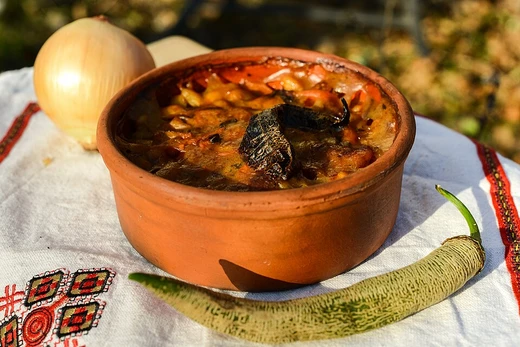
Shopska salad
Bulgaria's national salad, popularized by tourism in the 1950s.

Silar · CC BY-SA 4.0
Shopska salad, a cold dish widely eaten across Southeastern Europe, holds the status of Bulgaria’s national dish and its most iconic salad.
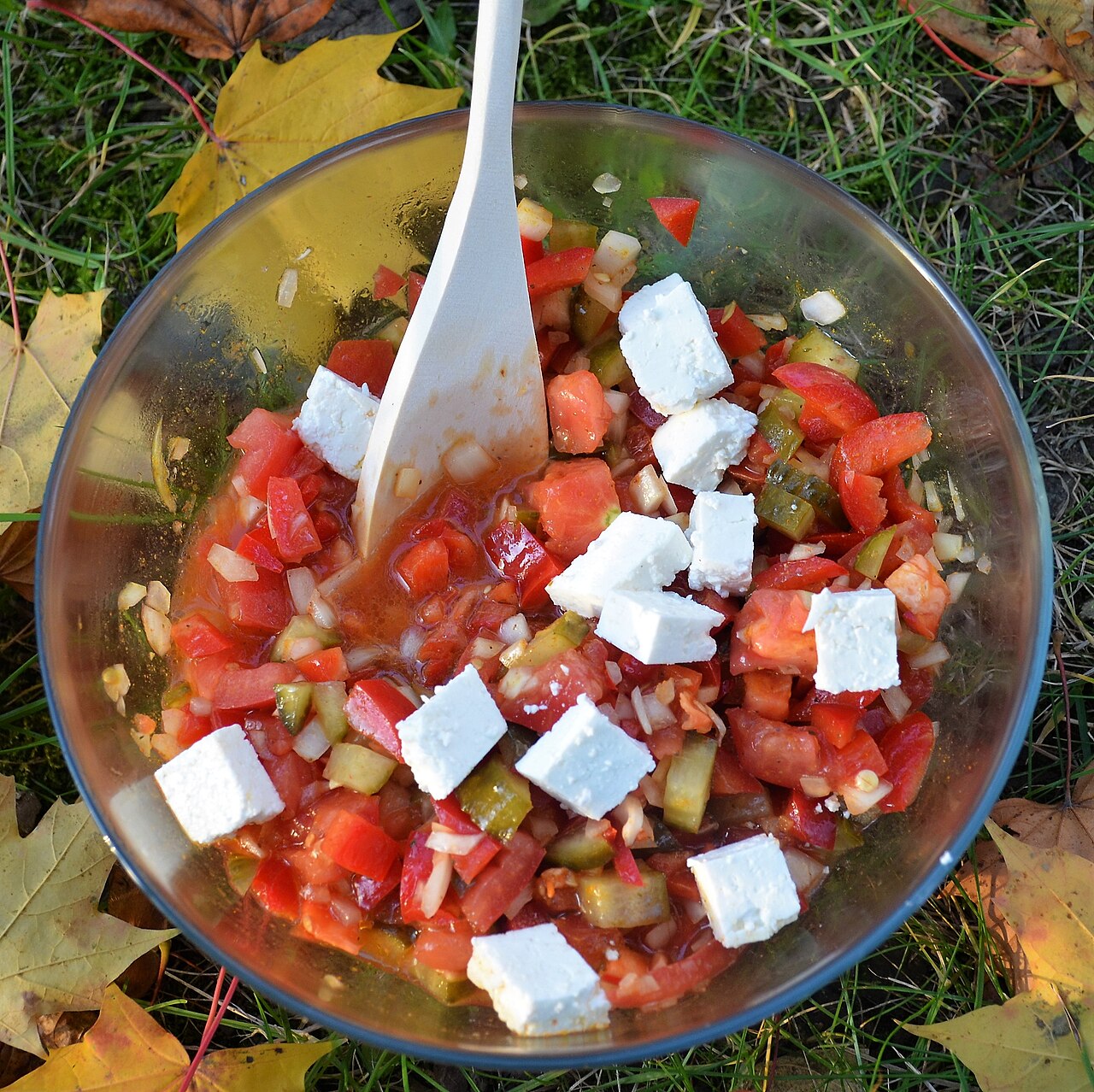
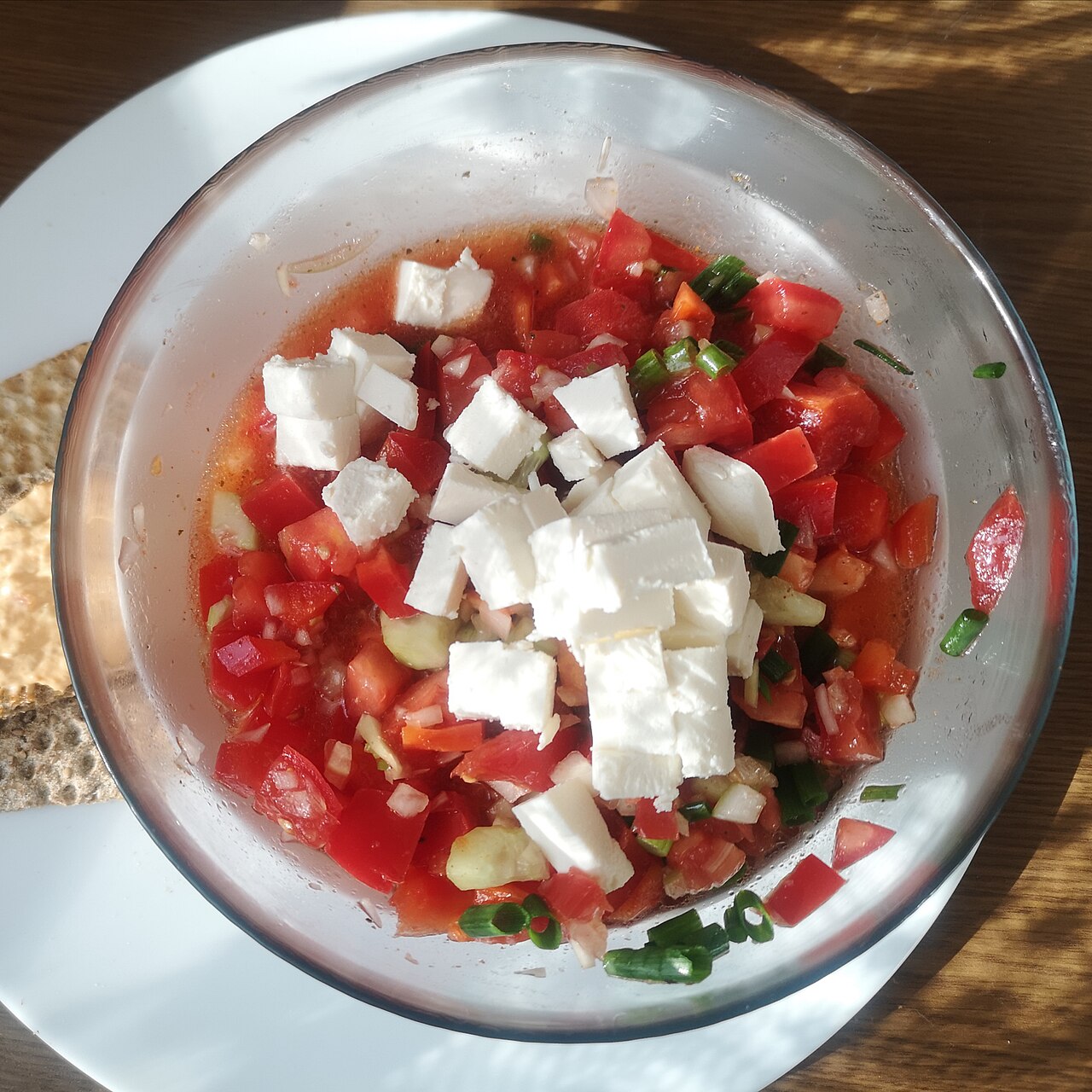
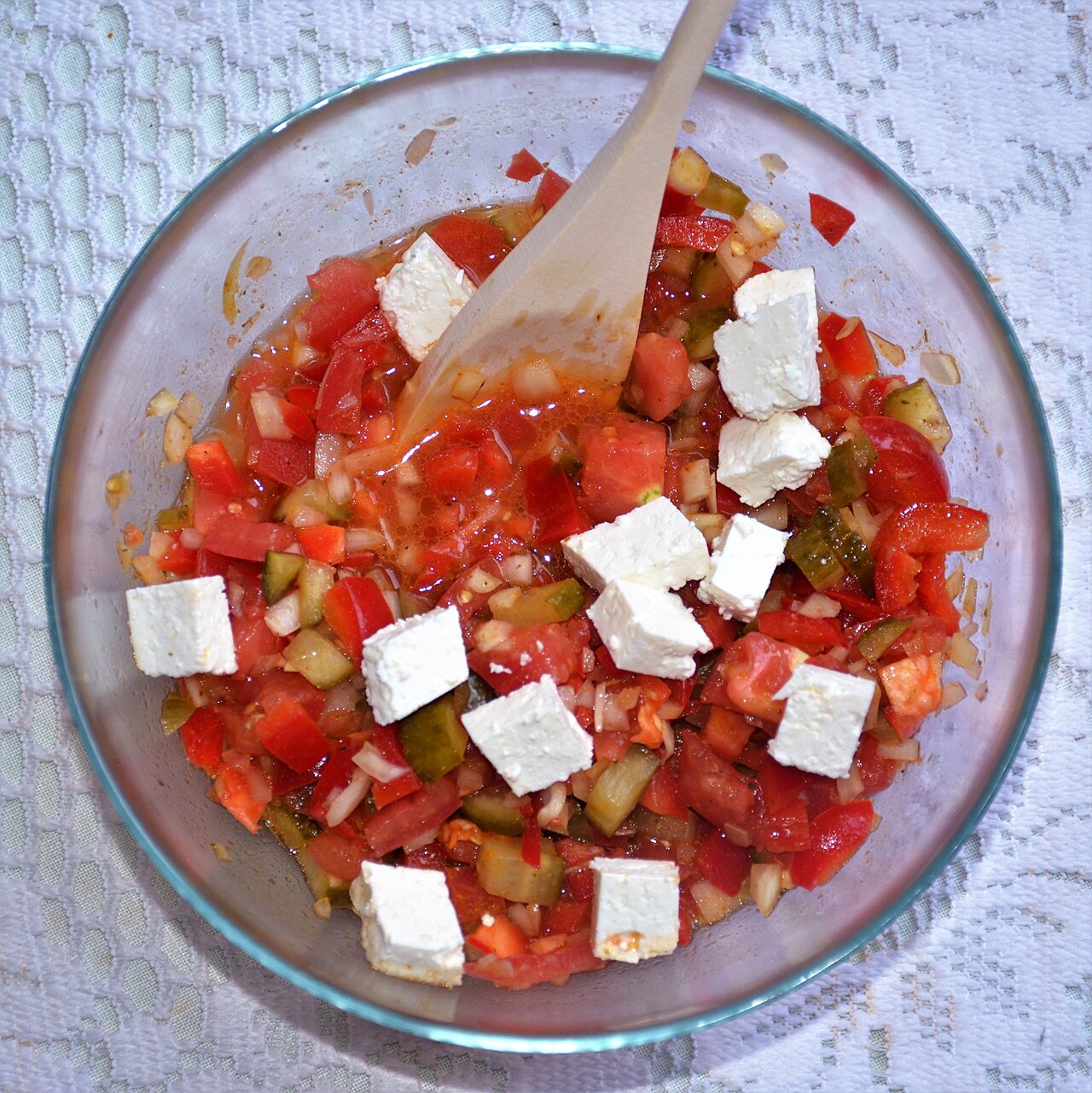
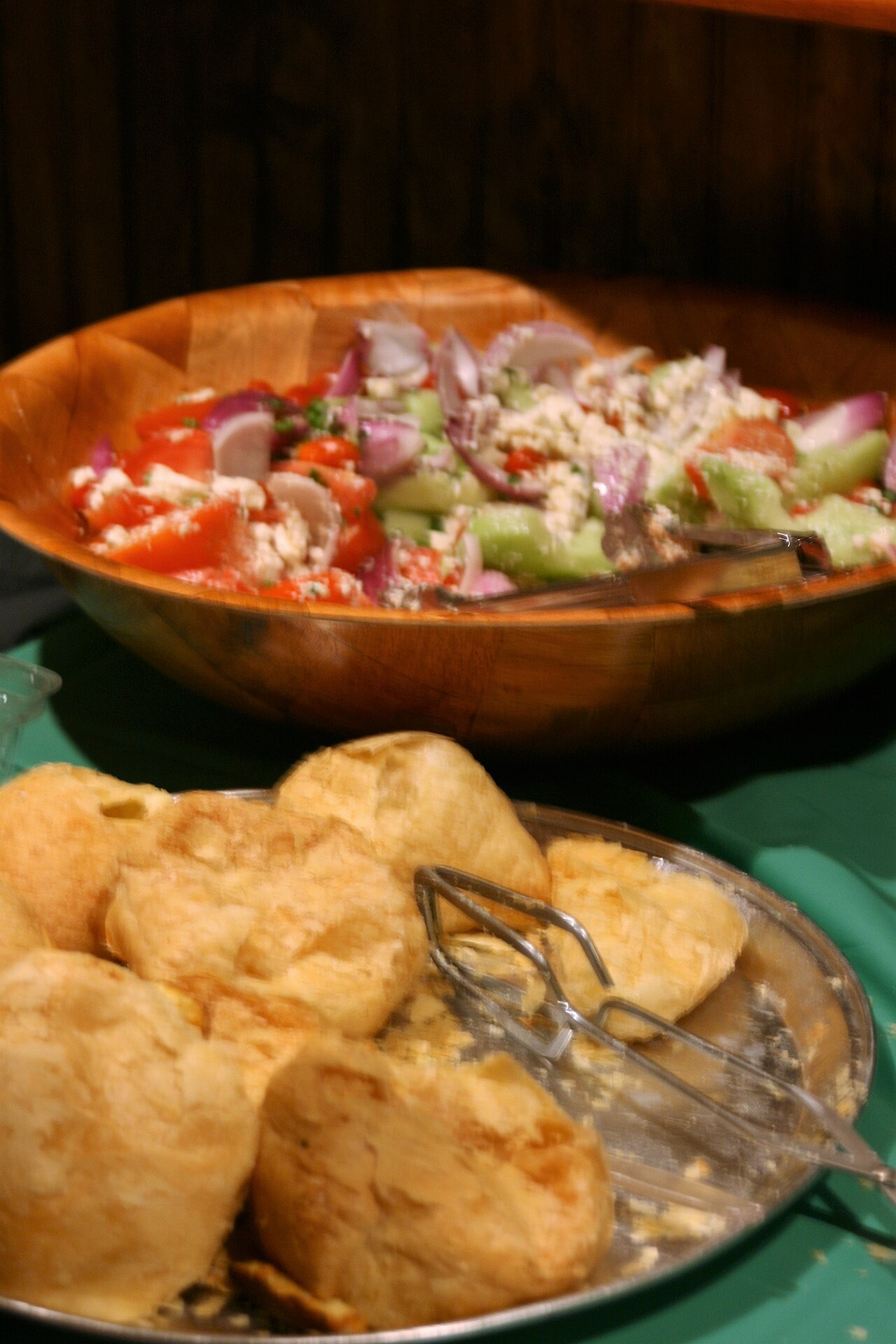
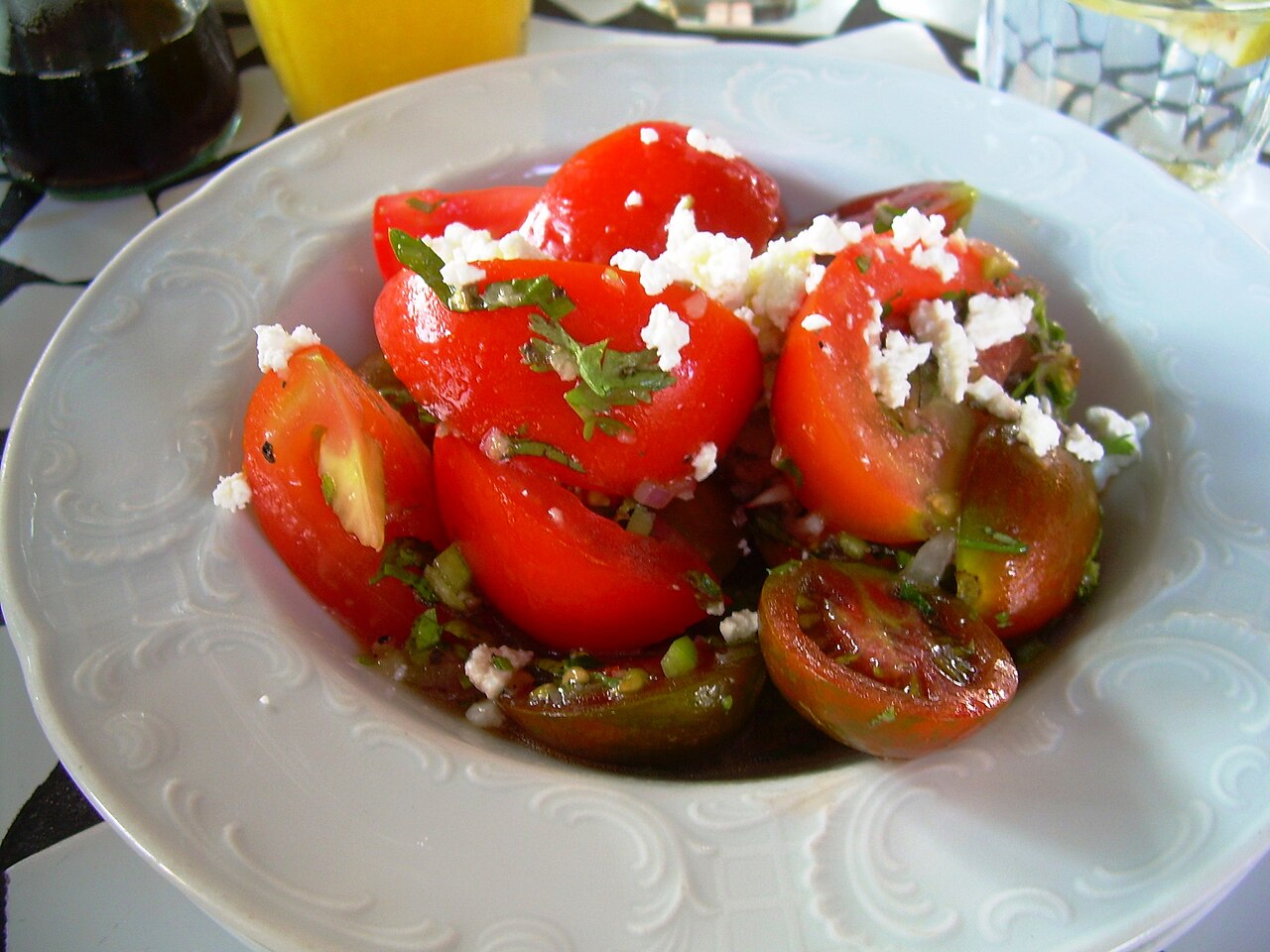
The salad combines diced tomatoes, cucumbers, onions or scallions, and raw or roasted peppers with sirene—a mild white brined cheese similar to feta. After salting the vegetables, a light dressing of sunflower or olive oil is added; vinegar is sometimes included, though it heightens the sourness already present from the tomatoes. In restaurants, the dressing is served on the side. A thick layer of grated or diced sirene cheese tops the vegetables. The salad is often eaten as an appetizer alongside rakia, and food anthropologist Rayna Gavrilova notes it is commonly paired with a shot of apricot or other fruit brandy.
Tomatoes reached Southeastern Europe in the mid-1800s, but Bulgarians had only a vague notion of salads in the late 19th century. Vegetable seed imports to Bulgaria began in the 1930s, and salads were first adopted by urban populations before appearing in cookbooks. The term “Shopska salad” first shows up in a 1940 Bulgarian cookbook, though it referred to a type of lyutenitsa, not the modern dish.
After World War II, the state tourism agency Balkantourist promoted Bulgaria’s Black Sea coast to both domestic and Western tourists as a showcase of socialist prosperity. This effort involved rebranding regional dishes as distinctly Bulgarian. The Shopska salad is a variation of a Greek salad of cucumbers, tomatoes, and feta; Balkantourist named their version in 1956. Its colors—red, green, and white—coincidentally match the Bulgarian flag, which helped evoke national pride.
Despite its name, which comes from the western Shopluk region, the salad first appeared on the Black Sea coast at the Chernomorets restaurant in the Druzhba resort near Varna. It is included in a state-approved 1956 cookbook (Sbornik recepti 1956, vol. 1, p. 50). The dish’s development and spread are credited to Petar Doychev (1924–2019), a leader in Bulgarian tourism. Doychev said the Shopska salad evolved from an earlier Balkantourist creation called “Harvest salad.”
Initially served only in Balkantourist hotels, it is the sole survivor of five or six recipes created for the tourism industry. It became an emblem of Bulgarian tourism and was officially recognized as a national culinary symbol in the 1970s and 1980s.
Quick Facts
- Place Of Origin
- Bulgaria
- Main Ingredient
- Tomatoes, cucumbers, onions, peppers, sirene
Facts from the source article.
Lore & Background
The dish is made from tomatoes, cucumbers, onion/scallions, raw or roasted peppers, and sirene, a white brined cheese similar to feta but milder. The vegetables are diced and salted, dressed with sunflower or olive oil, sometimes vinegar, and topped with grated or diced sirene. It is often consumed as an appetizer with rakia, and according to food anthropologist Rayna Gavrilova, commonly accompanied by a shot of apricot or other fruit brandy.
Tomatoes appeared in Southeastern Europe in the mid-1800s. The term 'Shopska salad' first appeared in a Bulgarian cookbook from 1940, but referred to a lyutenitsa recipe. In the post-war socialist era, Balkantourist reinvented regional dishes to identify them as Bulgarian. The Shopska salad is a variation on a Greek salad; Balkantourist in 1956 named their version Shopska salad. The salad's colors, mimicking the Bulgarian flag, were coincidences seen as positive for evoking national sentiment.
The salad first appeared at the Black Sea coast, in a resort near Varna called Druzhba, in the restaurant 'Chernomorets'. It can be found in a state-approved cookbook from 1956. Its development and popularization is attributed to tourism leader Petar Doychev. According to Doychev, it was a continuation of the 'Harvest salad'. Initially served only in Balkantourist hotels, it is the only survivor of five or six similarly created recipes. It became an emblem of Bulgarian tourism and was approved as a national culinary symbol during the 1970s and 1980s.
Reader's Guide
Shopska salad holds significance as Bulgaria's national dish and a symbol of the country's tourism industry. Developed and marketed by Balkantourist in 1956, it was part of a broader effort to showcase the socialist 'good life' to both domestic and Western tourists. The salad's colors coincidentally match the Bulgarian flag, which helped evoke national sentiment. It is the only survivor of several recipes created for the tourism industry, becoming an emblem of Bulgarian tourism and approved as a national culinary symbol during the 1970s and 1980s. In 2014, it was Bulgaria's most recognizable dish in Europe and the most popular recipe in a European Parliament initiative called A Taste of Europe. In 2025, CNN ranked it among the 24 best salads in the world. The salad's origin is disputed: Deutsche Welle noted a Croatian restaurant claimed it as Croatian, Serbian newspaper Politika claimed it as Serbian, and in North Macedonia it is also claimed as a local product. Despite these disputes, Shopska salad remains a staple of Bulgarian cuisine and a point of national pride.
Did You Know?
- The salad's colors coincidentally mimic those of the Bulgarian flag.
- The development and popularization of the salad is attributed to tourism leader Petar Doychev.
- In 2025, CNN ranked Shopska salad among the 24 best salads in the world.
Ingredients, Assembly & the Role of Sirene
The salad is assembled from diced tomatoes, cucumbers, onion or scallions, and either raw or roasted peppers. The vegetables are salted first, then dressed lightly with sunflower oil or olive oil, occasionally supplemented by a splash of vinegar—though this addition intensifies the sour quality the tomatoes naturally contribute. The defining top layer is sirene, a white brined cheese that resembles feta but tastes considerably milder, applied generously as a thick blanket of grated or diced shavings over the vegetables. In restaurant settings, the dressings are served separately so diners can adjust to taste. The finished dish is consumed cold and most often functions as an appetizer, traditionally accompanied by rakia. Food anthropologist Rayna Gavrilova observes that the salad is also commonly paired with a shot of apricot or other fruit brandy, reinforcing its role as a refreshing, bracing start to a meal.
The Balkantourist Origin Story
Tomatoes only reached Southeastern Europe in the mid-1800s, and vegetable seed imports to Bulgaria were not established until the 1930s. In the last decades of the 19th century, Bulgarians had only a vague notion of what constituted a salad. The term 'Shopska salad' first appeared in a 1940 Bulgarian cookbook, but it referred to a recipe for a kind of lyutenitsa, not the dish recognized today. The salad in its modern form was born in the post-war socialist era, when the state tourism organization Balkantourist set out to market Bulgaria's Black Sea coast to domestic and western visitors as a showcase of the socialist 'good life.' This campaign included reinventing and remarketing regional dishes to identify them as distinctly Bulgarian rather than simply Eastern European. In 1956, Balkantourist named their version of a Greek-style salad of cucumbers, tomatoes, and feta as the Shopska salad. It appeared in one of the first state-approved cookbooks, Sbornik recepti 1956, vol. 1, page 50. Petar Doychev (1924–2019), a leader in Bulgarian tourism, is credited with the dish's development and popularization, describing it as a continuation of an earlier 'Harvest salad' also created by Balkantourist.
National Symbol & Political Identity
The salad's red, white, and green colors mirror those of the Bulgarian flag—a coincidence that was nonetheless embraced as a positive for evoking national sentiment. During the socialist period, Balkantourist deliberately reinvented and remarked regional dishes to present them as distinctly Bulgarian rather than merely Eastern European, and the Shopska salad emerged as the emblem of Bulgarian tourism. It was initially served exclusively in Balkantourist hotels and stands as the sole survivor among five or six similarly crafted recipes created for the tourism industry. The dish was formally approved as a national culinary symbol during the 1970s and 1980s. Its recognition continued to grow well beyond Bulgaria's borders: in 2014 it was identified as Bulgaria's most recognizable dish in Europe, and it became the most popular recipe in the European Parliament's 'A Taste of Europe' initiative. In 2025, CNN ranked the Shopska salad among the 24 best salads in the world, cementing its status far beyond the single Black Sea resort restaurant where it first appeared.
Regional Origin Disputes
Despite its Bulgarian naming and codification, the Shopska salad has become a point of culinary contention across the region. According to the Bulgarian edition of Deutsche Welle, the Balkantourist recipe spread from Bulgaria into the cuisines of neighboring countries. A restaurant in Croatia has claimed the salad as a Croatian national dish. Serbian newspaper Politika, in the 2000s, asserted the salad was Serbian rather than Bulgarian, Macedonian, or Czech, as reported by Radio Bulgaria and the Sofia News Agency. Meanwhile, the Bulgarian weekly 168 hours noted that in North Macedonia, the dish is also claimed as a local product. These overlapping disputes underscore how a salad born in a single resort restaurant near Varna in 1956 has become a contested symbol of national identity across the Balkans, with multiple countries asserting their own connection to what is officially recognized as Bulgaria's most famous salad and national dish.
Gallery

Frequently Asked Questions
What is Shopska salad and where does it come from?
Shopska salad is a cold vegetable salad that originated in Bulgaria, where it is regarded as the country's national dish. It spread across Southeastern Europe after being popularized through tourism in the 1950s.
What are the main ingredients in Shopska salad?
The dish layers diced tomatoes, cucumbers, onions or scallions, and raw or roasted peppers beneath a generous topping of grated sirene, a mild white brined cheese comparable to feta. A light dressing of sunflower or olive oil, occasionally with vinegar, is drizzled over the vegetables.
When was Shopska salad first recorded?
An early, different version of the recipe showed up in 1940, but the form we recognize today was first documented in 1956. That 1950s period is also when the salad became a fixture on Bulgarian restaurant menus.
Why is Shopska salad considered Bulgaria's national dish?
Its red tomatoes, white sirene cheese, and green cucumbers and peppers are often noted for echoing the colors of the Bulgarian flag. Its iconic status was solidified by the dish's popularity with tourists during the 1950s.
How is Shopska salad typically served?
It is always served cold, with the salted vegetables piled high and crowned by a thick layer of grated or diced sirene cheese. In restaurants the oil-based dressing is usually set on the side so each diner can adjust the amount to taste.
More in Macedonian cuisine 1-23
Spotted an error? Know more?
Reader corrections go straight into our review queue. Suggest an edit · How this site is sourced