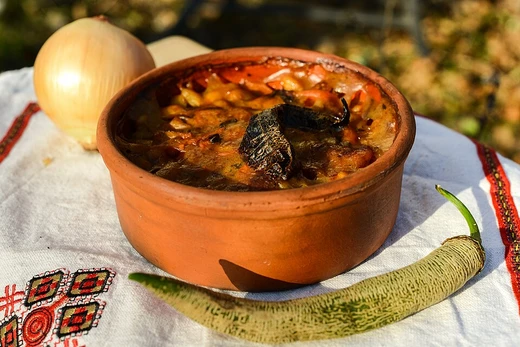
Embroidered peppers
Traditional Macedonian meze of threaded Capsicum annuum peppers.

John Henry Pepper · Public domain
Embroidered peppers (Macedonian: Везени пиперки, romanized: Vezeni piperki or Нарезнени пиперки, romanized: Narezneni piperki), sometimes called engraved peppers, are a traditional Macedonian meze. They are made from fresh, dried, or preserved peppers of the species *Capsicum annuum*, which are strung together on a thread.
Peppers are a basic ingredient in Macedonian cooking. Within North Macedonia and the neighboring countries of Kosovo, Albania, and Serbia, several local varieties of *Capsicum annuum* exist. Embroidered peppers have a distinct look, taste, and use, and there are multiple landraces.
To prepare them, pepper fruits are threaded onto strings and left to dry on balconies or in attics. They are also found in urban areas of the country or sold at local green markets. A spice called Bukovec, or Bukov piper, is made from coarsely crushed red peppers.
Quick Facts
- Country
- North Macedonia
- Course
- Meze, side dish
- Main Ingredient
- Peppers
Facts from the source article.
Lore & Background
Embroidered peppers are prepared by threading fruits of peppers on strings and leaving them on balconies or in attics to dry. They are also found in urban areas of the country or sold in local green markets. The peppers have a specific fruit appearance, taste and use, with several different landraces recognized.
Reader's Guide
Embroidered peppers hold significance as a traditional Macedonian meze, reflecting the centrality of peppers in the region's cuisine. The practice of threading and drying peppers is a common method of preservation, and the resulting product is used both as a food item and as a decorative element. The existence of approximately 789 pepper samples, 204 of which are embroidered peppers, indicates the genetic diversity and cultural importance of these landraces. The spice Bukovec, or Bukov piper, made from roughly crushed red peppers, is a related product. The tradition is shared across North Macedonia and neighbouring Kosovo, Albania and Serbia, highlighting a broader regional culinary heritage.
Did You Know?
- Embroidered peppers are also known as engraved peppers.
- They are made from fresh, dried or condimented peppers of the Capsicum annuum species.
- Bukovec, or Bukov piper, is a spice made from roughly crushed red peppers.
Cultural Identity & the Language of Flavor
Embroidered peppers carry two distinct Macedonian names—Vezeni piperki and Narezneni piperki—each evoking a different visual image of the finished product. The first, literally translating to 'embroidered,' suggests the delicate, string-like arrangement of small fruits strung together, while the second, meaning 'engraved' or 'carved,' hints at the textured, almost sculpted appearance of the individual peppers. In English, the dish is also called engraved peppers, preserving that sense of intricate craftsmanship. As a traditional meze, embroidered peppers occupy a foundational place on the Macedonian table, representing a category of small-plate food that accompanies meals across the region. The dish is not limited to a single state; its botanical lineage traces through North Macedonia and into neighboring Kosovo, Albania, and Serbia, where Capsicum annuum landraces have been cultivated for generations. This shared agricultural heritage makes embroidered peppers a small but meaningful thread connecting the broader Balkan and Eastern European culinary traditions.
Botanical Diversity & Regional Landraces
The Capsicum annuum species underlying embroidered peppers is far from a single uniform variety. Across North Macedonia and the adjacent territories of Kosovo, Albania, and Serbia, multiple distinct landraces have developed their own fruit shapes, flavors, and culinary roles. Research conducted by Sandeva Atanasova, Jankulovska, and Ivanovska catalogued roughly 789 pepper samples from the region, of which 204 were specifically identified as embroidered pepper types. This substantial subset underscores how deeply the embroidered-pepper form is embedded in local agriculture. Each landrace presents a particular combination of morphological traits—size, shape, color, and texture—that distinguishes it from its neighbors. A 2021 study published in ISHS Acta Horticulturae focused on genetic diversity expressed through these visible fruit characteristics, while a companion paper in the Macedonian Journal of Ecology and Environment examined the variability of fruit traits across different embroidered pepper genotypes. Together, these works confirm that what appears on a string or a market stall is the product of considerable natural and cultivated variation within a single species.
The Craft of Drying & Everyday Presence
Preparing embroidered peppers is as much about patience as it is about technique. The individual fruits are threaded together onto strings, after which the bundles are hung in open, airy spaces—balconies, attics, or other elevated areas—where they dry naturally over time. This method of preservation transforms fresh peppers into a shelf-stable meze that can be enjoyed well beyond the growing season. The practice is not confined to rural settings; embroidered pepper strings are a familiar sight in urban neighborhoods throughout the country, where residents maintain the tradition on apartment balconies. In local green markets, vendors display these strung peppers alongside other produce, making them an accessible part of everyday shopping. The tradition also extends into seasoning: Bukovec, also known as Bukov piper, is a coarsely ground spice derived from red peppers, offering a rustic heat that complements the whole-fruit meze. Whether eaten fresh, dried, or ground into a condiment, the pepper remains a versatile and central element of the Macedonian pantry.
Scientific Attention & Morphological Study
While embroidered peppers have long been a household staple, they have also attracted formal scientific scrutiny in recent years. A 2021 collaborative study by Nadica Sandeva Atanasova, Mirjana Jankulovska, and Sonja Ivanovska, published in the ISHS Acta Horticulturae, set out to characterize the genetic diversity of Macedonian embroidered peppers by examining their fruit morphological traits. The team worked within a broader collection of approximately 789 regional pepper samples, isolating the 204 that qualified as embroidered pepper types for focused analysis. Their findings were complemented by a second paper in the Macedonian Journal of Ecology and Environment, which explored the range of variability in fruit characteristics among different embroidered pepper genotypes. These publications are significant because they translate a deeply cultural food practice into the language of plant genetics and ecology, documenting the specific traits—shape, size, color, and other visible features—that make each landrace distinct. For a dish so rooted in tradition, such research provides a scientific foundation that can inform conservation, breeding, and the preservation of regional pepper varieties for future generations.
Gallery
Frequently Asked Questions
Who is Embroidered peppers?
Embroidered peppers is a traditional Macedonian meze made from Capsicum annuum peppers that have been threaded onto a string. In Macedonian it goes by the names Vezeni piperki or Narezneni piperki.
What are Embroidered peppers's powers/role?
The dish's signature trait is that individual peppers are strung together on a thread, creating a visually distinctive presentation. The peppers used can be fresh, dried, or preserved, each lending a different texture and flavor to the final preparation.
Why is Embroidered peppers important?
The dish underscores how central peppers are to everyday cooking in North Macedonia and the surrounding regions of Kosovo, Albania, and Serbia. Multiple local Capsicum annuum varieties exist across these areas, and threaded peppers represent a shared culinary tradition that ties those communities together.
What is Embroidered peppers's alternate name?
Beyond the English rendering, the dish is also widely called "Engraved peppers." In Macedonian it carries two romanized names—Vezeni piperki and Narezneni piperki—reflecting slightly different preparation styles.
More in Macedonian cuisine 1-23
Spotted an error? Know more?
Reader corrections go straight into our review queue. Suggest an edit · How this site is sourced