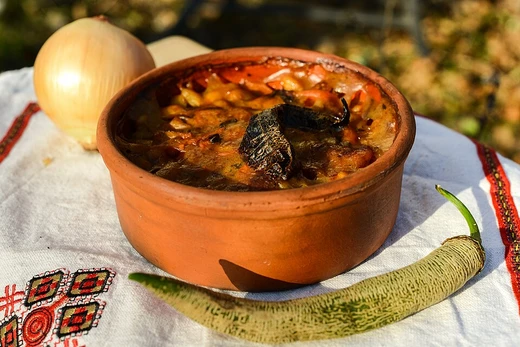
Sač
A bell-shaped lid for baking with coals.

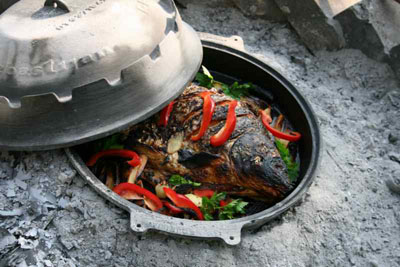
The sač (Сач in Cyrillic) is a large lid made of metal or ceramic, shaped like a shallow bell. It covers dough or other dishes for baking, with hot coals and ash piled on top. Food cooked this way turns out evenly done, stays juicy, and is known for its deep flavor. The word *sač* can also mean a specific dish—meat, vegetables, and potatoes baked under this lid.
The bell-shaped lid likely comes from the *saj*, a curved metal tool used in the Middle East and much of Asia. The *saj* is used convex-side-up for flatbreads and concave-side-down like a wok.
Historically, the sač was a basic oven for poorer families who had no stove at home. Today, it is common in restaurants across Turkey and the Balkan Peninsula—Albania, Bulgaria, Bosnia and Herzegovina, Croatia (where a similar but distinct dish is called *peka*), Greece (known as *Παραδοσιακή Γάστρα*, *Σινί*, or *Χάνι*), Kosovo, Montenegro, North Macedonia, and Serbia.
Cooking with a sač uses even convection heat. The bell shape lets steam circulate, keeping meat, fish, and vegetables moist while potatoes and other vegetables blend their flavors with the meat. It is also used for baking bread and pastries like burek and pizza. This method is valued for lightly smoking the food during convection cooking, which boosts its taste.
In Bulgaria, *сач* (sach) or *сачѐ* (sachè) means a flat clay or metal plate, not a bell-shaped lid. It is heated very hot and placed on the table, where thin slices of vegetables and meat are cooked on it without fat and without a cover. In the Rhodope region, more meat is typically used.
In parts of Romania, the equivalent of the sač is called *țest*, a word from the Latin *testum*, and was used for baking bread.
- Type
- Cooking utensil and dish
- Origin
- Probably from the saj, a curved metal utensil used in the Middle East and large parts of Asia
- Traditional use
- Simple, primitive oven for less well-off families who could not afford a stove
- Modern use
- Commonly used by restaurants in Turkey and the Balkan Peninsula
- Regional names
- Peka (Croatia, though a distinct cooking method), Παραδοσιακή Γάστρα/Σινί/Χάνι (Greece), țest (Romania)
Lore & Background
Traditionally, the sač was a simple, primitive oven for baking various foods used by less well-off families who could not afford a stove in their homes. The bell shape probably comes from the saj, a curved metal utensil used on its convex side for flatbread baking, and with the concave side employed similarly to a wok in the Middle East and large parts of Asia.
Reader's Guide
The sač is significant as a traditional cooking appliance that enables even convection baking, with the bell shape allowing steam to recirculate, keeping meat, fish and vegetables juicy, and allowing potatoes and other vegetables to intermix their flavours with that of the meat. It is also used for baking bread and traditional pastries like burek and pizza. This style of cooking has been adopted mostly because of its specific flavour-enhancing properties, which enable the food to be lightly smoked during the convection cooking process. Today, the baking appliance is commonly used by restaurants all over Turkey and the Balkan Peninsula – Albania, Bulgaria, Bosnia and Herzegovina, Croatia (where it is called 'peka'), Greece (where it is called 'Παραδοσιακή Γάστρα', 'Σινί' or 'Χάνι'), Kosovo, Montenegro, North Macedonia, Serbia, and Slovenia. In Bulgaria, the word сач (sach) or сачѐ (sachè) refers to a flat clay plate, heated to a high temperature, placed on the table, where thin slices of vegetables and meat are cooked on it without fat and without a cover. In some regions of Romania, the equivalent of sač, called țest, a derivate of the Latin testum, was used for baking bread.
Did You Know?
- In Bulgaria, the word сач (sach) refers to a flat clay or metal plate used for cooking thin slices of vegetables and meat without fat, not a bell-shaped lid.
- The sač is also used for baking traditional pastries like burek and pizza.
- In Romania, the equivalent of sač is called țest, a derivate of the Latin testum.
Definition and Physical Form
The sač is, at its most basic level, a baking lid. Rather than functioning as a simple cover, it serves as an active cooking vessel: the lid is placed over food and then topped with hot coals or ashes, creating an enclosed, radiant-heat environment in which the ingredients cook. This dual-sided heat application—warmth rising from below and radiating down from the ember-covered top—distinguishes the sač from ordinary lids or pans. Within the broader landscape of Balkan cuisine, which is noted for its diverse, strong, and occasionally spicy preparations, the sač occupies a central practical role. It is the typical method by which cooking is carried out across the region, spanning the national cuisines of Albania, Bosnia and Herzegovina, Bulgaria, Croatia, Greece, Hungary, Moldova, Montenegro, North Macedonia, Romania, Serbia, and Slovenia. Whether producing the stuffed vine leaves of sarma, the layered moussaka, or other hearty preparations, the sač provides the foundational cooking technique that unites these otherwise varied culinary traditions.
Ancient Greek Origins
The cooking technique associated with the sač does not emerge from a single national tradition but traces its roots to Ancient Greek cuisine. This ancient lineage places the sač among some of the oldest continuous cooking methods in the region, predating the many layers of foreign rule and internal power struggles that would later reshape Balkan food culture. Over the centuries, the technique was absorbed into a culinary landscape already rich with cross-cultural exchange. The historical foundation of modern Balkan cooking is Ottoman cuisine, which itself drew heavily on Arabian Levantine and medieval Byzantine traditions. The Ottomans introduced new ingredients and dishes—peppers, börek, ćevapi, pljeskavica, and Turkish coffee—while simultaneously allowing local practices to flourish; for instance, pork gained popularity in northern Serbia because pigs escaped taxation under Islamic law. The sač, as a method inherited from antiquity, thus sits at the intersection of these overlapping influences: an ancient Greek technique adapted through centuries of Ottoman, Mediterranean, Persian, and Central European contact, yet retaining its essential form as a coal- or ash-covered baking lid.
Role in Everyday and Traditional Cooking
Within the daily and ceremonial food culture of the Balkans, the sač functions as the typical cooking implement, the standard tool through which the region's characteristic dishes are prepared. The cuisine it helps produce is defined by bold, diverse, and sometimes spicy flavors. Pickled vegetables feature prominently, peppers appear in spreads like ajvar and as small hot varieties, and feta cheese is a staple in the southern parts of the region. Stuffed preparations—sarma with vine leaves, for example—are common, as are layered dishes such as moussaka made from eggplants or potatoes. Many of these preparations are finished or accompanied by kajmak, a thick cream, or avgolemono, an egg-and-lemon sauce. Meze, small shared appetizers, are served in a manner reminiscent of Levantine and Caucasian food traditions. Desserts such as baklava and halva round out the meal, often paired with fruit brandy known as rakia. The sač is the vessel that ties these elements together, providing the consistent, radiant-heat cooking environment in which such a wide range of ingredients and preparations come to life across the region's many national kitchens.
A Unifying Thread in a Diverse Culinary Mosaic
The sač occupies a unique position in a region where culinary identity is simultaneously shared and fiercely particular. Balkan cuisine, in its broadest sense, encompasses the native food traditions of at least twelve countries, from Slovenia to Greece, from Hungary to Montenegro. A shared natural environment supplies similar raw ingredients across these borders, and many dishes and recipes carry similar names with national variations. Yet the same dish name can refer to entirely different ingredients and preparation methods depending on the country. In the northern Balkans, chocolate, cakes, and sweet confections are popular, while the south favors seafood, honeyed sweets, and pastas in a more Mediterranean register. The common features of Balkan cuisine are most visible in haute cuisine, whereas home cooking reveals the full geographic spectrum from Northern European to Middle Eastern influences. The sač, as the typical cooking method, threads through all of these variations—Slovenian, Greek, Albanian, Serbian, and beyond—providing a single, ancient technique that accommodates the full breadth of the region's culinary diversity without erasing its national distinctions.
Gallery
Frequently Asked Questions
What exactly is a Sač in Macedonian cooking?
A Sač is a large, shallow bell-shaped lid made of metal or ceramic that you place over dough, meat, vegetables, or potatoes and then bury under hot coals and ash. The enclosed heat bakes everything evenly while keeping it juicy and deeply flavored. The word also refers to the finished dish itself—meat, potatoes, and vegetables baked under that lid.
Where did the Sač design come from?
Its bell shape most likely descends from the saj, a curved metal tool long used across the Middle East and much of Asia for flatbreads and wok-style cooking. The Sač essentially adapted that single curved vessel into a dedicated baking cover for a whole meal.
Why was the Sač historically important to ordinary families?
Before stoves became affordable, the Sač acted as a basic, portable oven for households that could not cook any other way. You sealed your ingredients under the lid, piled coals on top, and let the trapped heat do the work—no stove required.
Is the Sač still used in modern kitchens?
Yes; it remains a go-to method in restaurants throughout Turkey and the Balkan Peninsula. Macedonian, Turkish, and other regional eateries still serve Sač-prepared dishes as a signature preparation.
What do other countries call the Sač or its method?
Croatia uses the term Peka for a closely related baking technique, while in Greece you may see Παραδοσιακή Γάστρα, Σινί, or Χάνι. In Romania the equivalent cooking vessel is called a țest.
More in Macedonian cuisine 1-23
Spotted an error? Know more?
Reader corrections go straight into our review queue. Suggest an edit · How this site is sourced