Carlisle
Last updated
Where it is
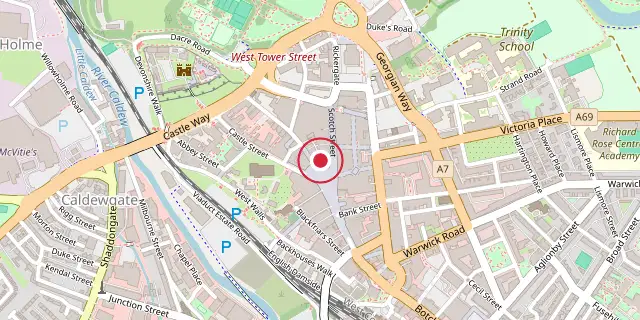
Coordinates: 54°53′42″N 2°56′10″W (54.8950, -2.9360) · Open in OpenStreetMap
Coordinates and connected clubs: the infobox of Wikipedia: Carlisle (CC BY-SA 4.0). Map: drawn by Codexery from OpenStreetMap tiles.
Carlisle is a city in the Cumberland district of Cumbria, England, and the largest settlement in the county. It was founded as a Roman settlement called Luguvalium and later became an important medieval military stronghold near the Anglo-Scottish border. The city is the seat of the Diocese of Carlisle, with its cathedral originating from a 12th-century priory.
History
The earliest known inhabitants of the area were the Carvetii tribe of Britons. Medieval historians Boethius and John of Fordun claimed Carlisle existed before the Romans and was one of the strongest British towns, said to have burned down in the time of Nero. The Roman settlement was named Luguvalium, derived from a Brittonic name meaning "[city] of Luguwalos". Excavations in the 1970s dated a Roman timber fort at the site of Carlisle Castle to the winter of AD 73, built to protect a strategic location on the Roman road north.
The fort was reconstructed in AD 83 using oak timbers, and was garrisoned by the 500-strong cavalry regiment Ala Gallorum Sebosiana. By the early 2nd century, Carlisle was a prominent stronghold on the Stanegate frontier. In AD 122, Hadrian approved a wall along the frontier, and a new fort called Petriana was built in the Stanwix area, the largest along the wall, housing the 1,000-strong Ala Gallorum Petriana. Hadrian's successor Antoninus Pius abandoned the frontier for the Antonine Wall, but after 20 years garrisons returned to Hadrian's Wall.
Governance
Local government for Carlisle is provided by Cumberland Council, a unitary authority based in the city. The Carlisle constituency, represented by Julie Minns of the Labour Party, covers the built-up area and rural areas to the north-east. Cumberland councillors for wards covering the built-up area act as charter trustees to preserve Carlisle's charters and city status, choosing one of their number each year as Mayor of Carlisle. Twelve trustees are appointed from councillors covering the City of Carlisle, defined from 1 April 2023 as covering former Carlisle City Council wards.
The charter trustees hold historic rights and privileges, including the mayoralty, subject to future governance reviews; these could transfer to the unparished area if a parish council were formed. Carlisle was an ancient borough; its earliest recorded municipal charter was issued by Henry II, but the borough existed earlier. The borough became a city on becoming the seat of the Diocese of Carlisle in 1133. The ancient borough covered approximately the area within the city walls, comprising the township of English Street in the parish of Carlisle St Cuthbert, four townships in the parish of Carlisle St Mary, and the extra-parochial Eaglesfield Abbey.
Culture
Her Majesty's Theatre, built in 1874 as Victoria Hall, began screening films in 1897; after a fire in 1904 it was rebuilt and reopened in 1905. It staged films and variety shows until around 1919, then only live productions. The theatre closed in 1963, became a bingo club, and was demolished in 1980. The West Walls Theatre is an amateur theatre in the city centre.
The Old Fire Station, converted into a performing arts venue in 2015, hosts bands, comedy, dramas, and art exhibitions. Carlisle Music Festival is held annually at Carlisle Cathedral. St Cuthbert's Church hosts an annual series of concerts organised by North Cumbria Recitals. The Carlisle Food Fair takes place every August in the pedestrianised city centre.
Sport
Carlisle United entered the Football League in 1928, taking Durham City's place in the Third Division's northern section. The club's best cup run came in 1969 when it reached the League Cup semi-finals, and it earned a place in the top division in 1974. After winning its first three matches of the 1974-75 season, Carlisle briefly sat at the top of English football, but the form faded and the team was relegated after a single season. By 1987 the club was back in the Fourth Division, and in 2004 it became the first former top-flight side to drop into the Football Conference, though it returned to the league a year later.
A memorable escape from relegation happened in 1999, when on-loan goalkeeper Jimmy Glass scored an injury-time winner against Plymouth Argyle, sending Scarborough down instead. Players who started at Carlisle before moving on include Peter Beardsley, Stan Bowles, Steve Harkness, Matt Jansen, and Rory Delap. Managers have included Bill Shankly, Alan Ashman, Bob Stokoe, Harry Gregg, Mick Wadsworth, Nigel Pearson, and Paul Simpson. The semi-professional side Celtic Nation, based in Carlisle, folded in April 2015 after financial troubles.
Did You Know?
- Carlisle was nicknamed the 'Great Border City' due to its proximity to Scotland.
- The Citadel towers were designed by Thomas Telford.
- Carlisle railway station was designed by William Tite in the neo-Tudor style.
More in Locations Associated with Arthurian Legend
Sources
Compiled from Wikipedia and the sources listed below. Text from Wikipedia is available under CC BY-SA 4.0; this entry is adapted from it.
- Wikipedia: Carlisle (CC BY-SA 4.0).
Spotted an error? Know more?
Reader corrections go straight into our review queue. Suggest an edit · How this site is sourced