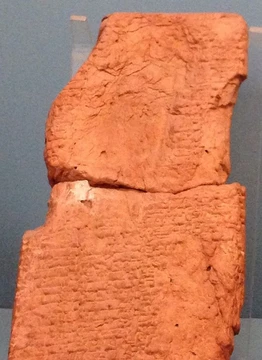
Contract
Last updated
Such an arrangement usually involves the parties agreeing to exchange goods, services, money, or a future commitment to exchange any of these.[1] When a contract is broken, the party that suffered harm can ask a court for remedies like monetary compensation or equitable relief such as requiring the breaching party to perform the contract or canceling it.[2]
Quick Facts
- Field
- Law of obligations
Facts from the source article.
Key facts and history
A notable early modern development was the hawala system in the Indian subcontinent and the Arab world, which gave rise to the hundi, a transferrable contract entitling its holder to obtain money from its issuer.[3] Contract law varies between jurisdictions, with distinct varieties including the German tradition's doctrine of abstraction and systems based on the Napoleonic Code.[4] Trade agreements have been a feature of human societies since the Neolithic Revolution, when commerce and settled living first emerged.[3] The hawala system contributed to the evolution of agency rules in both common law and civil law systems, a development that was necessary because under Roman law, agents were not permitted to create binding contracts on behalf of others.[5]
Islamic law permitted agency in contract law and the broader law of obligations, a position that has now become standard in common law, mixed law, and most civil law systems.[6] The UNIDROIT Principles of International Commercial Contracts, released in 2016, are designed to create a general, harmonized structure for international contracts that is independent of differences in national laws.[4]
What the cited sources add
The Australian Consumer Law prohibits unfair contract terms in standard form contracts, though only a court can declare a term unfair.[7] A future claim may be assigned, but the transfer depends on the claim coming into existence and being identifiable.[8] In a business-to-business context, a contractual prohibition on assignment does not affect the assignability of that claim.[8] A claim is not assignable if the parties intended that only the promisee should be entitled to it.[8]
An accessory right securing performance of the assigned claim is transferred to the assignee without a new act of transfer.[8]
References
- Wikipedia, "Contract" (CC BY-SA 4.0), which cites: Barnett, "Contracts is Not Promise; Contract is Consent", Suffolk University Law Review, 8 March 2021, p. 647 (original not read by us) en.wikipedia.org
- Wikipedia, "Contract" (CC BY-SA 4.0), which cites: "Case Note – Contract Law – Rule of Law Institute of Australia", Rule of Law Institute of Australia, 2018-05-31; "International Legal Research", law.duke.edu (original not read by us) en.wikipedia.org
- Wikipedia, "Contract" (CC BY-SA 4.0), which cites: "The Hawala Alternative Remittance System and its Role in Money Laundering" (original not read by us) en.wikipedia.org
- Wikipedia, "Contract" (CC BY-SA 4.0), which cites: UNIDROIT Principles of International Commercial Contracts; UNIDROIT Principles of International Commercial Contracts (original not read by us) en.wikipedia.org
- Wikipedia, "Contract" (CC BY-SA 4.0), which cites: Badr, "Islamic Law: Its Relation to Other Legal Systems", American Journal of Comparative Law, Spring 1978, p. 187–98 (original not read by us) en.wikipedia.org
- Wikipedia, "Contract" (CC BY-SA 4.0), which cites: Badr, "Islamic Law: Its Relation to Other Legal Systems", The American Journal of Comparative Law, Spring 1978, p. 187–98 [196–8] (original not read by us) en.wikipedia.org
- "Contracts", www.lawhandbook.sa.gov.au. facts only, no text reused. lawhandbook.sa.gov.au
- For the assignment of claim see Trans-Lex.org. facts only, no text reused. trans-lex.org
Each numbered sentence above was checked against the source it cites before publication. Sentences citing Wikipedia adapt text from the English Wikipedia article Contract (contributors), used under CC BY-SA 4.0; this entry is available under the same licence. Other sources were used for facts only; no text or images are copied from them.
More in Legal Systems & Concepts
Sources
Compiled from Wikipedia and the sources listed below. Text from Wikipedia is available under CC BY-SA 4.0; this entry is adapted from it.
- Wikipedia: Contract (CC BY-SA 4.0).
Spotted an error? Know more?
Reader corrections go straight into our review queue. Suggest an edit · How this site is sourced