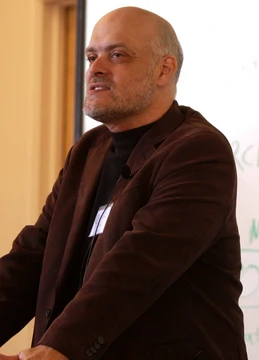
James Madison
Scholar of peasant resistance and state power

via Wikipedia: James C. Scott · see source
James Madison, born on March 16, 1751, in the Colony of Virginia, was a Founding Father who served as the fourth president of the United States from 1809 to 1817. He earned the title "Father of the Constitution" for his central role in drafting and promoting the U.S. Constitution and the Bill of Rights. Madison grew up in a prominent slave-owning planter family, the eldest of twelve children, with an estimated 100 slaves on his father’s large Piedmont plantation. He studied under a private tutor, learning mathematics, geography, and classical languages, and later attended the College of New Jersey (now Princeton University), where he focused on Latin, Greek, theology, and Enlightenment works, excelling in speech and debate.
In 1774, Madison joined the Patriots, opposing British taxation. He served in the Virginia House of Delegates and the Continental Congress during and after the American Revolutionary War. Dissatisfied with the weak national government under the Articles of Confederation, he helped organize the Constitutional Convention, where his Virginia Plan formed the basis for deliberations. He then became a key leader in the ratification movement, co-authoring The Federalist Papers with Alexander Hamilton and John Jay. As a congressman and close adviser to President George Washington, Madison later opposed Hamilton’s economic program and, with Thomas Jefferson, founded the Democratic-Republican Party. As Jefferson’s Secretary of State from 1801 to 1809, he helped secure Senate approval for the Louisiana Purchase.
Elected president in 1808, Madison sought to acquire land from Britain, Spain, and Native Americans. After diplomatic protests and a trade embargo failed to stop British seizures of American goods, he led the U.S. into the War of 1812. Re-elected during the war, he emerged convinced of the need for a stronger federal government. Though the war ended inconclusively in 1815, many Americans saw it as a successful "second war of independence," boosting his popularity. His postwar presidency saw the creation of the Second Bank of the United States and the Tariff of 1816, while land was acquired from Native American tribes through treaties or war. Retiring in 1817, Madison returned to his Montpelier plantation, where he died on June 28, 1836. He remained a slave owner throughout his life, freeing only one slave in 1783 to prevent a rebellion. Hi
- nationality
- American
Verified Timeline
Lore & Background
Scott was born in Mount Holly, New Jersey, on December 2, 1936, and grew up in Beverly, New Jersey. He attended the Moorestown Friends School, a Quaker Day School, and in 1953 matriculated at Williams College in Massachusetts. On the advice of Indonesia scholar William Hollinger he wrote an honors thesis on the economic development of Burma. Scott received his bachelor's degree from Williams College in 1958, and his PhD in political science from Yale University in 1967. Upon graduation, Scott received a Rotary International Fellowship to study in Burma, where he was recruited by an American student activist who had become an anti-communist organizer for the Central Intelligence Agency (CIA). Scott agreed to do reporting for the agency, and at the end of his fellowship, took a post in the Paris office of the National Student Association, which accepted CIA money and direction in working against communist-controlled global student movements over the next few years. Scott began graduate study in political science at Yale in 1961, though originally intended to study economics. His dissertation on political ideology in Malaysia, which was supervised by Robert E. Lane, analyzed interviews with Malaysian civil servants. In 1967, he took a position as an assistant professor in political science at the University of Wisconsin–Madison. In 1976, having earned tenure at Madison, Scott returned to Yale and settled on a farm in Durham, Connecticut, with his wife. They started with a small farm, then purchased a larger one nearby in the early 1980s, where they sheared sheep and pastured Highland cattle. To research his third book, Weapons of the Weak, Scott spent fourteen months in a village in Kedah, Malaysia between 1978 and 1980. When he had finished a draft, he returned for two months to solicit villagers' impressions of his depiction, and significantly revised the book based on their criticisms and insight. In 2011, Scott, along with other Burmese and Western scholars, convened at Yale with the goal of re-establishing the Journal of the Burma Research Society for scholars. The journal's successor, named the Independent Journal of Burmese Scholarship (IJBS), published its first issue in August 2016. Scott retired from teaching in 2022. In 1961, Scott married Louise Glover Goehring; they had three children and were married until her death in 1997. In 1999, he began a relationship with anthropologist Anna Tsing, which lasted until his death. Scott lived in Durham, Connecticut. He died at his home on July 19, 2024, at the age of 87.
Reader's Guide
Scott's work focuses on the ways that subaltern people resist domination. In The Moral Economy of the Peasant: Rebellion and Subsistence in Southeast Asia (1976), Scott asserted that the highest priority for most peasants is ensuring that their incomes will not fall below minimal subsistence level. He argued that in traditional societies, many peasants have relationships with the elite that provide some degree of assurance that the peasants will not fall below subsistence level, and that peasants believe elites are under a strong moral obligation to behave in a fashion that respects peasant needs. In Weapons of the Weak: Everyday Forms of Peasant Resistance (1985), Scott expanded his theories to peasants in other parts of the world, arguing that the everyday resistance of subalterns shows that they have not consented to dominance. In Domination and the Arts of Resistance (1990), Scott argues that subordinate groups employ strategies of resistance that go unnoticed, which he terms 'infrapolitics.' He describes the public interactions between dominators and oppressed as a 'public transcript' and the critique of power that goes on offstage as a 'hidden transcript.' In Seeing Like a State: How Certain Schemes to Improve the Human Condition Have Failed (1998), Scott showed how central governments attempt to force legibility on their subjects, and fail to see complex, valuable forms of local social order and knowledge. He highlights collective farms in the Soviet Union, the building of Brasília, and Prussian forestry techniques as examples of failed schemes. In The Art of Not Being Governed (2009), Scott addresses the question of how certain groups in the mountainous jungles of Southeast Asia managed to avoid a package of exploitation centered around the state, taxation, and grain cultivation, arguing that these people are 'barbaric by design': their social organization, geographical location, subsistence practices and culture have been shaped to avoid state control.
Did You Know?
- Scott spent fourteen months in a village in Kedah, Malaysia between 1978 and 1980 researching his book Weapons of the Weak, then returned for two months to get villagers' feedback and significantly revised the book based on their criticisms.
- He was recruited by a CIA-connected organizer while on a Rotary International Fellowship in Burma, and later took a post in the Paris office of the National Student Association, which accepted CIA money and direction.
- Scott and his wife started a small farm in Durham, Connecticut, then purchased a larger one in the early 1980s where they sheared sheep and pastured Highland cattle.
- In 2011, Scott convened Burmese and Western scholars at Yale to re-establish the Journal of the Burma Research Society, which became the Independent Journal of Burmese Scholarship, publishing its first issue in August 2016.
- Scott is unusual for conducting his primary ethnographic fieldwork only after receiving tenure.
More in Legal Scholars And Political Theorists 1-24
Spotted an error? Know more?
This is a living reference — every entry is fact-audited, and reader corrections feed straight into our audit queue. Suggest an edit · See this site's audit record