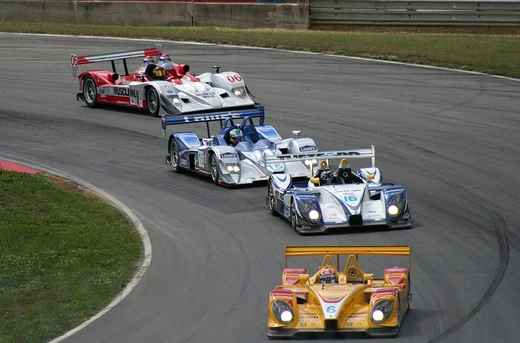
Porsche RS Spyder
Porsche's LMP2 racer that revived the firm's prototype program.

The Porsche RS Spyder (Type 9R6) is a racing car built for the LMP2 class, developed by Porsche with help from Penske. Its name combines the legendary Porsche 550 Spyder from the 1950s with Porsche’s “RennSport” (racing sports) label. This car marked Porsche’s first return to top-level sports prototype racing after the company stopped its LMP program in 1999.
The RS Spyder first raced at the final 2005 American Le Mans Series event at Laguna Seca, where it won its class. It went on to claim the ALMS LMP2 Championship in 2006, 2007, and 2008, and took class wins at Le Mans in 2008 and 2009. Its outright victory at the 2008 12 Hours of Sebring was Porsche’s first major endurance win in five years, and the first time in 14 years that a non-premier class car won overall at Sebring. Rule changes for 2011 made the RS Spyder obsolete, but its engine was developed further for the Porsche 918 Spyder, and the Porsche 919 Hybrid carried Porsche’s racing program into LMP1 from 2014.
The car was designed entirely in-house by Porsche engineers, with help from Carbotech. Its chassis is a rigid carbon fiber monocoque, with the engine and transmission acting as stressed members. The 3.4-liter 90-degree MR6 V8 engine and six-speed electro-pneumatic sequential gearbox were both new designs. Braking uses six-piston aluminum monobloc calipers and carbon ceramic discs, with suspension controlled by four-way adjustable spring/damper units activated by pushrods and adjustable torsion-bar springs. The car weighed 825 kg in 2010 specification, down from an initial 750 kg.
From its 2005 debut, the engine started at 478 hp and was modified to meet changing ALMS and ACO regulations. By 2008, it produced 503 hp with sequential multipoint injection, and in 2009 it was restricted to 440 hp due to air restrictor limits.
In 2005, the RS Spyder debuted at Laguna Seca with Penske Racing, driven by Lucas Luhr and Sascha Maassen, finishing first in class and fifth overall.
In 2006, Penske ran two RS Spyders in the ALMS, winning seven class victories, including an outright win at Mid-Ohio—the first LMP2 win in a race since 2003 and Porsche’s first major result since the 1998 Le Mans. Penske won the LMP2 Championship, and Sascha Maassen took the drivers’ title.
For 2007, Porsche introduced the RS Spyder Evo with 503 hp. Dyson Racing joined Penske in the ALMS.
- First race
- 2005 American Le Mans Series, Monterey Sports Car Championship at Mazda Raceway Laguna Seca
- Class wins at le mans
- 2008, 2009
- Alms lmp2 championships
- 2006, 2007, 2008
- Overall victory at 12 hours of sebring
- 2008
- Engine
- 3.4-litre 90-degree MR6 V8
- Dry weight (2010 spec)
- 825 kg
- Initial dry weight
- 750 kg
Lore & Background
The RS Spyder was designed completely in-house by Porsche engineers with help from Carbotech. The chassis is a rigid carbon fibre monocoque with both the engine and transmission being integral stressed members. The 3.4-litre 90-degree MR6 V8 racing engine was designed from scratch, as was the six-speed electro-pneumatic sequential gearbox. Braking is via six-piston aluminum monobloc calipers and carbon ceramic discs, mounted on suspension controlled by four-way adjustable spring/damper units activated by pushrods with adjustable torsion-bar springs. The car had a dry weight of 825 kg in 2010 specification but was initially 750 kg.
Since its introduction in 2005, the engine, which initially produced 478 hp, was developed and modified to meet changing regulations. For 2008, the engine developed 503 hp using sequential multipoint injection, and 440 hp in 2009-spec, with air restrictor limitations. The RS Spyder made its debut in the final event of the 2005 American Le Mans Series at Laguna Seca, winning its class. It went on to win the ALMS LMP2 Championship in 2006, 2007 and 2008, and took class honours at Le Mans in 2008 and 2009. The outright victory at the 2008 12 Hours of Sebring was the first major victory for Porsche in endurance racing for five years and the first time in 14 years that the non-premier class won the 12 Hours of Sebring overall.
Reader's Guide
The RS Spyder's significance lies in its role as Porsche's return to top-level sports prototype racing after a hiatus following the 1999 Porsche LMP. It established a dominant record in the American Le Mans Series, winning the LMP2 championship three consecutive years and securing class victories at the 24 Hours of Le Mans in 2008 and 2009. The 2008 overall win at the 12 Hours of Sebring was a landmark, marking Porsche's first major endurance victory in five years and the first overall win by a non-premier class car in 14 years. Regulation changes for the 2011 season rendered the RS Spyder obsolete, but its legacy continued in the Porsche 918 Spyder, which uses a development of the RS Spyder's engine, and the Porsche 919 Hybrid, which carried Porsche's racing program into the LMP1 category starting in 2014. The car's engineering—a carbon fibre monocoque with stressed engine and transmission, a purpose-built V8, and advanced suspension—set a benchmark for LMP2 design.
Did You Know?
- The RS Spyder's name combines the legendary Porsche 550 Spyder with the 'RennSport' designation.
- The car's engine was developed from scratch and initially produced 478 hp.
- The RS Spyder won its class at Le Mans in both 2008 and 2009.
- The 2008 12 Hours of Sebring overall victory was the first time in 14 years a non-premier class car won the race.
More in Le Mans Prototypes 1-24
Spotted an error? Know more?
Reader corrections go straight into our review queue. Suggest an edit · How this site is sourced