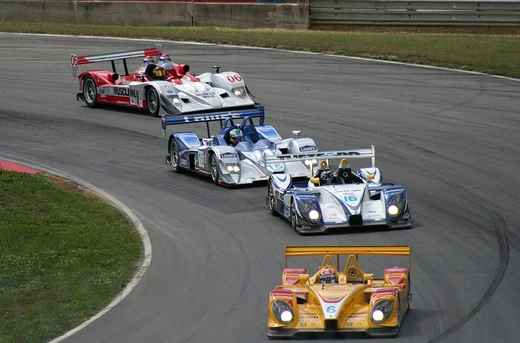
Courage C60
Courage's first all-new prototype since 1994, raced until 2006.
The Courage C60, a Le Mans Prototype (LMP) racer, debuted in 2000 from Courage Compétition and competed internationally through 2006. It succeeded the C52 and marked Courage’s first entirely fresh design since the C41 of 1994. Initially, SMG Compétition fielded the car with a 4.0-liter naturally aspirated Judd GV4 V10 engine. From 2001, Pescarolo Sport campaigned a version powered by a 3.2-liter twin-turbocharged Sodemo-Peugeot A32 V6, and these Peugeot-engined cars became the most victorious. In 2004, Pescarolo independently reworked the C60, swapping the Peugeot units for 5.0-liter Judd GV5 V10s. The following year, Courage ran two updated C60 Hybrid variants (using Judd GV4 engines) as a factory effort; Pescarolo similarly upgraded their cars to Hybrid spec, securing second place at the 2005 and 2006 24 Hours of Le Mans while also winning the Le Mans Series both years. Courage replaced the C60 with the all-new LC70 in 2006, and Pescarolo introduced their 01 in 2007.
Design and development began in 2000, when Courage Compétition created the C60 as a clean-sheet successor to the C52. Paolo Catone, who had designed the earlier car, penned the C60’s shape. Its chassis used a carbon fiber and aluminum honeycomb monocoque, while suspension relied on double wishbones, pushrods, and horizontally mounted dynamic dampers. SMG Compétition first ran the car, equipping it with a 4.0-liter naturally aspirated Judd GV4 V10. In 2001, Pescarolo Sport adopted the C60, fitting a Sodemo-developed 3.2-liter twin-turbocharged Peugeot A32 V6 that claimed 550 hp. For 2002, André de Cortanze revised the design into the C60 Evo, adding an unusual open-wheel-style brake duct system at the front and redesigned rear wing endplates; the Peugeot A32 then claimed 580 hp. Further endplate tweaks came in 2003, alongside a reduction in engine air restrictors from 32.4 mm to 30.7 mm, dropping claimed power to 510 hp. In 2004, Pescarolo began running the car as a “Pescarolo C60” with a 5.0-liter Judd GV5 V10, after Henri Pescarolo’s own development work. For 2005, both Courage and Pescarolo released updated versions for new LMP1 rules, both called C60 Hybrids and both using Judd engines. Pescarolo’s retained the GV5, claiming 630 hp, while Courage’s used the smaller 600 hp GV4 and featured a noticeably different rear wing.
- Manufacturer
- Courage Compétition
- Production years
- 2000–2006
- Designer
- Paolo Catone
- Chassis
- Carbon fibre and aluminium honeycomb monocoque
- Suspension
- Double wishbones, pushrods, horizontally-located dynamic dampers
- Engine (initial)
- 4.0 L Judd GV4 V10 naturally aspirated
- Engine (most successful)
- 3.2 L Sodemo-Peugeot A32 V6 twin-turbocharged
Lore & Background
The Courage C60 was designed by Paolo Catone as a clean-sheet replacement for the Courage C52. Its chassis used carbon fibre and aluminium honeycomb, with suspension comprising double wishbones, pushrods and horizontally-located dynamic dampers. SMG Compétition first ran the car in 2000 with a 4-litre Judd GV4 V10 engine. In 2001, Pescarolo Sport began using a version with a Sodemo-developed 3.2-litre twin-turbocharged Peugeot A32 V6 engine claimed to produce 550 hp. For 2002, André de Cortanze redeveloped the C60 into the C60 Evo, featuring an unusual brake duct system similar to that on an open-wheel car at the front, redesigned rear wing endplates, and a Peugeot A32 engine now claimed at 580 hp. In 2003, the endplates were further developed and the engine's air restrictors were decreased from 32.4 to 30.7 mm, reducing claimed power to 510 hp. In 2004, Pescarolo began running the car as a 'Pescarolo C60' with a 5-litre Judd GV5 V10 engine, as Henri Pescarolo had further developed the C60. For 2005, both Courage and Pescarolo released redeveloped versions designated C60 Hybrids, using Judd engines; the Pescarolo version retained the Judd GV5 (claimed 630 hp), while the Courage version used the smaller 600 hp Judd GV4 and featured a noticeably different rear wing. Courage introduced the new Catone-designed Courage LC70 in 2006 as the C60's replacement.
Reader's Guide
The Courage C60's significance lies in its longevity and adaptability across multiple engine configurations and regulatory eras. It was Courage's first all-new prototype in six years and served as the basis for Pescarolo Sport's most successful campaigns. The Peugeot-engined versions proved the most successful, with Pescarolo taking second at the 2005 and 2006 24 Hours of Le Mans while also winning the Le Mans Series in both years. The car's racing history includes a debut at the 2000 Silverstone 500 USA Challenge, its first victory at the 1000 km Estoril in 2001, and multiple class finishes at Le Mans. In 2004, Pescarolo were the only team to use the C60, running it as the 'Pescarolo C60'. The C60's development culminated in the C60 Hybrid for the new LMP1 regulations in 2005, before being succeeded by the Courage LC70 in 2006 and the Pescarolo 01 in 2007.
Did You Know?
- The C60 was Courage's first all-new prototype since the Courage C41 was built in 1994.
- In 2002, the C60 Evo featured an unusual brake duct system similar to that on an open-wheel racing car at the front.
More in Le Mans Prototypes 1-24
Spotted an error? Know more?
Reader corrections go straight into our review queue. Suggest an edit · How this site is sourced