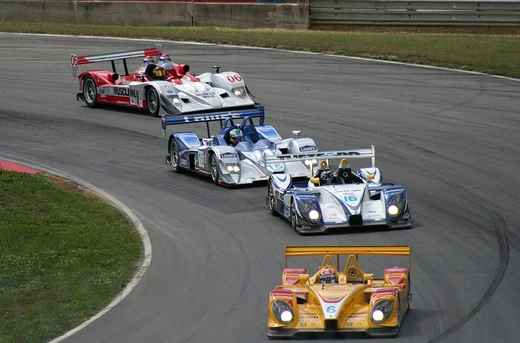
Audi R8 (LMP)
Five Le Mans wins in six years of competition.
The Audi R8 LMP is a Le Mans Prototype race car that debuted in 2000, built from the lessons of Audi’s two 1999 entries: the open-top R8R and the closed-top R8C. Over six years of competition, it claimed five overall wins at the 24 Hours of Le Mans—in 2000, 2001, 2002, 2004, and 2005—making it one of the most successful cars in its class. The only year it lost during that span was 2003, when the Bentley Speed 8, another Volkswagen Group entry, took the victory. The car was powered by a 3.6-liter V8 with Fuel Stratified Injection (FSI), a gasoline direct injection system developed by Volkswagen that boosted both power and fuel efficiency. This technology later appeared in production vehicles across the Volkswagen Group. A total of 16 chassis were built. Audi’s push into sports car racing began in 1998, when Audi Sport boss Wolfgang Ullrich evaluated joining a field that included BMW, Mercedes-Benz, Porsche, Toyota, and Nissan. The American Le Mans Series offered a stage for the U.S. market, and Audi announced plans to compete in 1999 with the R8R, an open-top roadster built by Dallara and run by Joest Racing. It used a 550-hp V8 turbo. Later that year, after closed-cockpit LM-GTP prototypes like the Porsche 911 GT1 and Toyota GT-One proved successful, Audi commissioned Racing Technology Norfolk—led by Tony Southgate—to build a closed-cockpit car, the R8C, using the same drivetrain. ACO rules allowed closed prototypes larger air restrictors, giving them about 600 hp and higher top speed, but they were limited to smaller tires and fuel tanks. In 1999, two R8Rs debuted at the 12 Hours of Sebring, finishing third. At Le Mans, the new R8Cs struggled with gearbox issues and were 10 seconds off the pace. The R8Rs ran steady but lacked speed for pole. After a race marked by the Mercedes-Benz CLR’s airborne crashes and retirements from leading Toyotas and BMWs, the R8Rs took third and fourth behind the winning BMW V12 LMR and a Toyota. Audi regrouped for 2000, building a new R8 spyder with Joest and Dallara. The R8C was retired, but Audi-owned Bentley used its closed-cockpit concept for the EXP Speed 8, which won Le Mans in 2003. After 1999, Mercedes left sports cars for DTM and F1. Toyota and BMW also moved to F1, though BMW continued in the ALMS for two years.
- Years active
- 2000–2005 (with limited action in 2006)
- Le mans victories
- 2000, 2001, 2002, 2004, 2005
- Engine
- 3.6 L Audi V8 with Fuel Stratified Injection (FSI)
- Power (official)
- About 610 hp (2000–2002), 550 hp (2003–2004), 520 hp (2005)
- Transmission
- Ricardo six-speed sequential with electropneumatic paddle shift
- Chassis construction
- Carbon fibre
- Total chassis built
- 16
Lore & Background
The Audi R8 was developed by Audi Motorsport and Joest Racing, debuting in 2000 with a win at the 12 Hours of Sebring. The car won Le Mans five times and the American Le Mans Series overall championship six times in a row from 2000 to 2005. The R8 achieved a hat trick at Le Mans in 2000–2002, campaigned by Audi Sport Infineon Team Joest and driven by Tom Kristensen, Emanuele Pirro, and Frank Biela. In its first outing in 2000, the team scored a 1-2-3 finish. Privateer teams also won at Le Mans in 2004 and 2005. The R8's structure was designed for rapid parts changes; the entire rear transaxle could be replaced in as low as three minutes and 16 seconds. The transmission, rear suspension, and rear subframe were built as one unit, with quick-connect hoses and easily removable bolts. The Automobile Club de l'Ouest (ACO) later mandated that the gearbox casing remain the same item through the race, but the R8 still had quicker access to gearbox internals than other cars. The highest recorded speed at Le Mans was 338 km/h in practice for the 2002 race; a low-downforce setup could reach about 350 km/h. In 2001, ex-F1 driver Michele Alboreto died in an accident during an R8 test session at the Lausitzring after a high-speed tyre failure. The petrol-powered R8 was replaced in 2006 by the Audi R10 TDI Diesel, but the R8 saw action in a few races leading up to the 24 Hours of Le Mans while the R10 was further developed.
Reader's Guide
The Audi R8 is notable for its dominance in sports car racing during the early 2000s, winning Le Mans five times and the American Le Mans Series championship six consecutive years. Its success was built on a combination of engineering innovations, including a 3.6 L V8 with Fuel Stratified Injection (FSI) that maximized both power and fuel economy, and a quick-change rear subframe that allowed the Joest pit crew to replace a damaged transaxle in minutes. The ACO responded by restricting gearbox casing changes, but the R8 retained an advantage in serviceability. The car's structure and body were made of carbon fibre. The R8's Le Mans streak was broken only by the Bentley Speed 8 in 2003, a car based on the R8's closed-cockpit predecessor and fielded by the same Volkswagen Group. After the factory team dropped its campaign in 2002, privateer teams continued to win with the R8. The car's legacy includes influencing the development of the Audi R10 TDI Diesel, which replaced it in 2006.
Did You Know?
- The Audi R8 won the 24 Hours of Le Mans five times: 2000, 2001, 2002, 2004, and 2005.
- The R8's engine used Fuel Stratified Injection (FSI), a gasoline direct injection technology developed by Volkswagen.
- A total of 16 Audi R8 chassis were built.
More in Le Mans Prototypes 1-24
Spotted an error? Know more?
Reader corrections go straight into our review queue. Suggest an edit · How this site is sourced