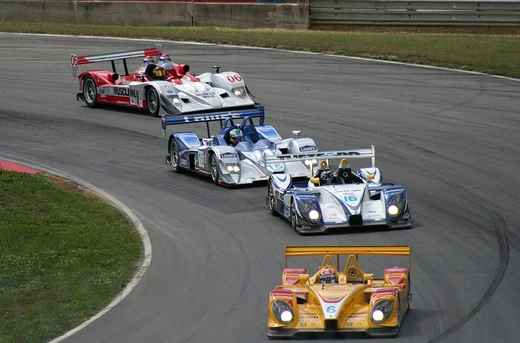
Audi R10 TDI
First diesel-powered car to win the 24 Hours of Le Mans.
The Audi R10 TDI is a Le Mans Prototype 1 (LMP1) sports car developed by Audi with chassis partner Dallara. It made history as the first diesel-powered vehicle to win the 24 Hours of Le Mans, a victory it achieved in 2006, the first of three consecutive wins at the event. The car was shown to the public in Paris on 13 December 2005, and just 200 days later, it won the 2006 24 Hours of Le Mans. After the 2008 American Le Mans Series season, the R10 was succeeded by the R15 TDI. Colin Kolles’ team, then known as Kolles, continued to run the R10 at Le Mans for two more years and for one season in the 2009 Le Mans Series.
The R10’s predecessor, the R8, was an open-cockpit design that grew out of experience with the Audi R8R. Audi chose open cockpits after the closed-cockpit R8C proved less successful, a philosophy they kept until the closed-cockpit R18 TDI arrived in 2011. A key difference between open and closed prototypes, like the Bentley Speed 8, was that closed-cockpit LMGTP cars used narrower tires but had larger air restrictors, giving them more power than open-cockpit LMP1 cars. The R8 became one of the most successful sports prototypes ever, winning 63 of 79 races in the LMP900 class from 2000 onward. By 2005, weight and air restrictor penalties brought competitors closer; for the 2005 Le Mans, the R8 carried an extra 50 kg of ballast and smaller restrictors, making its V8 obsolete. The R8 ended its European racing at the 2005 Le Mans Endurance Series finale in Istanbul, but like the R8R before it, the R8 replaced the R10 after the R10’s debut at the 2006 12 Hours of Sebring until the 2006 Le Mans.
The R8 was famous for easy servicing, especially its rear assembly, nicknamed “Hinterwagen.” The R10 continued this trend, with both the rear bodywork and front crash structure removable. It carried over the R8’s carbon fiber monocoque and aluminum honeycomb, but replaced the plastic bodywork with carbon-fiber composite to handle the extra weight of the V12 engine compared to the earlier V8.
Audi was not the first to run a diesel at Le Mans. French brothers Jean and Jacques Delettrez entered the 1949 race with a 4.4 L inline-6 diesel producing 70 PS, in a car with bodywork by Delage. They retired after 1660 km when the starter battery died after they tried to drive back to the pits on an empty fuel tank.
- Unveiled
- 13 December 2005 in Paris
- First le mans win
- 2006
- Engine
- 5.5 litre V12 TDI diesel
- Power output
- over 650 PS between 3,000 and 5,000 rpm
- Torque output
- 1100 Nm
- Transmission
- 5-speed pneumatically-actuated sequential (Xtrac)
- Replaced by
- R15 TDI at the conclusion of the 2008 American Le Mans Series
Lore & Background
The R10's predecessor, the R8 Le Mans Prototype, was an open-cockpit design based on experience gained with the Audi R8R. The R8R's sibling, the closed-cockpit R8C, was not as successful as the R8R and Audi chose open-cockpits as their design philosophy; this remained the case until 2011, when the R18 TDI was unveiled with a closed-cockpit. The R8 proved to be one of the most successful sports prototypes of all time, dominating the LMP900 class from its introduction in 2000, scoring 63 victories from 79 races. Eventually, weight and air restrictor penalties resulted in the R8's competitors becoming increasingly closer on pace, and for the 2005 edition of the 24 Hours of Le Mans the R8 was forced to carry 50 kg extra in ballast and had smaller air restrictors. These changes to the regulations meant that the V8 in the R8 LMP was becoming obsolete.
The R10 carried over the R8's carbon fibre monocoque and aluminium honeycomb, with the plastic bodywork replaced by a carbon-fibre composite construction, necessitated by the increased weight of the V12 compared to the previous V8. The R10 was unveiled to the public on 13 December 2005 in Paris, and would go on to win the 2006 24 Hours of Le Mans just 200 days later. The R10 was eventually replaced by the R15 TDI at the conclusion of the 2008 American Le Mans Series. Colin Kolles of ByKolles Racing (known then as 'Kolles') fielded the car for two more years at Le Mans and for a single year in the 2009 Le Mans Series.
Reader's Guide
The Audi R10 TDI is significant as the first diesel-powered car to win the 24 Hours of Le Mans, achieving this in 2006 and going on to win the race three times. Its development was driven by a desire to change the stereotype of diesels being dirty and 'oil-burners', and to push the sportiness of the diesel through motorsport. The project was given the go-ahead by Ferdinand Piëch, then-chairman of the supervisory board of Volkswagen, after a conversation in 2004. The engine presented unique challenges, including the construction of the block from an aluminium-silicon alloy rather than cast iron to save weight. Bosch provided a bespoke Motronic MS14 engine control unit and a common rail fuel injection system with piezoelectric injectors delivering fuel at over 1600 bar, combined with a Garrett turbocharger for each bank, resulting in over 650 PS and 1100 Nm of torque. Dow Automotive developed a specialised diesel particulate filter that was so efficient that exhausts were practically transparent, and the exhaust note was around 5 dB quieter than the R8, at 105 dB. The R10's serviceability continued the trend from the R8, with not only the rear bodywork being removable but the front crash structure too. The R10's legacy includes demonstrating that diesel technology could compete at the highest level of endurance racing, and it paved the way for subsequent diesel-powered Audi prototypes.
Did You Know?
- The engine block was made from an aluminium-silicon alloy rather than cast iron to reduce weight.
- The diesel particulate filters were so efficient that exhausts from the engine were practically transparent.
More in Le Mans Prototypes 1-24
Spotted an error? Know more?
Reader corrections go straight into our review queue. Suggest an edit · How this site is sourced