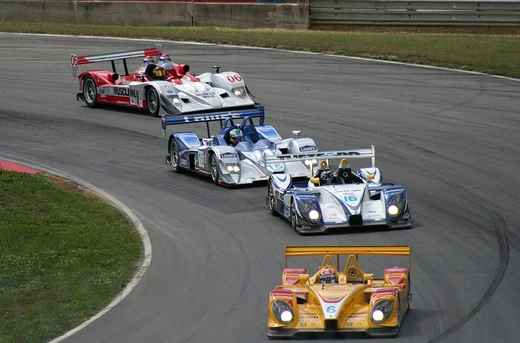
Panoz LMP-1 Roadster-S
Front-engine Le Mans Prototype with a distinctive silhouette.

The Panoz LMP-1 Roadster-S, also called simply the Panoz LMP-1, was a Le Mans Prototype built for Panoz in 1999. It replaced the Esperante GTR-1, which had raced in international Grand Tourer classes. The car ran in the American Le Mans Series and the 24 Hours of Le Mans until 2001, when the Panoz LMP07 took over. After the LMP07 was abandoned, Panoz reworked the LMP-1 Roadster-S into the LMP01 Evo, which raced until the end of 2003. Both the LMP-1 Roadster-S and the LMP01 Evo stood out among Le Mans prototypes because their engines sat in front of the cockpit instead of the usual midship layout, giving them a distinctive appearance.
Development began in late 1998, when the FIA GT Championship and United States Road Racing Championship dropped the GT1 class used by the Esperante GTR-1 since 1997. That left the Esperante GTR-1s without a series unless they were converted into Le Mans Prototypes, similar to what some Porsche 911 GT1s underwent. Panoz decided a brand-new car would be more competitive against the new Audi and BMW prototypes in the American Le Mans Series, a championship Panoz itself had founded. Reynard Motorsport returned as designer. The LMP-1 Roadster-S kept many styling cues from the Esperante GTR-1, mainly because it retained the front-engine layout. While other GT-based cars like the Esperante GTR-1 had used front engines, it was rare for a purpose-built prototype, but Panoz insisted on keeping it.
The LMP-1 Roadster-S shared much of its design with the Esperante GTR-1. Both had nearly identical front ends, with narrow fenders around deep valleys and a rounded nose housing the engine. A NACA duct fed the engine’s air intake, while the deep valleys on the sides, which shrouded the front suspension, led directly to radiators placed in front of the cockpit. The car’s sides were carved at various angles, creating an indented look compared to the fenders and helping air exit from different areas. The cockpit sat behind the engine and just ahead of the rear axle, with a single roll hoop immediately behind the driver. Only the driver’s side protection and rear headrest rose above the mostly flat top of the car. The rear overhang was short, so the rear wing struts attached directly to the rear diffuser behind the bodywork. For power, Panoz used the Ford Élan Power Products 6L8 6.0-liter V8, paired with an X-Trac six-speed sequential gearbox.
- Manufacturer
- Panoz
- Production
- 1999
- Successor
- Panoz LMP07
- Engine
- Ford Élan Power Products 6L8 6.0 litre V8
- Transmission
- X-Trac six-speed sequential gearbox
- Layout
- Front-engine
- Designer
- Reynard Motorsport
Lore & Background
At the end of 1998, both the FIA GT Championship and United States Road Racing Championship eliminated the GT1 category that the Esperante GTR-1 had competed in since 1997. Panoz decided an all-new car would be more competitive against the new Audi and BMW prototypes in the American Le Mans Series, a championship founded by Panoz. Retaining Reynard Motorsport as a designer, the LMP-1 Roadster-S retained many styling cues from the Esperante GTR-1, mostly due to the continued front-engine layout. Although other GT-based cars had used front engines, it was uncommon for a purpose-built prototype, but Panoz insisted on keeping this layout.
The LMP-1 Roadster-S shared much with the Esperante GTR-1 in design. Both had nearly identical front ends, with narrow fenders surrounding deep valleys and a rounded nose housing the engine. A NACA duct fed the air intake, while deep valleys on the side shrouding the front suspension led directly to radiators in front of the cockpit. The sides were carved at various angles, giving an indented look that helped air exit. The cockpit sat behind the engine and just ahead of the rear axle, with a single rollhoop behind the driver. The rear overhang was short, with rear wing struts attached to the rear diffuser behind the bodywork.
Following the failure of the LMP07 to perform as planned, Panoz returned to the LMP-1 Roadster-S and upgraded it into the LMP01 Evo. The front was modified to become much more narrow in the fenders and center nose, all coming to a singular point instead of the rounded design. Brake cooling ducts were made larger, the raised nose tip moved upward, and side air intakes were revised. Side air exhaust vents were enlarged, rear bodywork was extended to envelop the rear wing mounts, and the mounts were brought closer together.
Reader's Guide
The Panoz LMP-1 Roadster-S made its debut at the second race of the inaugural American Le Mans Series season in 1999. Backed by title sponsor Visteon, only one car was available, so Panoz used an older Esperante GTR-1 modified for the LMP class. The LMP-1 Roadster-S took fifth place a lap behind the winner. A second chassis was completed for the 24 Hours of Le Mans, where both cars finished seventh and eleventh behind BMW, Audi, and Toyota. Returning to the ALMS, the cars took first and second at Mosport, then completed the podium at the next round. At Petit Le Mans, a third car sold to J&P Motorsport allowed all three to finish, with the factory car winning overall over BMW. The two factory cars finished the season without another victory, but fourth place at Las Vegas allowed Panoz to take the LMP teams championship by two points over BMW.
In 2000, one former factory car was sold to Danish Team Den Blå Avis for the Sports Racing World Cup, while two new cars were built for the factory. The season began poorly with neither finishing Sebring, but the cars rebounded at Charlotte. At Le Mans, five LMP-1s entered (two factory, one Den Blå Avis, two from Japanese Team Dragon); four finished classified, taking fifth, sixth, eighth, and fifteenth. The only win of the year came at the 1000km Nürburgring. Panoz finished third in the LMP championship behind Audi and BMW. In 2001, Panoz started with LMP-1s before switching to the LMP07, selling the older cars to privateers. After Le Mans, frustrated with the LMP07, Panoz brought back the LMP-1 Roadster-S, which won at Portland and Mid-Ohio. Combined points earned Panoz second in the LMP900 championship behind Audi. The redesigned LMP01 Evo debuted for 2002.
Did You Know?
- The Panoz LMP-1 Roadster-S used a front-engine layout, unusual for a purpose-built Le Mans Prototype.
- Its engine was a Ford Élan Power Products 6L8 6.0 litre V8 paired with an X-Trac six-speed sequential gearbox.
- The car helped Panoz win the LMP teams championship in the inaugural 1999 American Le Mans Series season by two points over BMW.
Frequently Asked Questions
What is the Panoz LMP-1 Roadster-S?
It is a Le Mans Prototype that Panoz built in 1999 to replace their earlier Esperante GTR-1 grand tourer. The car competed in the American Le Mans Series and the 24 Hours of Le Mans through 2001.
What makes the Panoz LMP-1 Roadster-S layout unusual for a Le Mans prototype?
Instead of the standard midship engine placement found in nearly every other LMP-1 car, Panoz put the powerplant in front of the cockpit. This front-engine arrangement gave the car a distinctly different silhouette on track.
What happened to the Panoz LMP-1 Roadster-S after 2001?
Panoz initially moved on to the LMP07, but after that project was dropped they went back to the Roadster-S architecture and reworked it into the LMP01 Evo. That evolved version kept racing until the end of the 2003 season.
Why do fans consider the Panoz LMP-1 Roadster-S significant in LMP history?
It proved that a front-engine, roadster-style silhouette could be competitive at the highest level of sports-prototype racing. Its long service life—spanning from 1999 through the LMP01 Evo in 2003—also made it one of Panoz's most recognizable and enduring race cars.
More in Le Mans Prototypes 1-24
Spotted an error? Know more?
Reader corrections go straight into our review queue. Suggest an edit · How this site is sourced