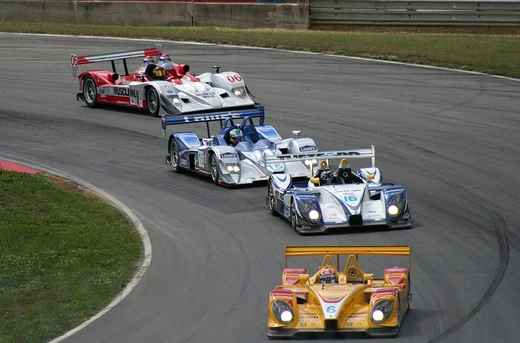
Lola B2K/10
An evolution of the B98/10 with distinctive front-end design.

The Lola B2K/10 is a Le Mans Prototype built in 2000 by Lola Cars International. It was designed for the 24 Hours of Le Mans, the American Le Mans Series, the Grand American Road Racing Championship, and the Sports Racing World Cup. This car succeeded the Lola B98/10 and shared some features with the smaller Lola B2K/40.
The B2K/10 was more of an evolution of the B98/10 than a completely new design. Many elements carried over, especially at the front. The unusual fenders and headlights stayed, but the nose was raised to allow for a higher footbox. Unlike other prototypes that tapered to a point for an air intake, the B2K/10’s nose ended where the footbox stopped, leaving a large vertical section. A third headlight was mounted inside this area to improve visibility during endurance races.
The decision to avoid a nose intake came from a plan to draw all cooling air from underneath the car. This design had problems with ambient track temperature, a issue that had also troubled the BMW V12 LM in 1998. The large air intake mounted under the rollbar on the B98/10 could be removed, though not all cars did so. When removed, the intakes were moved to small nacelles beside the cockpit, allowing cleaner airflow to the rear wing from under the rollbar.
The sides of the car changed significantly. Large openings between the sidepod and cockpit let air flowing over the nose escape out the side. The radiator intakes on the sides, partly fed by air channeled from the nose, were larger than those on the B98/10.
Lola used the same engine as the B98/10: a Roush Racing-designed Ford 6.0-liter V8. As before, teams often chose other engines, including the Judd GV4 V10 and a Porsche twin-turbocharged flat-6.
In early 2000, the first three B2K/10s were delivered to customers. Team Rafanelli received a Judd-powered chassis, Philip Creighton Motorsport a Ford-powered one, and Champion Racing a Porsche-powered chassis. Creighton Motorsport’s car was not ready, but the other two debuted at the 12 Hours of Sebring. Neither finished: Champion suffered a suspension failure in the closing hours, and Rafanelli dropped out early.
Rafanelli and Champion stayed in the American Le Mans Series, later joined by Intersport Racing, which added a Judd-powered B2K/10 alongside its B98/10 for a two-car team. Rafanelli took the season’s best result, a third at Charlotte Motor Speedway.
Quick Facts
- Car Name
- Lola B2K/10
- Category
- LMP900/SR1
- Constructor
- Lola Cars International
- Wheelbase
- 2800 mm
- Length
- 4640 mm
- Height
- NNNN mm
- Track
- 1660 mm front / 1580 mm rear
- Engine Name
- Caterpillar TDI 4.9 L twin-turbocharged V10 engine (Diesel) / Judd GV4 4.0 L N/A V10 / Roush Racing-Ford 6.0 L N/A V8 / Porsche M96/70 3.6 L twin-turbocharged Flat-6
- Capacity
- NNNN cc
- Engine Position
- mid-engined, longitudinally mounted
- Gears
- 6-speed
- Power
- NNN hp
Facts from the source article.
Lore & Background
The B2K/10 was more an evolution of the B98/10 than an all-new car, sharing many design elements, most notably at the front end. The unusual fenders and headlights remained, while the nose was raised to accommodate a higher footbox. Unlike other prototypes which usually had the nose come to a point for an air intake, the B2K/10's nose merely stopped where the footbox ended, leaving a large vertical protrusion with a third headlight mounted inside for better visibility in endurance races. All cooling air for the car was drawn from underneath, a design that suffered problems due to ambient track temperature, similar to the BMW V12 LM in 1998. The large air intake mounted underneath the rollbar of the B98/10 could be removed; if removed, intakes were relocated to small nacelles beside the cockpit. The sides were radically changed, with large openings between the sidepod and cockpit allowing air over the nose to escape out the side, and radiator intakes were larger than those on the B98/10.
In early 2000, the first three B2K/10s were delivered to customers: Team Rafanelli (Judd-powered), Philip Creighton Motorsport (Ford-powered), and Champion Racing (Porsche-powered). Neither Rafanelli nor Champion finished their debut at the 12 Hours of Sebring. Over the following years, the car saw competition in multiple series, with Intersport Racing, Konrad Motorsport, and others fielding chassis. The B2K/10 scored its first victory in 2001 in the Grand American Road Racing Championship at Phoenix International Raceway for Intersport Racing. By 2002, design flaws left it behind the competition, but it saw a resurgence in 2003. In 2004, Taurus Sports Racing attempted to bring diesel technology to Le Mans with a Caterpillar-tuned Volkswagen twin turbocharged V10, but the torque destroyed the gearbox after 35 laps. The final active B2K/10 was retired after a failure at Silverstone Circuit.
Reader's Guide
The Lola B2K/10 represents a transitional design in Lola's prototype lineage, bridging the B98/10 and later models such as the B01/60 and B06/10. Its unusual front-end layout—lacking a nose intake and relying on underfloor cooling—was a distinctive but problematic feature, echoing issues seen in the BMW V12 LM. The car's adaptability to multiple engines (Ford, Judd, Porsche, and even a diesel Volkswagen) allowed it to serve a variety of customer teams across several championships, from the American Le Mans Series to the Sports Racing World Cup. Despite never achieving dominant success, the B2K/10 secured a handful of podium finishes and two race wins, notably in the Grand American Road Racing Championship. Its most notable legacy may be the 2004 diesel experiment by Taurus Sports Racing, which, though unsuccessful, foreshadowed later diesel efforts at Le Mans. With only six chassis built, the B2K/10 remains a relatively rare but historically interesting prototype that illustrates the challenges of endurance racing design in the early 2000s.
Did You Know?
- The B2K/10's nose lacked a traditional air intake, instead drawing all cooling air from underneath the car.
- A third headlight was mounted inside the vertical protrusion at the front for better visibility in endurance races.
- The car was powered by a variety of engines including a Roush Ford V8, Judd V10, Porsche Flat-6, and a Caterpillar-tuned Volkswagen diesel V10.
- Only six B2K/10 chassis were constructed, running competitively from 2000 to 2004.
More in Le Mans Prototypes 1-24
Spotted an error? Know more?
Reader corrections go straight into our review queue. Suggest an edit · How this site is sourced