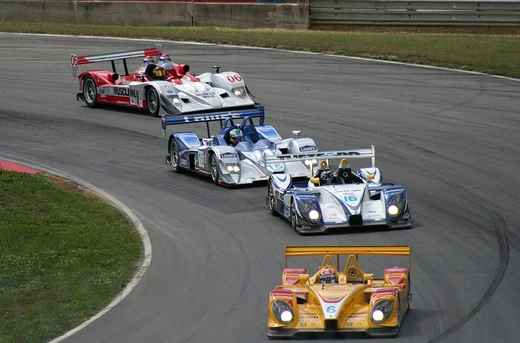
Audi R15 TDI
Audi's diesel LMP1 that won Le Mans in 2010.

The Audi R15 TDI, often shortened to R15, is a Le Mans Prototype built by Audi AG. It replaced the R10 TDI and, like its predecessor, runs on a turbocharged diesel engine. However, the new car uses a V10 instead of a V12, making the powerplant physically smaller. This smaller engine sits closer to the car’s center, giving it a more balanced weight distribution and sharper cornering ability.
The R15’s 5.5-liter turbocharged direct-injection V10 produces over 600 PS and 1050 Nm of torque. It was also the first Audi sports prototype to feature a lithium-ion battery, LED headlights, and LED rear lights mounted on the rear wing endplates.
First tested in December 2008, the R15 made its racing debut at the 2009 12 Hours of Sebring on March 21, winning the event and setting a new race record. Three cars entered the 2009 24 Hours of Le Mans under Joest Racing, but Peugeot’s 908 HDi FAP took the top two spots, ending Audi’s five-year winning streak that began in 2004 with the gasoline R8. Audi did not defend its American Le Mans Series or Le Mans Series titles with the R15.
Before the 2009 Le Mans, Peugeot protested that the R15’s bodywork violated rules against parts designed solely for downforce. The ACO rejected the protest after Wednesday practice. During the race, the No. 3 car ran off at Indianapolis Corner early on but finished 17th. The No. 2 car crashed and retired. The No. 1 car lost a lap to the faster Peugeots and later dropped seven laps due to technical issues, but still finished third.
On August 25, 2009, Audi announced two R15s would race at Petit Le Mans. Both led for about 90% of the race, but a late spin during a rain-soaked caution handed victory to a Peugeot 908. This was Audi’s first loss at Petit Le Mans since its debut at Road Atlanta in 2000.
For 2010, Audi updated the car into the R15 Plus after losing to Peugeot at Le Mans and Petit Le Mans. New regulations reduced diesel air restrictors and turbo boost, but engineer Ulrich Baretzky’s team maintained comparable power. Aerodynamics were heavily revised: the front area was redesigned to expose crash structures, front fenders were lowered to cut drag, the air-through-the-car concept was dropped, side air channels were reconfigured, and a new headlight design appeared. Fuel tank and cooling systems were also improved.
- Engine
- 5.5 L Turbocharged Direct Injection (TDI) turbodiesel V10
- Power
- Over 600 PS
- Torque
- 1050 Nm
- First test
- December 2008
- Competition debut
- 2009 12 Hours of Sebring (21 March 2009)
- Races entered
- 10
- Wins
- 3
Lore & Background
The R15 TDI made its competition debut at the 2009 12 Hours of Sebring, winning the race and setting a new race record. Three R15 TDIs participated in the 2009 24 Hours of Le Mans under Joest Racing. Rival Peugeot, with its 908 HDi FAP, took the top two spots, ending Audi's five-win streak dating back to 2004. In the week before the 2009 Le Mans, Peugeot lodged a protest claiming the R15's bodywork did not comply with regulations, but the ACO rejected it after the Wednesday free practice session. At the 2009 Le Mans, the No. 3 R15 ran off at Indianapolis Corner early but finished 17th; the No. 2 crashed and retired; the No. 1 lost a lap to the leading Peugeot and further technical issues dropped it seven laps down, though it clinched a third-place podium finish. At the 2009 Petit Le Mans, two R15s led for approximately 90% of the race, but a late spin during a rain-soaked caution handed victory to a Peugeot 908 HDi FAP, Audi's first loss at Petit Le Mans since its initial attempt in 2000.
Reader's Guide
In response to losing the 2009 24 Hours of Le Mans and Petit Le Mans to Peugeot, Audi updated the R15 for the 2010 season, creating the R15 Plus. Despite 2010 regulations reducing diesel LMP1 air restrictors and turbocharger boost pressure, Audi's engineering team achieved engine power and performance comparable to the 2009 powerplant. Aerodynamic efficiency was a major focus: the frontal area was redesigned to reveal raw crash structures, front fenders were lowered to reduce drag, the air channel exiting to the side was redesigned, and a new headlight concept was introduced. The fuel tank and cooling system were also improved. The R15 Plus won the 2010 8 Hours of Le Castellet five laps ahead of Aston Martin, with the Oreca Peugeot eight laps down. At the 2010 Spa 1000 km, three cars finished third, fifth, and twelfth. At the 2010 24 Hours of Le Mans, Peugeot occupied top spots for much of the race, but three Peugeot cars experienced engine problems from connecting rod failure late in the race, and another retired due to suspension failure. The three Audis finished 1–2–3, with the winning No. 9 car setting a distance record of 5410.7 km. Post-Le Mans, Audi lost all three remaining races to Peugeot. The R15's final race was the 2011 12 Hours of Sebring, where it competed as an upgraded R15++ while the R18 was still being developed. Throughout its career, the R15 won three of ten races entered: Sebring in 2009, Paul Ricard and Le Mans in 2010.
Did You Know?
- The R15 TDI was the first Audi sports prototype to use a lithium-ion battery.
- At the 2009 24 Hours of Le Mans, Peugeot lodged a protest against the R15's bodywork, which the ACO rejected.
- The R15's V10 engine was physically smaller than the R10's V12 and positioned further toward the middle of the car.
- The R15 won three of the ten races it entered: Sebring 2009, Paul Ricard 2010, and Le Mans 2010.
More in Le Mans Prototypes 1-24
Spotted an error? Know more?
Reader corrections go straight into our review queue. Suggest an edit · How this site is sourced