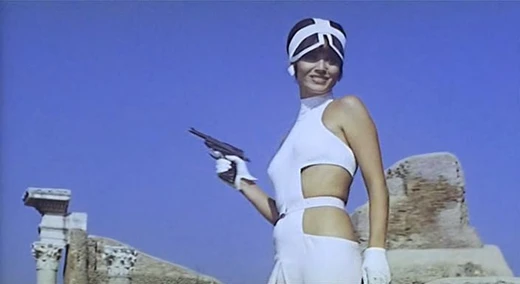
The Humanoid (film)
Italian space opera inspired by Star Wars.

The Humanoid (Italian: L'umanoide) is a 1979 Italian space opera film directed by Aldo Lado, who was credited as 'George B. Lewis'. The film is generally considered to have been a cash-in on the success of the original Star Wars. It stars Richard Kiel, Corinne Cléry, Leonard Mann, Ivan Rassimov, and Arthur Kennedy.
Quick Facts
- Native Name
- it · L'umanoide
- Director
- Aldo Lado
- Screenplay
- Adriano Bolzoni / Aldo Lado
- Story
- Adriano Bolzoni
- Producer
- Giorgio Venturini
- Starring
- Richard Kiel / Corinne Cléry / Leonard Mann / Barbara Bach / Arthur Kennedy / Ivan Rassimov / Marco Yeh / Massimo Serato
- Music
- Ennio Morricone
- Runtime
- 100 minutes
- Cinematography
- Silvano Ippoliti
- Editing
- Mario Morra
- Released
- 11 April 1979 · Italy
- Studio
- Merope Film
Facts from the source article.
Lore & Background
The film is set in the distant future on the planet Metropolis, once known as Earth, a peaceful utopia led by the Great Brother. His brother Graal, escaped from a prison satellite, steals a warship and enlists mad scientist Dr. Kraspin to create an army of unstoppable supersoldiers called Humanoids using the element Kapitron. The plot involves a raid on the Grovan Institute, the mutation of a giant man named Golob into a superhuman, and a rescue mission led by security officer Nick and Golob, aided by a mysterious boy named Tom Tom who possesses mental powers.
Reader's Guide
The Humanoid is significant primarily as an example of the wave of Italian science fiction films that followed the global success of Star Wars. Its director used the pseudonym George B. Lewis, a clear reference to George Lucas, and the film features numerous visual and narrative similarities to Star Wars: A New Hope, including a text crawl, a villain in a Darth Vader-like costume, and a triangle-shaped spaceship. Filmed on location in Eilat, Israel, and at Cinecittà Studios in Rome, the film is often noted for its derivative nature rather than its originality. Its legacy lies in its representation of the international film industry's rapid response to blockbuster trends.
Did You Know?
- The director Aldo Lado was credited as 'George B. Lewis' in reference to George Lucas.
- Antonio Margheriti served as the film's visual effects supervisor.
- The film features a robot dog companion named Kip.
From Creepypasta to Cinema
The Backrooms concept originated as a piece of internet horror fiction known as creepypasta, a genre of collaborative online storytelling built around unsettling, rule-based scenarios. The response was immediate and industry-wide: within months, multiple studios reached out to Parsons with offers to expand his work into a theatrical feature. Among the interested parties was A24, the independent studio known for elevating genre cinema. The screenplay initially went to Roberto Patino, though he was ultimately replaced by Will Soodik.
The Labyrinth of Liminal Dread
The narrative then shifts to Clark, a failed architect running a struggling furniture shop in San Jose, California, who battles alcoholism and the wreckage of a broken marriage. His therapist, Dr. Mary Kline, carries her own wounds: the demolition of her childhood home and the institutionalization of her agoraphobic mother. When Clark discovers a glowing fissure in his store's basement wall, he tumbles into the yellow labyrinth and stumbles upon Naren's remains. He drags his assistant Kat and her boyfriend Bobby into the space to document their findings, but Bobby is ambushed and killed by the entity. Clark's psyche fractures; he imprisons Mary and reveals Kat's severed head. A towering, distorted simulacrum of himself in a pirate costume—the store's mascot, Cap'n Clark—emerges and murders him. Mary fights her way out using a chunk of concrete from her demolished childhood home, triggering an Async gas trap that leads to her capture and interrogation.
An Ensemble in the Yellow Dark
Chiwetel Ejiofor anchors the film as Clark, a man whose failed architectural ambitions and crumbling personal life make him vulnerable to the Backrooms' psychological corrosion. Renate Reinsve brings a quiet, wounded intensity to Dr. Mary Kline, a therapist whose own traumas—the loss of her childhood home and the institutionalization of her agoraphobic mother—mirror the film's themes of displaced memory and fractured identity. Mark Duplass plays Phil, an Async Research Institute scientist who monitors the Backrooms through surveillance feeds and later interrogates Mary. Finn Bennett and Lukita Maxwell portray Bobby and Kat, Clark's assistant manager and her boyfriend, whose brief foray into the labyrinth ends in Bobby's fatal encounter with the entity. Robert Bobroczkyi embodies the film's most visceral antagonist, Pirate Clark, a towering distorted simulacrum of the store's mascot. Krista Kosonen plays Mary's mother, Nora, while Patrick Baynham, Dana Mahmood, and Rhiannon Roberts appear as the eerie, largely motionless "Still Life" simulacra that populate Clark's final chamber.
A24's New Benchmark
Critics responded with broad enthusiasm, praising the film's atmospheric dread and its sharp psychological underpinnings. The achievement also made Kane Parsons the youngest filmmaker ever to simultaneously top both the domestic and international box office charts. For a project that began as a single creator's web series inspired by an internet creepypasta, the trajectory from online short to global phenomenon underscored how deeply the liminal-space aesthetic had embedded itself in contemporary popular culture.
Frequently Asked Questions
What is The Humanoid (L'umanoide)?
It is a 1979 Italian space opera that hit theaters just two years after Star Wars dominated global box offices. Fans and critics generally treat it as a quick cash-in that borrowed the same epic spacefaring template to ride that wave in the Italian market.
Who directed The Humanoid and why does the credit say 'George B. Lewis'?
The film was actually directed by Aldo Lado, a veteran of Italian genre cinema, but he attached the pseudonym 'George B. Lewis' to the credit. This kind of anglicized alias was a common tactic among Italian genre directors of the era to make their names read more familiar to international distributors.
Who is in the cast of The Humanoid?
The lead ensemble includes Richard Kiel (who would later become globally recognized as Jaws in The Spy Who Loved Me), alongside Corinne Cléry, Leonard Mann, Ivan Rassimov, and Arthur Kennedy. It is a typical late-'70s Italian genre mix of character actors and a few recognizable faces.
Who supervised the visual effects on The Humanoid?
Antonio Margheriti handled the effects work. He was one of the most prolific figures in Italian sci-fi and monster filmmaking, having contributed to dozens of low-budget genre pictures from the 1960s through the 1970s.
Why do fans and critics keep bringing up Star Wars when discussing The Humanoid?
Because the film's premise, visual language, and marketing all lean heavily on the space-opera formula that Star Wars made a worldwide phenomenon in 1977. It is widely read as a deliberate attempt to capture the same audience appetite in Italy before the trend cooled.
More in Italian science fiction films 1-23
Spotted an error? Know more?
Reader corrections go straight into our review queue. Suggest an edit · How this site is sourced