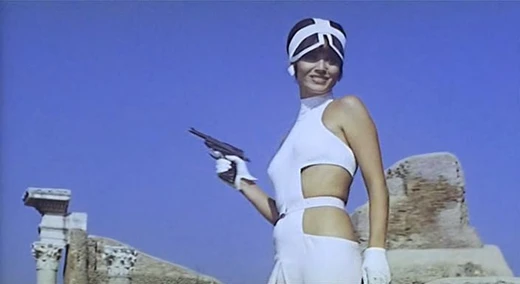
Star Pilot
1966 Italian sci-fi film re-cut for US release after Star Wars.

Star Pilot (Italian: 2+5: Missione Hydra) is a 1966 Italian science fiction film directed by Pietro Francisci. It was produced by Golden Motion Pictures and stars Leonora Ruffo as Keyna. The film follows a spaceship from the constellation Hydra that crashes on Sardinia, leading to the abduction of Earth scientists and technicians who are forced to repair the ship and later taken to Hydra for genetic research, only to face a mutiny by the humans.
Quick Facts
- Director
- Pietro Francisci
- Screenplay
- Pietro FrancisciANICA
- Story
- Fernando Paolo GirolamiANICA
- Starring
- Leonora Ruffo / Mario Novelli
- Cinematography
- Silvano Ippoliti / Giulio AlbonicoANICA
- Music
- Nico FidencoANICA
- Studio
- Golden Motion Pictures
- Distributor
- ItalcidANICA
- Released
- 2 October 1966 · Italy
- Country
- ItalyBritish Film Institute · 2026
Facts from the source article.
Lore & Background
Star Pilot was produced by Golden Motion Pictures and released in Italy on October 2, 1966 as 2 + 5 Missione Hydra. The cast includes Leonora Ruffo as Keyna, Mario Novelli (credited as Anthony Freeman) as Paolo Bardi, Roland Lesaffre as Prof. Solmi, and Gordon Mitchell as Comandante centro Hydra, among others. The plot involves a spaceship from the constellation Hydra crashing on Sardinia, where Earth scientist Prof. Solmi, technicians, companions, and Asian agents are abducted and forced to repair the ship. After repairs, the aliens decide to take the humans to Hydra for genetic research, but the humans mutiny during flight.
Reader's Guide
Contemporary reviews were critical; a reviewer in the Italian newspaper l'Unità found the special effects poor, noting that some were obvious cut outs from postcards. Retrospective reviews, such as Michael Barrett of PopMatters, said the film sometimes felt deliberately campy like the 1960s Batman television series while others were just boring. The film's significance lies in its status as a mid-1960s Italian science fiction entry that was later repackaged for the American market in the wake of Star Wars, reflecting the era's exploitation of space themes.
Did You Know?
- The film was originally released in Italy as 2 + 5 Missione Hydra on October 2, 1966.
- A reviewer for l'Unità criticized the special effects as obvious cut outs from postcards.
Silent Pioneers and the Question of Origins
For decades, 1958 was treated as the definitive starting line for Italian science fiction on screen, yet the rediscovery of earlier silent-era works has forced a serious rethinking of that date. As early as 1910, Enrico Novelli, working under the name Yambo, crafted a short comedy in which an earthling falls in love with a Martian woman, the romance sparked by a telescope sighting and sustained through radiotelegraphic signals. In 1913, Marcel Fabre directed a fantastical comic adaptation of Albert Robida's novel, and a lost 1920 picture by Eugenio Testa—often cited as Italy's first horror film—actually centers on a scientist who assembles a being through a chemical formula; the creature rebels, triggers a string of disasters, and is ultimately contained. The silent period also explored brain transplants producing dual consciousness, solar-powered machines aimed at influencing the mentally ill, aerial warfare fought with airships, and futurist experiments. André Deed's 1921 L'uomo meccanico ranks among cinema's earliest robot-centered narratives, staging the first on-screen clash between a benevolent and a malevolent automaton, with the destructive consequences placed squarely on the foreign woman who operates the machine.
The 1958 Watershed and Post-War Genre Formation
Paolo Heusch's La morte viene dallo spazio, released in 1958, has long been credited with launching the Italian science fiction strand. The Italian-French co-production depicted Earth under siege from a cascade of asteroids and anticipated the disaster-film subgenre that would follow. Atomic energy played a decisive narrative role: an atomic rocket triggers the initial catastrophe, and the climax sees the great powers unleashing nuclear-tipped missiles to obliterate the incoming rocks. Mario Bava handled both the cinematography and the special effects. The picture cost 120 million lire to produce and returned 142 million in Italian box-office receipts. Contemporary reviews singled out the ingenuity of the plotting and the film's ability to sustain narrative tension through to the final reel, and it has since been counted among the finest Italian genre pictures. In the United States it appeared in 1961 under the English title The Day the Sky Exploded. Heusch's work drew directly on the wave of American science fiction that dominated the latter 1950s, and the broader Italian strand that followed was shaped by lower budgets and a tendency to respond to successful Hollywood templates rather than originate them.
Genre Hybridity and International Reach
Italian science fiction cinema has never been a monolithic category. A defining trait is the frequent blending of genres, with a particularly close affinity to horror running through the output. Satire and parody stand out as distinctly Italian contributions to the field, setting the national strand apart from its American counterparts. Beyond strictly genre-driven production, several art-house directors touched the subject matter at various points in their careers: Elio Petri, Marco Ferreri, Ugo Tognazzi, Pupi Avati, and Gabriele Salvatores all engaged with science fiction alongside other forms. The strand also produced figures who operated well beyond Italy's borders. Special effects artist Carlo Rambaldi won three Academy Awards, and producer Dino De Laurentiis oversaw at least one Oscar-winning film. Directors Antonio Margheriti, who worked under the English name Anthony M. Dawson, and Mario Bava carved out distinct niches—Margheriti in space opera, Bava in science fiction horror. Despite modest budgets and a B-movie reputation, several of these Italian productions found audiences and admirers abroad, establishing a recognizable strand of popular entertainment that nonetheless carried genuine craft.
Crisis, Digital Shift, and the Dystopian Revival
From the latter half of the 1980s, Italian genre cinema entered a prolonged period of difficulty. The impulse to produce science fiction aimed at international audiences gradually exhausted itself through the 1990s, and the once-vibrant output of the post-war decades faded into relative silence. The 2000s brought a different dynamic: independent productions began to gain visibility, aided by digital technologies that allowed filmmakers to keep production costs down while also broadening the channels through which films could be distributed and consumed. By the 2010s, Italian science fiction experienced a noticeable resurgence, but its thematic preoccupations had shifted markedly. Dystopias, eco-dystopias, uchronias, and post-catastrophe narratives became prominent, alongside stories examining the entangled relationships among human beings, technology, and the natural environment. This newer wave marked a departure from the American-influenced, low-budget spectacle of earlier decades, reflecting instead a more introspective and environmentally conscious sensibility that resonated with contemporary anxieties about ecological and technological futures.
Frequently Asked Questions
What is the real Italian title of Star Pilot?
The film was originally released in 1966 as "2+5: Missione Hydra" (2+5: Hydra Mission). It was later re-cut and retitled "Star Pilot" for its American distribution.
Who directed Star Pilot and who plays the lead?
Pietro Francisci helmed the production, which was made by Golden Motion Pictures. Leonora Ruffo takes on the role of Keyna, the film's central character.
What is the basic premise of Star Pilot?
A spacecraft from the constellation Hydra crashes on Sardinia, and its crew abducts Earth scientists and technicians to repair the damaged vessel. The captives are then shipped to Hydra for genetic experimentation, but they eventually stage a mutiny against their alien overlords.
How does the story of Star Pilot end?
The Earth scientists and technicians, initially coerced into fixing the Hydra ship, turn on their captors in a full-scale mutiny. This rebellion serves as the film's climactic confrontation between humans and the Hydra crew.
Why do fans of classic sci-fi talk about Star Pilot?
It's a prime example of mid-1960s Italian genre filmmaking that found a second audience in the US after being re-edited in the wake of Star Wars. Fans often cite it as a curious footnote in the "spaghetti sci-fi" wave that preceded the modern blockbuster era.
More in Italian science fiction films 1-23
Spotted an error? Know more?
Reader corrections go straight into our review queue. Suggest an edit · How this site is sourced