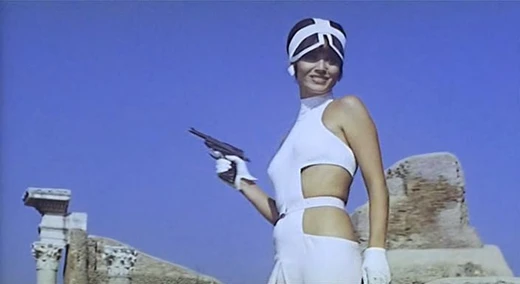
Star Odyssey
A 1979 Italian space opera with reused props and poor reviews.

Star Odyssey (originally released in Italian as *Sette uomini d'oro nello spazio*, or *Seven Gold Men in Space*) is a 1979 Italian film directed by Alfonso Brescia. It has also been distributed under the titles *Space Odyssey*, *Metallica*, and *Captive Planet* in various video markets. Aliens auction off minor planets, and the evil despot Kress wins the bid for Sol 3, which is Earth. Kress makes first contact with Earth’s inhabitants, then uses a robot army to capture humanoid slaves for sale to other villains. Defending the planet is the kindly Professor Maury, along with a mismatched group of humans—one of whom wears a Spider-Man t-shirt—and robot allies. They plan to destroy the alien ship’s metal, called Iridium or etherium, after discovering its weakness. After being defeated and forced to retreat, Kress resells Earth at the space auction for a profit. The film was one of five low-budget Italian space operas directed by Alfonso Brescia (using the pseudonym Al Bradley) following the success of *Star Wars*. To cut costs, the production reused miniature effects, models, and costumes from Brescia’s earlier film *War of the Robots*. Low-budget props were used; a *Popular Mechanics* review noted that the “light-sabers” were simply cardboard swords painted with fluorescent paint. Critical reception was highly negative. Bill Gordon of *Worst Movies Ever Made* criticized the poor special effects and confusing narrative. *Popular Mechanics* called the film a “dreadful trashpile,” while *TechRadar* described it as alternating between “insufferable or hilariously bad” depending on the viewer’s mood. *Creature Feature* gave it two out of five stars, calling it an example of sci-fi so bad it must be seen to be believed.
Quick Facts
- Director
- Alfonso Brescia · (as Al Bradley)
- Producer
- Luigi Alessi
- Writer
- Alfonso Brescia · Massimo Lo Jacono · Giacomo Mazzocchi
- Starring
- Yanti Somer · Gianni Garko · Malisa Longo · Chris Avram
- Music
- Marcello Giombini
- Cinematography
- Silvio Fraschetti
- Editing
- Mariano Arditi
- Released
- 26 October 1979 · Italy
- Runtime
- 88 minutes (Italy) · 103 minutes (US)
- Country
- Italy
- Language
- Italian
Facts from the source article.
Lore & Background
The evil despot Kress wins the auction for Sol 3 (Earth) and flies there, making first contact with its inhabitants. He uses a robot army to gather humanoid slaves to sell to his evil counterparts. Defending Earth is kindly Professor Maury and his ragtag band of humans, one of whom wears a Spider-Man t-shirt, along with robot friends. They discover the weakness of the alien ship's metal, called Iridium or etherium, and plan to destroy it. After being defeated, Kress retreats and resells the planet at the space auction for a profit.
Reader's Guide
Star Odyssey is notable as a low-budget Italian imitation of Star Wars, heavily reusing miniature effects, models, and costumes from Brescia's previous film War of the Robots. The film's 'light-sabers' were cardboard swords coated with fluorescent paint. It received highly negative reviews for its technical quality, with critics calling it a 'dreadful trashpile' and noting its special effects were poor and narrative confusing. Some viewers find it either insufferable or hilariously bad. Despite its poor reception, it represents a specific moment in Italian cinema's attempt to capitalize on the space opera craze of the late 1970s.
Roots in the Silent Screen
Science fiction on the silver screen traces its origins to the earliest days of filmmaking, when directors produced short, black-and-white narratives—sometimes enhanced with hand-applied color tints—that leaned heavily on technological subject matter and frequently aimed for a comedic tone. The 1910s and 1920s saw the genre cross-pollinate with horror, yielding adaptations of Mary Shelley's Frankenstein and Robert Louis Stevenson's Jekyll and Hyde, while Jules Verne's submarine adventure found its way to the screen in 1916. European directors of the 1920s pushed the form toward social prediction and political commentary, producing landmark works like Metropolis and Frau im Mond. Himmelskibet, with its 97-minute runtime, is generally recognized as the first feature-length science fiction film ever made.
The Long B-Movie Era and the Road to Legitimacy
Between the 1930s and the 1950s, science fiction on screen was largely a domain of low-budget productions, though a handful of ambitious, higher-budget titles broke through. The 1930s yielded Just Imagine, King Kong, and Things to Come, while the serialized adventures of Flash Gordon and Buck Rogers—both starring Buster Crabbe—captivated mainstream audiences through comic-strip adaptations. The decade also produced a rich catalog of genre-blending pictures, from the Universal horror staples Frankenstein and The Invisible Man to the more experimental The Man Who Changed His Mind. The 1940s continued this pattern with titles like Dr. Cyclops and It Happened Tomorrow. By 1950, the release of Destination Moon and Rocketship X-M signaled what many observers now call the golden age of science fiction cinema, a period fueled by genuine public fascination with space travel and emerging technologies. That landmark production fundamentally shifted how audiences and critics perceived the category, elevating it from novelty entertainment to a form capable of serious philosophical and artistic ambition.
The Blockbuster Transformation and Genre Taxonomy
The late 1970s marked a decisive turning point when big-budget, special-effects-driven science fiction captured the popular imagination on an unprecedented scale. In the broader landscape of cinema classification, screenwriter and scholar Eric R. Williams places science fiction among eleven super-genres in his taxonomy for screenwriters, arguing that every feature-length narrative film can be sorted into one of these categories. The other ten—action, crime, fantasy, horror, romance, slice of life, sports, thriller, war, and western—frame science fiction as a distinct yet interconnected pillar of storytelling. This formal recognition underscores how the genre, once dismissed as mere pulpy entertainment, now occupies a central position in how filmmakers and scholars organize the entire spectrum of cinematic narrative.
Theoretical Foundations and Visual Grammar
Academic scholars have offered rich frameworks for understanding what makes science fiction film distinct. British cinema theorist Vivian Sobchack defines the genre as one that foregrounds actual, extrapolative, or speculative science alongside the empirical method, while still engaging—albeit less prominently—with the transcendental impulses of magic and religion, all in service of reconciling humanity with the unknown. Her formulation places science fiction on an empiricist end of a spectrum that stretches toward purely transcendental narratives, though the boundary is porous, as evidenced by hybrid works like Frankenstein and Alien that fuse the genre with horror. Visually, the genre is defined by a constant tension between the alien and the familiar: A Clockwork Orange renders its bizarre milkbar décor almost domestic through repetition, while Repo Man and Liquid Sky twist recognizable settings into something uncanny. Dr. Strangelove distorts human figures to make the ordinary feel strange, and The Deadly Mantis places a giant insect against the Washington Monument. Cultural theorist Scott Bukatman adds that the genre lets contemporary culture experience the sublime—through exaggerated scale, apocalyptic spectacle, or moments of transcendence.
Frequently Asked Questions
What is Star Odyssey?
Star Odyssey is a 1979 Italian space opera helmed by Alfonso Brescia, originally released under the Italian title Sette uomini d'oro nello spazio. The story centers on Professor Maury and a ragtag team defending Earth after an alien despot wins the planet in an interstellar auction and begins harvesting humanoids for the slave trade.
Who directed Star Odyssey?
Alfonso Brescia directed the film, which was produced in Italy and released in 1979.
What is the basic plot of Star Odyssey?
Extraterrestrial beings hold an auction of minor planets, and the villainous Kress outbids them for Sol 3, which is Earth. Kress then makes first contact with humanity and deploys a robot army to capture humanoids for sale to other villains, prompting Professor Maury and a mismatched group of defenders to mount a resistance.
What other titles is Star Odyssey known by?
Beyond its original Italian name Sette uomini d'oro nello spazio, the film has been distributed in various video markets as Space Odyssey, Metallica, and Captive Planet.
What is Star Odyssey's reputation among fans?
The picture is widely recognized as a low-budget production that leaned heavily on reused props and drew poor reviews at the time of its release. Nevertheless, it has accumulated a modest cult following among enthusiasts of 1970s Italian space opera and B-movie cinema.
More in Italian science fiction films 1-23
Spotted an error? Know more?
Reader corrections go straight into our review queue. Suggest an edit · How this site is sourced