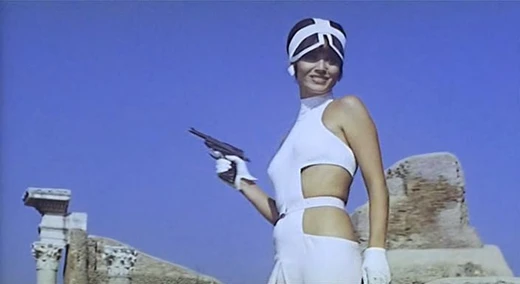
Massacre Mania
Italian 1967 sci-fi film blending superhero and thriller elements.

Massacre Mania (Italian: Hipnos follia di massacro) is an Italian 1967 science fiction film written and directed by Paolo Bianchini. It is the third and final film directed by Bianchini for producer Gabriele Crisanti, following The Devil's Man and Superargo and the Faceless Giants. The film is often labelled as a spy flick but is closer to the superhero films of the era, representing a darker, very Italian version.
Quick Facts
- Director
- Paolo Bianchini
- Producer
- Gabriele Crisanti
- Writer
- <!-- or
- Starring
- Robert Woods / Rada Rassimov / Giovanni Cianfriglia / Fernando Sancho
- Released
- 1967 · Italy
Facts from the source article.
Lore & Background
Massacre Mania was shot in eight weeks in and around Rome between February and March 1967. Among the cast was Robert Woods, who described the script as improvised, stating that 'these were nearly always collaborative efforts (where almost everyone involved had input).' Woods spoke positively about working on the film, specifically on how it was a departure from the Westerns and that he 'loved the comic book implications' of Massacre Mania. The film was submitted to the Italian board of censors in October 1967, one month after Superargo and the Faceless Giants, but was eventually released earlier than that film. Producer Gabriele Crisanti described the film's release as 'a flop', acknowledging that he 'made the mistake of giving it to a distributor-Vecchioni, the owner of United International Films-who went bankrupt before the film was released.'
Reader's Guide
Massacre Mania is significant as an example of Italian genre cinema of the 1960s that drew on comic book conventions. In his book about Italian films inspired by comic books, Roberto Curti described the film as 'often labelled as a spy flick, Massacre Mania is actually a lot closer to the superhero films of the era, of which it represents a darker version, and very Italian too.' Curti felt the film was a 'strange mixture of science fiction, thriller and comic-book style adventure.' Director Paolo Bianchini did not have a high opinion of the film, stating that he had been 'invited to conventions and film schools concerning [Massacre Mania]. But every time I watch it again, it's such a terrible thing. Perhaps people notice that there's a certain high craft about these pics, as they were literally made out of nothing.' The film's legacy is that of a cult curiosity, noted for its improvised script and troubled distribution.
Did You Know?
- The Italian title for the film is Hipnos follia di massacro and is sometimes misspelled as Hypnos in reference books.
- Robert Woods described the script as improvised, saying 'these were nearly always collaborative efforts (where almost everyone involved had input).'
- Producer Gabriele Crisanti stated the film's release was 'a flop' because the distributor went bankrupt before release.
- Director Paolo Bianchini called the film 'a terrible thing' but acknowledged 'a certain high craft' in it.
Production & the Collaborative Shoot
Massacre Mania was filmed over a compressed eight-week period in and around Rome during February and March 1967. It marked the third and final collaboration between director Paolo Bianchini and producer Gabriele Crisanti, following The Devil's Man and Superargo and the Faceless Giants. What distinguished the production was its notably improvisational and collective creative process. Actor Robert Woods, cast as Henry Spengler, recalled that the script was largely improvised on set, describing these productions as "nearly always collaborative efforts" in which almost everyone on the crew contributed ideas. Woods spoke warmly of the experience, emphasizing how the project offered a refreshing departure from the Westerns that typically defined his career. He singled out the "comic book implications" of the film as a particular joy, suggesting the visual and narrative language drew heavily from that medium. The ensemble cast also included Rada Rassimov as Nicole Bouvier, Ken Wood as Inspector Griffith, Fernando Sancho as Professor Kenitz, Lino Coletta as Maurice, Piero Gerlini as The Policeman, and Nino Vingelli.
Genre Identity & Comic-Book DNA
Although Massacre Mania is frequently slotted into the spy-thriller category, film scholar Roberto Curti offered a more precise reading of its genre identity. In his study of Italian cinema inspired by comic books and their conventions, Curti argued the film is "actually a lot closer to the superhero films of the era," functioning as what he termed a darker, distinctly Italian take on that tradition. He characterized the finished product as a "strange mixture of science fiction, thriller and comic-book style adventure," a description that captures the film's deliberately hybrid texture. Released in 1967, it sits alongside other Italian science fiction entries of the decade, yet its pulpy, panel-driven sensibility set it apart from more conventional genre fare. The Italian title, Hipnos follia di massacro, has been persistently misspelled as Hypnos in reference books, a small but recurring confusion that has shadowed the film's modest critical footprint. This blend of speculative storytelling with adventure-comic conventions gave the film a singular place in the late-1960s Italian genre landscape.
The Distributor Collapse & Commercial Failure
The road to theatrical release for Massacre Mania was derailed by circumstances beyond the creative team's control. The film was submitted to the Italian board of censors in October 1967, one month after its sibling production Superargo and the Faceless Giants, yet it paradoxically reached audiences earlier than that title. Producer Gabriele Crisanti did not mince words when describing the outcome, calling the release "a flop" and pinpointing the cause with blunt candor: he "made the mistake of giving it to a distributor" — Vecchioni, the owner of United International Films — who went bankrupt before the picture ever reached screens. This collapse in the distribution chain meant the film's commercial failure was less a verdict from audiences than a logistical misfortune. The production itself had been completed on schedule within its tight eight-week window in early 1967, and the cast and crew had delivered their work as planned. The bankruptcy of United International Films effectively severed the film from the public, relegating it to a curiosity rather than a box-office event and contributing to its relative obscurity in the decades that followed.
Bianchini's Self-Criticism & a Brief Directorial Run
Paolo Bianchini, who both wrote and directed the film, held a decidedly unflattering view of the finished product. He recalled being "invited to conventions and film schools concerning" Massacre Mania, indicating the film attracted some academic or retrospective interest despite its box-office failure. Yet his personal verdict was stark: "every time I watch it again, it's such a terrible thing." What made his self-assessment particularly revealing was the context he supplied — he acknowledged that "people notice that there's a certain high craft about these pics, as they were literally made out of nothing." That admission underscores the resource-constrained conditions of the eight-week Roman shoot that nonetheless produced a completed feature. Bianchini's name is attached to only three films for Crisanti — The Devil's Man, Superargo and the Faceless Giants, and Massacre Mania — making this final collaboration the endpoint of a brief but distinctive directorial partnership. The film thus endures as both a creative artifact of a specific production era and a personal source of disappointment for the man who made it.
Frequently Asked Questions
What is Massacre Mania?
Massacre Mania is a 1967 Italian film that weaves comic-book superhero storytelling into a thriller framework. It was written and directed by Paolo Bianchini under producer Gabriele Crisanti, and carries the Italian title Hipnos follia di massacro.
Who directed Massacre Mania?
Paolo Bianchini both wrote and helmed the picture. It served as the final project in a three-film collaboration with producer Gabriele Crisanti, following The Devil's Man and Superargo and the Faceless Giants.
Is Massacre Mania a spy movie or a superhero film?
While it is frequently catalogued as a spy thriller, its structure and tone align much more closely with the Italian superhero genre of the late 1960s. It essentially delivers a grittier, more distinctly Italian take on the comic-book adventure formula.
What genre does Massacre Mania fall under?
The film sits at the intersection of science fiction, thriller, and comic-book-style adventure. Its blend of superhero and thriller elements creates a darker, more atmospheric tone than typical genre fare of the period.
Where does Massacre Mania fit in Bianchini's filmography for Crisanti?
It is the third and final entry in a sequence of three films that Bianchini made for producer Gabriele Crisanti. The two earlier titles in that run were The Devil's Man and Superargo and the Faceless Giants.
More in Italian science fiction films 1-23
Spotted an error? Know more?
Reader corrections go straight into our review queue. Suggest an edit · How this site is sourced