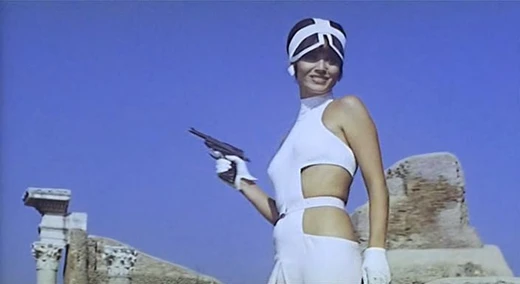
The Day the Sky Exploded
First Italian sci-fi film; stock footage and Bava's effects.

In 1958, the science fiction film *The Day the Sky Exploded* (originally titled *La morte viene dallo spazio*, or “Death Comes From Space,” and released in the UK as *Death Comes From Outer Space*) was released. It holds the distinction of being the first Italian science fiction film, appearing before the works of Antonio Margheriti. The production was a joint effort between Italy and France, involving Royal Film, Lux Film, and Lux Compagnie Cinématographique. The story begins at Cape Shark in the Australian desert, where the United Nations launches a crewed atomic rocket toward the Moon. One engine malfunctions, forcing American pilot John MacLaren to eject in an escape capsule and return to Earth. The atomic booster continues on its own, eventually exploding within the Delta asteroid cluster. MacLaren insists on staying at Cape Shark to assist, but his homesick wife Mary takes their son and leaves for the United States without him. Meanwhile, engineer Peter (or Pietro) is a boastful ladies' man who attempts to win over his co-worker Katy, though the film does not feature a specific bet about thawing her frigid demeanor with a kiss within six days. Katy initially rejects his advances but later allows him to kiss her while they work through the night calculating the explosion’s results. When she realizes his affection was motivated by a bet, she is heartbroken—though he has developed genuine feelings for her. The rocket explosion dislodges the asteroids from their orbits, merging them into a giant cluster heading for Earth. Scientists discover the cluster will pass the Moon, causing tidal effects that flood coastal regions. As it approaches, worldwide disasters unfold: tidal waves, wind, firestorms, and earthquakes. Mass evacuations lead to panic and riots. Under pressure, Katy cracks, and Peter takes over her shift, revealing his sensitive side. At the last moment, MacLaren proposes arming every missile on Earth with a nuclear warhead and firing them all at the cluster. The climate change caused by the cluster forces Cape Shark’s air conditioning to run at maximum to keep the base’s calculator cool enough to determine firing data. MacLaren is reunited with his family; Mary explains they waited until the last minute to board their plane, hoping he would join them, and returned to Cape Shark after hearing the asteroid announcement. Scientist Dr.
Quick Facts
- Director
- Paolo Heusch / Mario Bava
- Producer
- Guido Giambartolomei
- Screenplay
- Marcello Coscia / Alessandro Continenza
- Story
- Virgilio Sabel
- Starring
- Paul Hubschmid / Madeleine Fischer / Fiorella Mari / Ivo Garrani
- Narrator
- <!-- or
- Music
- Carlo Rustichelli
- Cinematography
- Mario Bava
- Editing
- Otello Colangeli
- Studio
- Royal Film / Lux Film / Lux Compagnie Cinématographique de France
- Released
- 4 September 1958 · Italy · 1959 · 7 · 15 · France
- Runtime
- 82 minutes
Facts from the source article.
Lore & Background
The Day the Sky Exploded was developed in early 1958, though it is unknown whose idea it was to create a science fiction film. The credited director is Paolo Heusch, who had made his directorial debut with L'uomo facile earlier that same year. According to cast member Ivo Garrani, the film was 'completely directed by Bava.
Reader's Guide
The Day the Sky Exploded holds a significant place in film history as the first Italian science fiction film, preceding the works of Antonio Margheriti. Its production is notable for the extensive involvement of Mario Bava, who effectively directed much of the film according to cast and crew accounts, though Paolo Heusch is the credited director. Bava's innovative use of stock footage—nearly 60% of the film—and his homemade special effects, such as glass shots using magazine clips and multiple exposures with a Mitchell camera, demonstrate early resourcefulness in low-budget sci-fi. The film's score by Carlo Rustichelli, created with unconventional objects like a fire extinguisher and blender, reflects the crude, experimental nature of the genre at the time. Commercially, it grossed less than 150 million Italian lire domestically and received mixed reviews, with the Monthly Film Bulletin calling it 'the stock-shot film par excellence' and TV Guide rating it one out of four. Despite its modest reception, the film is recognized for its pioneering role in Italian science fiction and as a showcase for Bava's emerging talents.
Did You Know?
- The film is known as the first Italian science fiction film, predating the sci-fi films of Antonio Margheriti.
- Nearly 60% of the film consists of stock footage documenting dozens of unrelated events, according to Bava biographer Tim Lucas.
- Composer Carlo Rustichelli used a fire extinguisher, a blender, and a vacuum cleaner to create special sound effects for the score.
A Pioneering Place in Italian Cinema
The Day the Sky Exploded holds a singular distinction in European film history: it is recognized as the very first science fiction movie produced in Italy, arriving before the genre work of directors like Antonio Margheriti. Released in 1958 under the Italian title La morte viene dallo spazio and the English-language title Death Comes From Outer Space, the picture was an international co-production involving Italy and France, backed by Royal Film, Lux Film, and Lux Compagnie Cinématographique. Its creation came at a moment when Italian audiences were hungry for speculative storytelling. American titles such as Invaders From Mars had only reached Italian screens in 1957 and earned strong box-office returns, while earlier domestic efforts like Mario Mattoli's comedy 1,000 chilometri al minuto featured scientists but treated space research as a mere backdrop rather than a driving force. Development on the project kicked off in early 1958, though the exact origin of the idea to make a full science fiction feature remains unclear. The film thus opened a door that Italian cinema would walk through for decades to come.
A Story of Doom and Desperate Ingenuity
The narrative unfolds at Cape Shark, a remote station in the Australian desert, where the United Nations launches a crewed atomic rocket toward the Moon. When one engine fails, American pilot John MacLaren ejects in an escape capsule while the booster keeps flying and detonates inside the Delta asteroid cluster. The blast shatters the asteroids' stable orbits, fusing them into a single massive body on a collision course with Earth. Scientists warn the cluster will swing past the Moon, triggering tidal surges that will drown coastal cities. As the object nears, the planet convulses with tidal waves, firestorms, earthquakes, and riots. A lighter subplot follows boastful engineer Peter Leduq, who wagers he can win over the icy Katie Dandridge with a kiss within six days, unaware she overhears the bet. By the eleventh hour, MacLaren devises a last-ditch plan: load every missile on Earth with a nuclear warhead and fire them all at the cluster. A religiously motivated scientist, Dr. Randowsky, sabotages the base's air conditioning to stop the calculator from computing firing data, leading to a violent confrontation in which MacLaren's friend Herbert Weisser is fatally shot. The missiles are launched, obliterating the cluster and saving the world.
Bava's Invisible Directorship and Effects Wizardry
Though Paolo Heusch receives the directorial credit, the true creative force behind the camera was Mario Bava, who served as cameraman, special effects designer, and the person who manipulated newsreel footage to construct the film's narrative. Cast member Ivo Garrani later recalled that the picture was completely directed by Bava, and production assistant Armando Govoni confirmed that Bava had already helmed a project for Heusch before this one. Bava's effects work was remarkably resourceful. Biographer Tim Lucas noted that nearly sixty percent of the finished film consists of stock footage documenting dozens of unrelated events. For glass shots, Bava borrowed magazine clips: a Minaret from National Geographic stood in for Moscow, and a Mt. Hula telescope from Popular Science filled another frame. To create the image of a vast haloed sphere looming over a city, he projected slides of world landmarks onto an opaque silk screen lit by a brute light, then layered multiple exposures shot on his father's Mitchell camera with footage of backyard and homemade rocket models. Lucas described the resulting object as looking like a large sponge with chunks torn out.
Cast and a Score Built from Household Objects
The ensemble cast includes Swiss actor Paul Hubschmid, who portrays the lead John MacLaren and who had earlier appeared in The Beast from 20,000 Fathoms under the screen name Paul Christian. Other performers include Fiorella Mari as Mary MacLaren, Ivo Garrani as Herbert Weisser, Madeleine Fischer as Katie Dandridge, Dario Michaëlis as Peter Leduq, Sam Galter as Dr. Randowsky, and Jean-Jacques Delbo as Sergei Boetnikov. Giacomo Rossi-Stuart also appears, marking his first of several collaborations with Bava. The musical score was composed by Carlo Rustichelli, who reported directly to Bava during its development. Rustichelli combined acoustic instruments, electronic sounds, and non-musical devices to build the soundtrack. He described entering the recording studio with a fire extinguisher, a blender, and a vacuum cleaner to generate the special sound effects.
Frequently Asked Questions
What is The Day the Sky Exploded?
It is a 1958 Italian-French co-produced science fiction feature, originally released under the title La morte viene dallo spazio and later exported to English-speaking markets as Death Comes From Outer Space. The film was a joint venture among Royal Film, Lux Film, and Lux Compagnie Cinématographique.
Who directed The Day the Sky Exploded?
Paolo Heusch carries the official director credit, but fans and film historians widely recognize Mario Bava's uncredited contributions to the camerawork and special-effects design, with some accounts even crediting him as a co-director.
Where and when does The Day the Sky Exploded take place?
The narrative opens at Cape Shark in the Australian outback, where a United Nations crewed atomic rocket is launched on a mission toward the Moon. The remainder of the story follows the crew's journey and the dangers they face beyond Earth.
Why is The Day the Sky Exploded important to Italian cinema?
It is recognized as Italy's first science fiction feature, arriving before the genre became more established through directors like Antonio Margheriti. Its lean production, built around stock footage and Bava's hand-built effects, set an early blueprint for Italian sci-fi filmmaking.
How did The Day the Sky Exploded perform at the box office?
The film grossed under 150 million Italian lire domestically, a modest figure that reflected how niche the sci-fi audience still was in 1950s Italy. Despite the limited commercial return, it has since become a cult touchstone for genre enthusiasts.
More in Italian science fiction films 1-23
Spotted an error? Know more?
Reader corrections go straight into our review queue. Suggest an edit · How this site is sourced