
Hydrogen iodide
A strong acid and key source of iodine.

Jynto ( talk ) · CC0
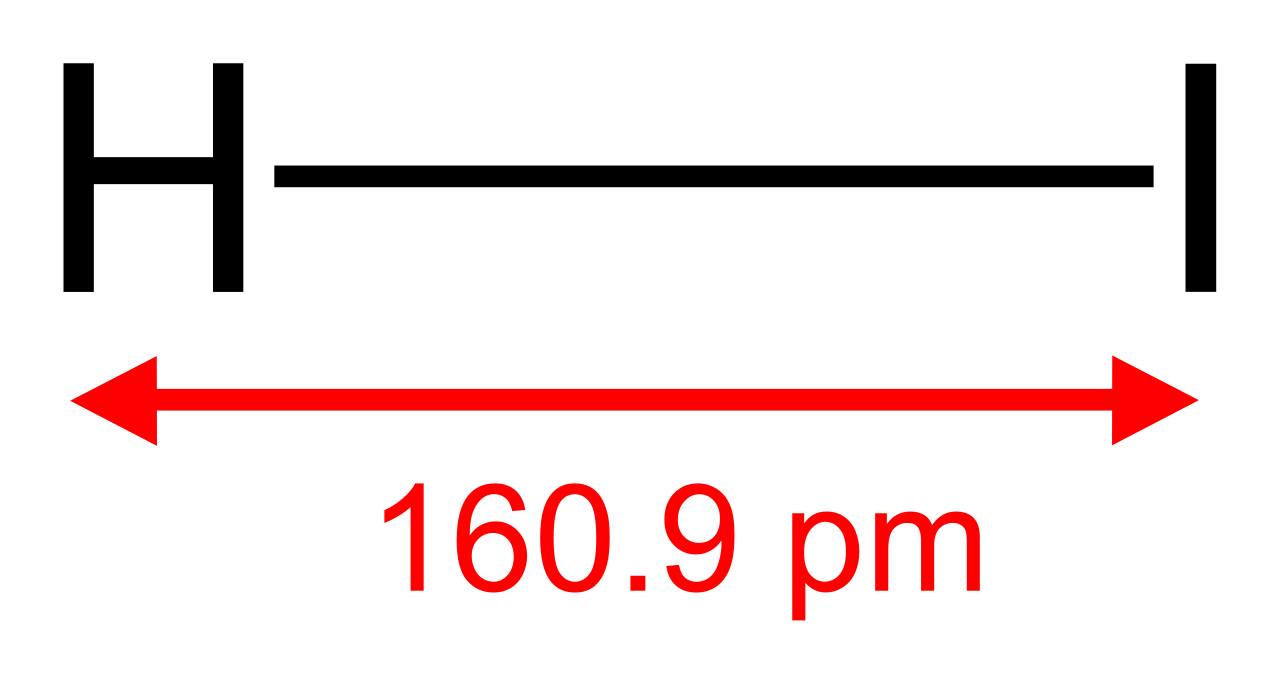
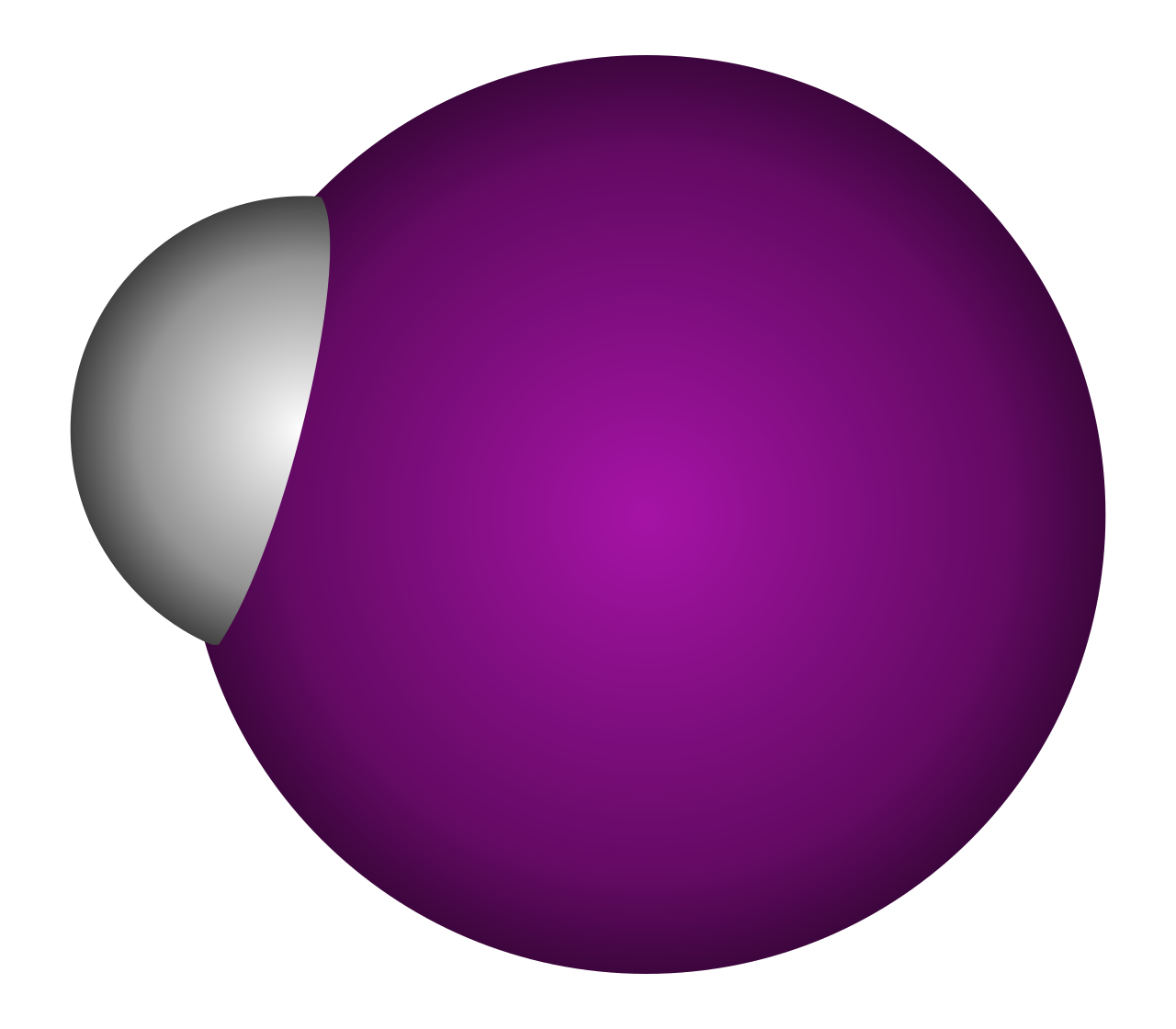
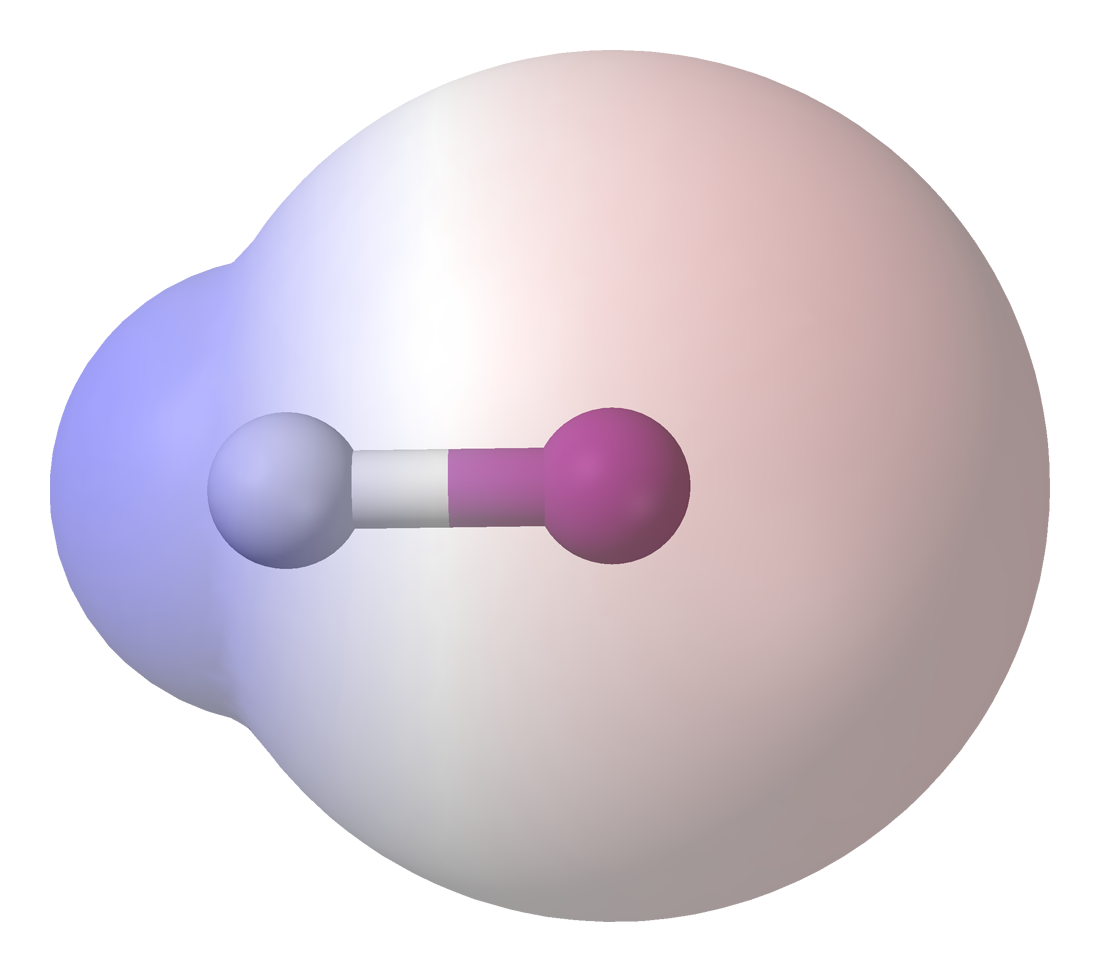
Hydrogen iodide, or HI, is a diatomic molecule that belongs to the hydrogen halide family. When dissolved in water, it forms hydroiodic acid (also called hydriodic acid), which is a strong acid. It is important to distinguish between the two: under standard conditions, hydrogen iodide is a gas, while hydroiodic acid is simply the gas dissolved in water. The two forms can be converted back and forth. In both organic and inorganic synthesis, HI serves as a major source of iodine and as a reducing agent.
As a colorless gas, hydrogen iodide reacts with oxygen to produce water and iodine. In moist air, it forms a mist of hydroiodic acid. HI is exceptionally soluble in water—one liter of water can dissolve 425 liters of the gas, and the most concentrated solution at room temperature contains about 2.5 water molecules for every molecule of HI, corresponding to approximately 57% HI by mass.
Hydroiodic acid, the aqueous solution, is commercially available at concentrations of 48–57% HI by mass. At 57% HI and 43% water, the solution forms an azeotrope that boils at 127 °C. Its high acidity comes from the large size of the iodide ion, which spreads the negative charge over a wide volume. This weakens the interaction between the proton and the anion, making dissociation easier. As a result, HI is the strongest acid among the hydrohalides, with an acid dissociation constant (Ka) around 10¹⁰, compared to about 10⁹ for HBr and 10⁶ for HCl.
Industrially, HI is typically made by reacting iodine with hydrogen sulfide or by direct combination of hydrogen and iodine over a catalyst. For example, hydrogen sulfide reduces iodine to HI: H₂S + I₂ → 2 HI + S. Alternatively, H₂ and I₂ can be combined directly, often catalyzed by platinum, to produce high-purity samples. Anhydrous HI can be prepared by reacting iodine with tetrahydronaphthalene: C₁₀H₁₂ + 2 I₂ → C₁₀H₈ + 4 HI. Another method distills HI from a solution of sodium iodide or another alkali iodide treated with a non-oxidizing acid like phosphoric acid, which acts as a dehydrating agent. Concentrated sulfuric acid is not suitable for acidifying iodides because it oxidizes iodide to elemental iodine. Historically, HI was made by the reduction of iodine with hydrogen sulfide: H₂S + I₂ → 2 HI + S. Simply combining hydrogen and iodine gases also works: H₂ + I₂ → 2 HI.
- Chemical formula
- HI
- State at standard conditions
- colorless gas
- Solubility in water
- 425 liters of HI gas per liter of water
- Boiling point of azeotrope
- 127 °C (57% HI, 43% water)
- Acid dissociation constant (ka)
- approximately 10^10
- Commercial concentration
- 48–57% HI by mass
Lore & Background
Hydrogen iodide is a colorless gas that reacts with oxygen to give water and iodine. With moist air, HI gives a mist of hydroiodic acid. It is exceptionally soluble in water; one liter of water will dissolve 425 liters of HI gas, the most concentrated solution at room temperature having about 2.5 water molecules per molecule of HI, corresponding to approximately 57% HI by mass. The high acidity of hydroiodic acid is caused by the dispersal of the ionic charge over the large iodide anion, resulting in the weakest H+···I− interaction among the hydrohalides, facilitating dissociation.
Industrial preparation of HI typically involves the reaction of iodine with hydrogen sulfide or the direct combination of hydrogen and iodine over a catalyst. Anhydrous HI can be prepared by reaction of iodine with tetrahydronaphthalene. HI can also be distilled from a solution of NaI or other alkali iodide treated with a non-oxidizing acid like phosphoric acid. Historically, HI was made by reducing iodine with hydrogen sulfide.
Reader's Guide
Hydrogen iodide is significant as the strongest of the hydrohalic acids, with a Ka of approximately 10^10, due to the large iodide ion dispersing charge and weakening the H+···I− interaction. Its role as a primary source of iodine and a reducing agent makes it valuable in both organic and inorganic synthesis. In organic chemistry, HI is used for converting alcohols to alkyl iodides, cleaving ethers, and reducing certain functional groups. Historically, it was employed in early reduction experiments, such as the attempted reduction of benzene to cyclohexane, which instead yielded methylcyclopentane. Commercial processes for obtaining iodine focus on iodide-rich brines, converting iodide to hydroiodic acid then oxidizing to iodine. The compound's ability to form a constant-boiling azeotrope at 127 °C with 57% HI is important for purification. Its reactivity with oxygen and tendency to form brown HI3 in aged solutions are practical considerations. The synthesis methods range from industrial reactions with hydrazine to laboratory preparations via hydrolysis of phosphorus triiodide, reflecting its versatility.
Did You Know?
- One liter of water dissolves 425 liters of HI gas, forming the most concentrated solution with only four water molecules per HI molecule.
- HI is the strongest hydrohalic acid, with a Ka of about 10^10, due to the large iodide ion dispersing charge.
- The reaction of H2 and I2 to form HI was long thought to be bimolecular, but irradiation at 578 nm supports a mechanism involving iodine atoms.
- Aged solutions of HI often appear dark brown due to the formation of HI3.
Chemical Identity and Acidic Dominance
Hydrogen iodide is a colorless diatomic gas at standard conditions, but its encounter with water produces one of the most formidable acids in the hydrohalide family. The gaseous molecule and its aqueous solution—hydroiodic acid—are distinct physical states of the same chemical entity, yet they behave very differently. HI dissolves in water with remarkable ease: one liter of water can absorb roughly 425 liters of the gas, yielding a solution so concentrated that only about four water molecules accompany each HI unit. The reason hydroiodic acid outperforms its lighter siblings as an acid is geometric. The iodide ion is substantially larger than chloride or bromide, so its negative charge is smeared across a much greater volume. This dilution of charge weakens the electrostatic attraction between the proton and the anion, making proton release far easier. The acid dissociation constant reflects this, sitting near 10 to the tenth power—two orders above hydrobromic acid and four above hydrochloric. In commerce, the acid appears at 48 to 57 percent by mass and forms a well-defined azeotrope boiling at 127 degrees Celsius.
Synthetic Routes and the Photodissociation Puzzle
Producing hydrogen iodide in the laboratory or on an industrial scale has never been a single-path affair. The most common industrial route couples iodine with hydrazine, a reaction that simultaneously liberates harmless nitrogen gas and, when run in water, allows the HI to be purified by simple distillation. For anhydrous material, chemists react iodine with tetrahydronaphthalene, stripping four hydrogens and releasing the naphthalene ring as a byproduct. An older, historically important method oxidizes hydrogen sulfide with aqueous iodine, depositing elemental sulfur while generating HI in solution. Perhaps the most elegant route is the direct combination of hydrogen and iodine gases, often catalyzed by platinum to yield high-purity product. For decades this was assumed to be a straightforward bimolecular collision. Then researchers discovered that irradiating the mixture at 578 nanometers—the dissociation energy of the iodine bond—dramatically accelerates the reaction. The light first splits I2 into two free iodine atoms, which then sandwich the hydrogen molecule and cleave its H–H bond, revealing a stepwise mechanism far richer than a simple one-step collision.
Reactivity in Organic Synthesis
In the organic chemist's toolkit, hydrogen iodide occupies a versatile niche. It adds across carbon–carbon double bonds following the same Markovnikov and anti-Markovnikov rules that govern its lighter halide cousins. More practically, HI converts primary alcohols into alkyl iodides through an SN2 displacement in which the iodide ion replaces the hydroxyl group as water departs. The reagent also cleaves ethers, a reaction that is regioselective because the iodide preferentially attacks the less sterically crowded carbon; aryl–alkyl ethers, for instance, split into phenols and alkyl iodides. HI's role as a reducing agent dates to the nineteenth century, when chemists attempted to hydrogenate benzene into cyclohexane at high temperature. The effort backfired, yielding the rearranged product methylcyclopentane instead. Kiliani later showed that hydroiodic acid can strip multiple hydroxyl groups from sugars and polyols, though yields and reproducibility were often poor. More reliably, HI reduces benzyl alcohols and alpha-carbonyl alcohols to their parent hydrocarbons, and the process can be made catalytic by adding red phosphorus to re-reduce the iodine that forms as a byproduct.
Industrial Iodine Production and the Chemistry of Aging
Beyond the laboratory, hydrogen iodide plays a pivotal intermediary role in the commercial extraction of iodine. The process begins with iodide-rich brines, where the iodide is first converted into hydroiodic acid. That acid is then oxidized back to elemental iodine, which is recovered by evaporation or adsorption. The HI thus serves as a chemical shuttle, carrying iodine from a dissolved ionic form into a state where it can be cleanly separated. In the bottle, however, hydroiodic acid is not static. Exposure to atmospheric oxygen steadily oxidizes the HI, producing water and elemental iodine. The iodine in turn complexes with excess HI to form triiodide, HI3, a brown species that tints aged solutions dark. This slow self-oxidation is why freshly prepared solutions appear clear while stored ones gradually darken. The phenomenon also underscores a practical limitation: hydroiodic acid is a reagent that must be handled with awareness of its own reactivity toward the very air in which it sits.
Gallery

Frequently Asked Questions
What is Hydrogen iodide?
Hydrogen iodide (HI) is a diatomic gas consisting of one hydrogen atom bonded to one iodine atom, placing it squarely in the hydrogen halide family. At standard conditions it is a colorless gas that dissolves extraordinarily well in water—roughly 425 liters of gas per liter of liquid.
What's the difference between Hydrogen iodide and hydroiodic acid?
Hydrogen iodide is the free gas, whereas hydroiodic (hydriodic) acid is simply that same gas dissolved in water. The two forms interconvert readily, and the aqueous solution is a very strong acid with a Ka near 10^10; commercially it is sold at about 48–57% by mass and forms an azeotrope boiling at 127 °C.
What role does Hydrogen iodide play in synthesis?
In both organic and inorganic chemistry, HI serves as a primary iodine source and a powerful reducing agent. That dual capability makes it a go-to reagent whenever a chemist needs to install iodine or strip electrons from another reactant.
How does Hydrogen iodide react with oxygen?
HI is notably sensitive to oxygen, decomposing to produce water and elemental iodine. The reaction is especially fast in moist air, so the gas must be handled and stored with care to avoid premature degradation.
Why is Hydrogen iodide important in the inorganic world?
Its extreme water solubility combined with very strong acidity make it one of the most versatile iodine-delivery and reduction tools available to synthetic chemists. Without HI, many iodination and deoxygenation transformations would be significantly harder to achieve.
More in Inorganic Compounds & Materials 1-20
Spotted an error? Know more?
Reader corrections go straight into our review queue. Suggest an edit · How this site is sourced