
Diphosphane
A colorless, spontaneously flammable phosphorus hydride.

Jynto ( talk ) · CC0
Diphosphane (also called diphosphine) is an inorganic compound with the formula P₂H₄. It is a colorless liquid and belongs to the group of binary phosphorus hydrides. Its presence as an impurity is what usually makes phosphine samples catch fire when exposed to air.
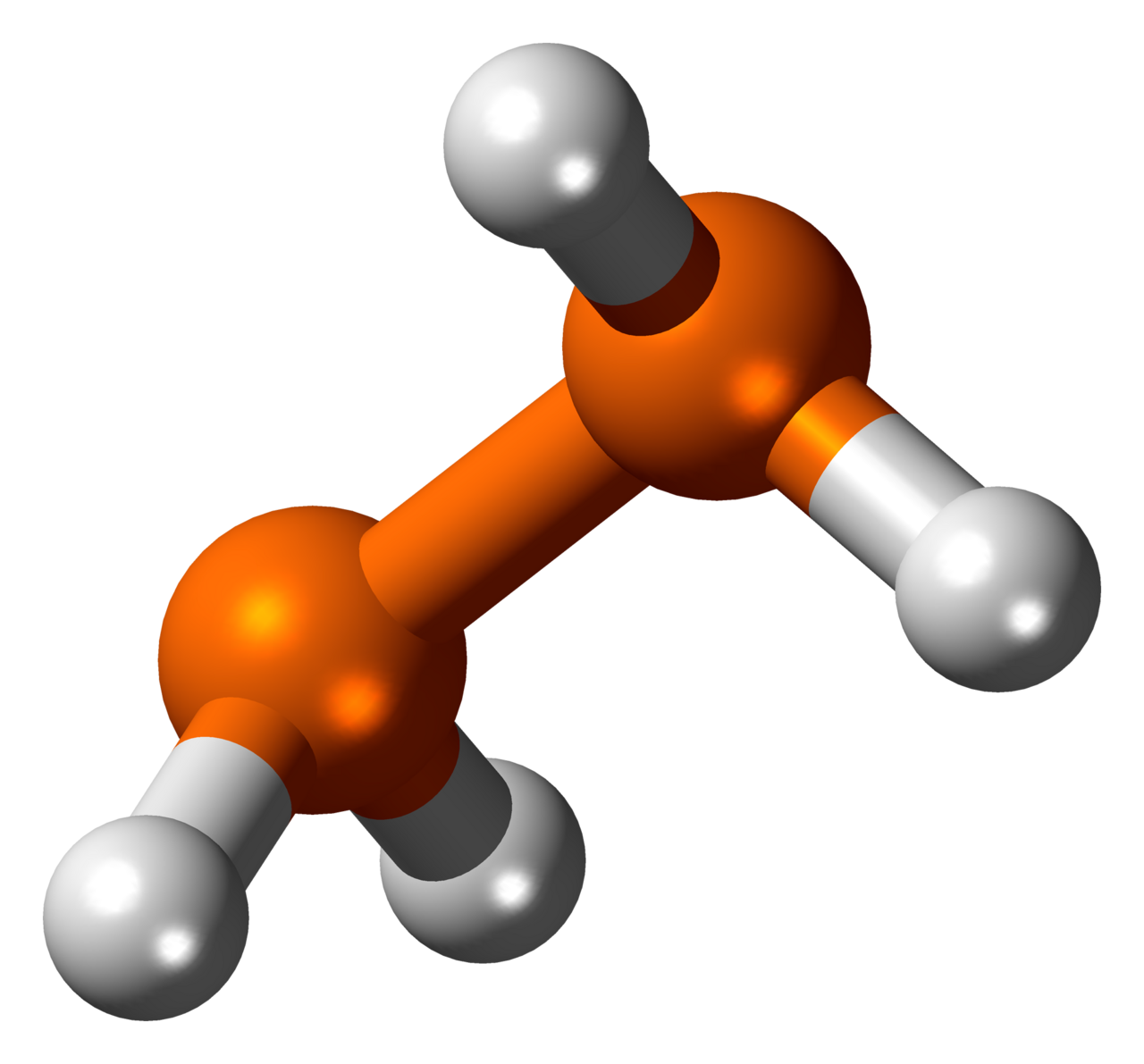
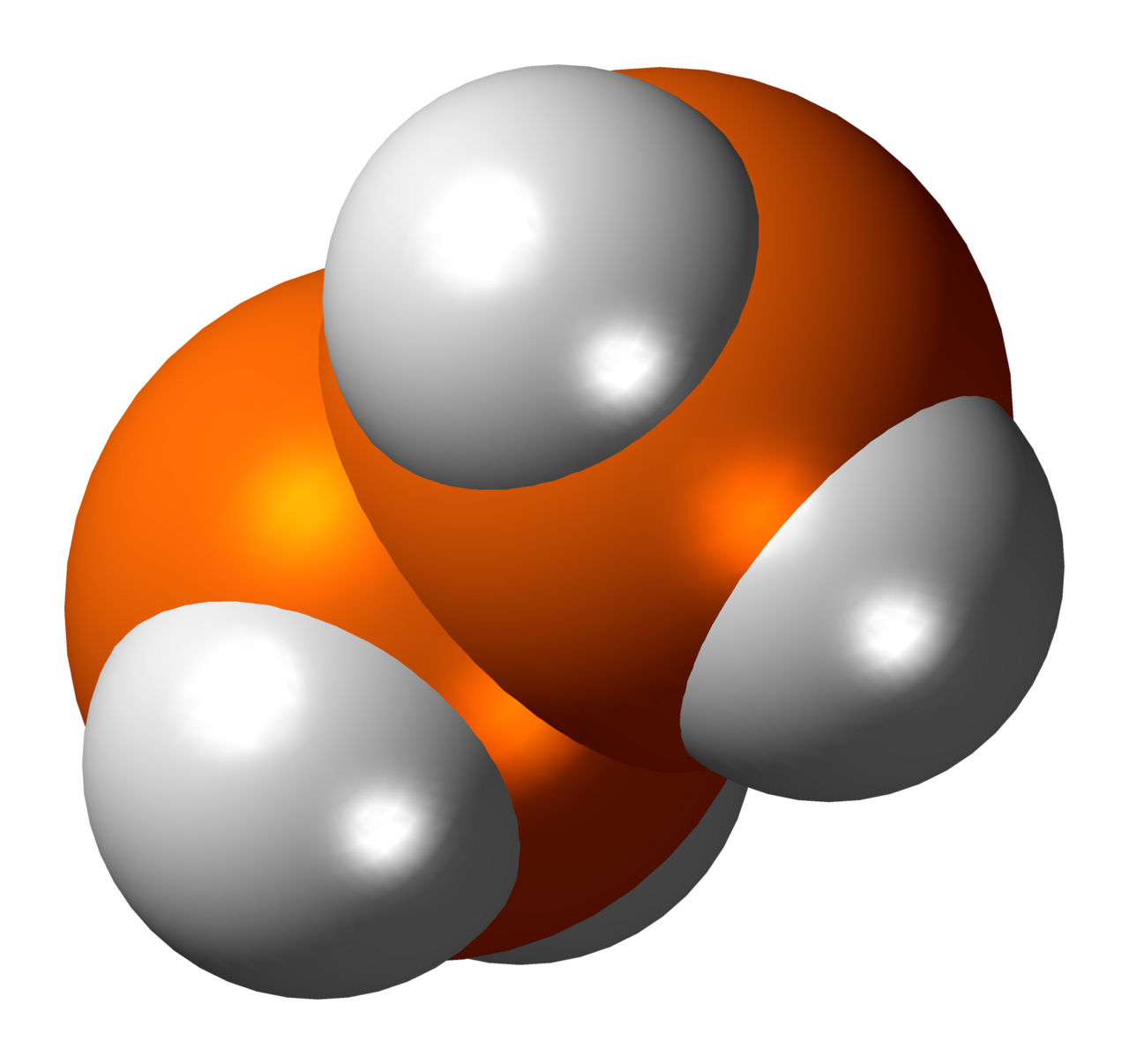
The molecule of diphosphane has a gauche conformation, similar to hydrazine but less symmetrical than the structure often depicted in images. The distance between the two phosphorus atoms is 2.219 angstroms. It is not basic, is unstable at room temperature, and ignites spontaneously in air. It dissolves poorly in water but readily in organic solvents. Its ¹H NMR spectrum shows 32 lines due to an A₂XX'A'₂ splitting pattern.
Diphosphane is made by hydrolyzing calcium monophosphide, which can be thought of as the Ca²⁺ salt of the P₄²⁻ ion. In an optimized procedure, 400 grams of CaP are hydrolyzed at –30 °C to yield about 20 grams of product, slightly contaminated with phosphine. When diphosphane reacts with butyllithium, it produces various condensed polyphosphine compounds.
Many organic derivatives of diphosphane exist, but asymmetric ones are only stable at very low temperatures; otherwise, the substituents easily redistribute among the phosphorus atoms, forming mixtures. However, there appears to be a significant barrier to chiral inversion. The central phosphorus–phosphorus bond is weak and readily adds substituents.
The simplest way to synthesize an organic diphosphane is to heat a phosphorus halide with a phosphane, for example: Ph₂PCl + HPPh₂ → Ph₂P–PPh₂ + HCl↑. Alkali metals can replace the hydrogen in that reaction (using a dialkylphosphide), and in some rare cases a dialkylamine can replace the halide. Symmetric diphosphanes are easily made by reductive coupling, such as tetraphenyldiphosphine from chlorodiphenylphosphine: 2 ClPPh₂ + 2 Na → Ph₂P–PPh₂ + 2 NaCl. Ultraviolet radiation decomposes mercury(II) dialkylphosphides into the metal and a dialkylphosphane. The methyl compound P₂Me₄ is prepared by reducing Me₂P(S)–P(S)Me₂, which itself is made by methylating thiophosphoryl chloride with methylmagnesium bromide.
- Chemical formula
- P2H4
- Appearance
- Colorless liquid
- Key property
- Spontaneously flammable in air
- P-p distance
- 2.219 angstroms
- Solubility
- Poorly soluble in water, soluble in organic solvents
- Stability
- Unstable at room temperature
Lore & Background
Diphosphane adopts the gauche conformation, similar to hydrazine but less symmetrical, with a phosphorus–phosphorus distance of 2.219 angstroms. It is nonbasic, unstable at room temperature, and spontaneously flammable in air. Its 1H NMR spectrum consists of 32 lines resulting from an A2XX'A'2 splitting system. The compound is only poorly soluble in water but dissolves in organic solvents.
Reader's Guide
Diphosphane is produced by the hydrolysis of calcium monophosphide, described as the Ca2+ derivative of P4−2. An optimized procedure using 400 g of CaP at −30 °C yields about 20 g of product, slightly contaminated with phosphine. Reaction of diphosphane with butyllithium affords a variety of condensed polyphosphine compounds. Organic derivatives of diphosphane exist, but asymmetric diphosphanes are only stable at cryogenic temperatures; otherwise, substituents readily redistribute on the phosphorus centers. The central bond is weak and easily adds substituents. Symmetric diphosphanes are easily prepared by reductive coupling, such as tetraphenyldiphosphine from chlorodiphenylphosphine.
Did You Know?
- Diphosphane is the impurity that typically causes samples of phosphine to ignite in air.
- It adopts a gauche conformation with a P–P distance of 2.219 angstroms.
- Hydrolysis of 400 g of calcium monophosphide at −30 °C gives about 20 g of diphosphane.
- The central P–P bond is weak and easily adds substituents.
Structure and Physical Character
Diphosphane exists as a colourless liquid and belongs to the family of binary phosphorus hydrides. Its molecular geometry is particularly noteworthy: rather than adopting a simple symmetric arrangement, the molecule settles into a gauche conformation—structurally analogous to hydrazine—where the two phosphorus atoms sit 2.219 angstroms apart. This lower symmetry has direct spectroscopic consequences. The proton NMR spectrum of the compound resolves into 32 distinct lines, arising from an A2XX'A'2 splitting pattern that reflects the inequivalent hydrogen environments around each phosphorus centre. In terms of bulk behaviour, diphosphane is nonbasic and shows only poor solubility in water, though it dissolves readily in organic solvents. Two practical hazards define its handling: the compound is unstable at ordinary temperatures and ignites spontaneously upon contact with air. In fact, trace amounts of diphosphane are the usual culprit behind the notorious tendency of phosphine samples to catch fire, making its presence a persistent contaminant problem in phosphine chemistry.
Inorganic Synthesis via Calcium Monophosphide
The parent diphosphane molecule is obtained through the hydrolysis of calcium monophosphide, a compound that can be conceptualised as the calcium(II) salt of the P4−2 anion. The procedure demands careful temperature control: in an optimised protocol, 400 grams of calcium monophosphide are hydrolysed at −30 °C, yielding roughly 20 grams of diphosphane. The modest yield and the cryogenic working conditions reflect the compound's inherent instability at room temperature. The product is not perfectly clean; a small amount of phosphine co-elutes with the desired diphosphane, a contamination that is difficult to eliminate entirely. Because diphosphane is the species responsible for the spontaneous ignition of phosphine samples in air, even this trace phosphine by-product is chemically significant, as it underscores the delicate boundary between the two hydrides. The inorganic route thus remains the primary laboratory access to the parent P2H4 molecule, though its low throughput and the need for sub-zero temperatures limit its practical utility compared with the more versatile organic diphosphane syntheses described elsewhere.
Routes to Organic Diphosphanes
A rich variety of organic diphosphane derivatives can be assembled through several complementary strategies. The most straightforward approach involves heating a phosphorus halide together with a phosphane; for instance, diphenylphosphoryl chloride reacts with diphenylphosphine to liberate tetraphenyldiphosphine and hydrogen chloride gas. In related variants, an alkali metal can displace the hydrogen on the phosphane (forming a dialkylphosphide), and in rarer cases a dialkylamine substitutes for the halide. Symmetric diphosphanes are also accessible by reductive coupling: two equivalents of chlorodiphenylphosphine react with sodium metal to furnish the P–P coupled product alongside sodium chloride. A photochemical pathway offers another entry, as ultraviolet irradiation cleaves mercury(II) dialkylphosphides into elemental mercury and the corresponding dialkylphosphane. Finally, the methyl analogue P2Me4 is prepared by reducing Me2P(S)–P(S)Me2, a precursor itself generated by methylating thiophosphoryl chloride with methylmagnesium bromide.
Reactivity, Stability, and the P–P Bond
The phosphorus–phosphorus single bond at the heart of diphosphane is intrinsically weak, making the central linkage a reactive site that readily accepts additional substituents. This lability has profound consequences for the stability of substituted derivatives. Asymmetric diphosphanes, in which the two phosphorus centres bear different organic groups, are stable only at cryogenic temperatures; at higher temperatures the substituents migrate between the two phosphorus atoms, eroding the intended regiochemistry and producing a statistical mixture of isomeric products. Paradoxically, while substituent redistribution is facile, chiral inversion at the phosphorus centres faces a substantial energy barrier, meaning that once a particular stereoisomer is formed it does not racemise easily. The parent P2H4 compound itself is nonbasic and decomposes at room temperature, and it ignites spontaneously in air. On the positive side, treatment of diphosphane with butyllithium opens a route to a family of condensed polyphosphine compounds, demonstrating that the weak P–P bond can be harnessed as a building block for more extended phosphorus frameworks.
Gallery
Frequently Asked Questions
What is Diphosphane?
Diphosphane, also called diphosphine, is a binary phosphorus hydride with the formula P₂H₄. It exists as a colorless liquid and sits in the family of inorganic phosphorus–hydrogen compounds.
Why is Diphosphane so dangerous to handle?
It ignites spontaneously the moment it meets air, and it is unstable even at room temperature. Those two traits together make any practical handling extremely hazardous.
What does Diphosphane's molecular structure look like?
The molecule adopts a gauche conformation that is loosely analogous to hydrazine, though it is less symmetrical than the structure often shown in textbook diagrams. The two phosphorus atoms are separated by 2.219 angstroms.
How does Diphosphane behave in different solvents?
It dissolves very poorly in water but mixes readily with organic solvents. For that reason, any experimental work involving it is carried out in organic media rather than aqueous ones.
What is Diphosphane's connection to phosphine?
It is most commonly encountered as a trace impurity inside phosphine samples. It is this impurity, not phosphine itself, that is usually responsible for the spontaneous ignition observed when a phosphine sample is exposed to air.
More in Inorganic Compounds & Materials 1-20
Spotted an error? Know more?
Reader corrections go straight into our review queue. Suggest an edit · How this site is sourced