
Ferrocyanide
An iron-cyanide complex used in pigments and anticaking agents.

Xhmikos · CC BY 3.0
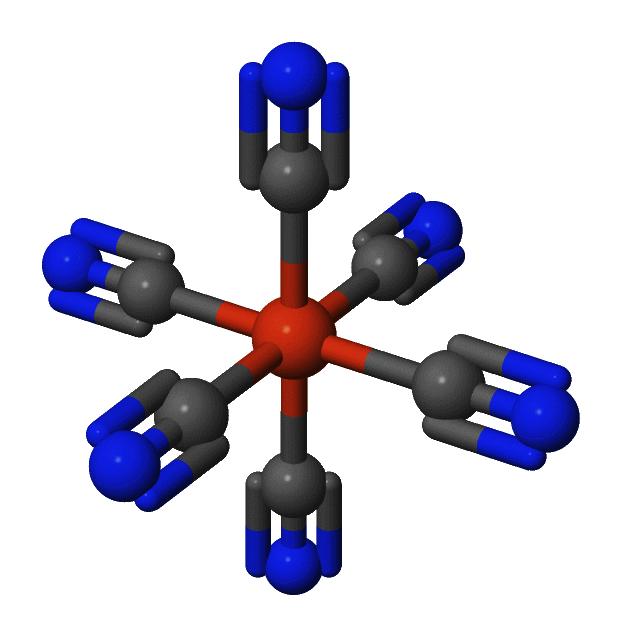
Ferrocyanide is the anion [Fe(CN)6]4−, a coordination complex whose salts typically yield yellow solutions. It is usually available as potassium ferrocyanide (K4Fe(CN)6). Ferrocyanide is of commercial interest as a precursor to the pigment Prussian blue and, as its potassium salt, an anticaking agent.
- Chemical formula
- [Fe(CN)6]4−
- Common salt
- potassium ferrocyanide (K4Fe(CN)6)
- Spin state
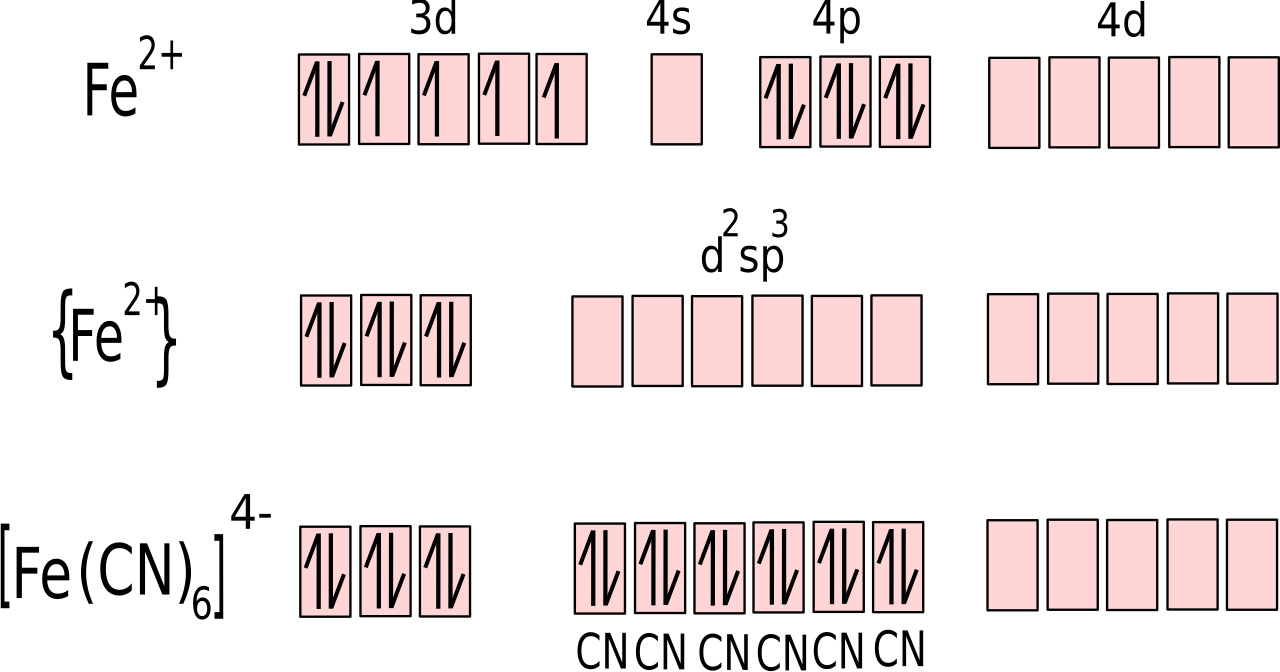
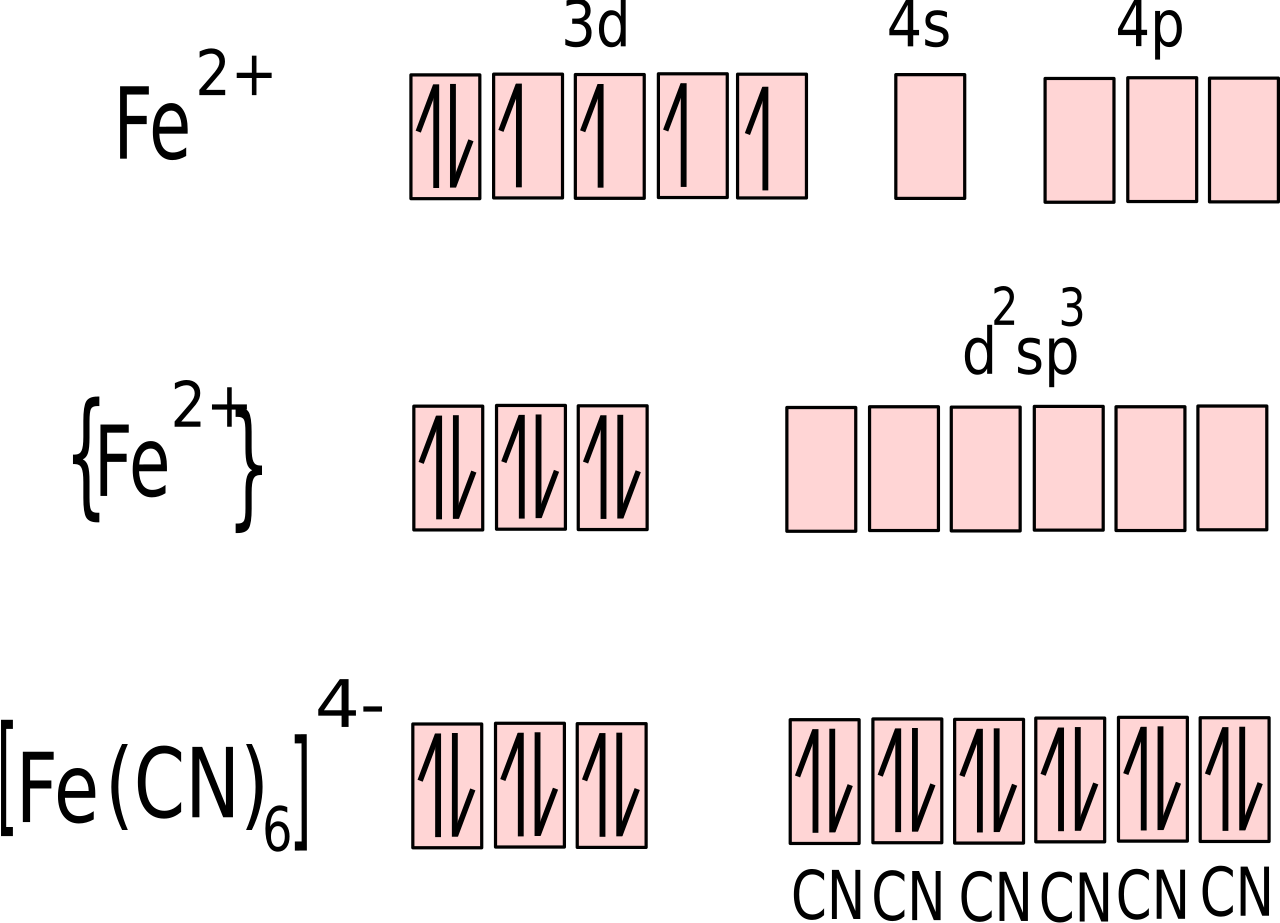
- low-spin iron(II) center
- Magnetic property
- diamagnetic
- Coordination geometry
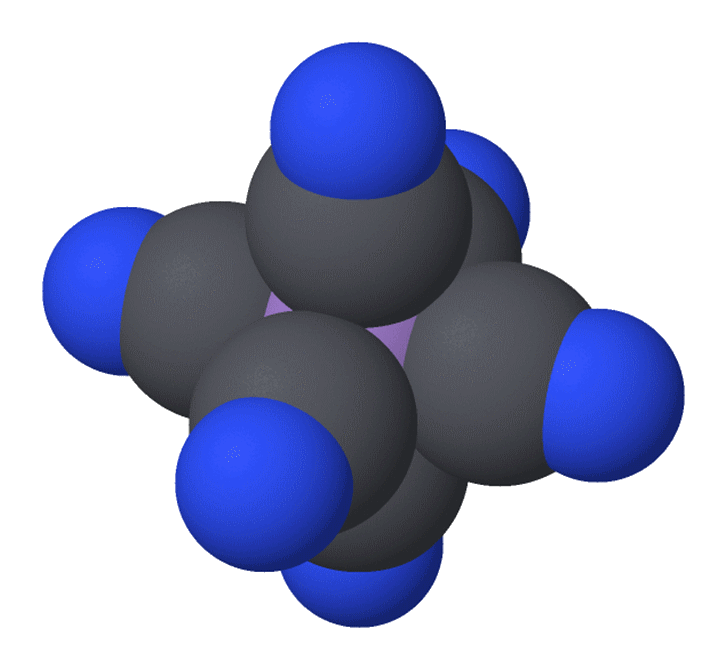
- octahedral
- Key application
- precursor to Prussian blue pigment
- Toxicity note
- less toxic than many cyanide salts because it tends not to release free cyanide
Lore & Background
Ferrocyanide is the anion [Fe(CN)6]4−, featuring a low-spin iron(II) center in an octahedral ligand environment. It is diamagnetic and its salts give yellow solutions. The compound is usually available as potassium ferrocyanide, K4Fe(CN)6. Although many cyanide salts are highly toxic, ferro- and ferricyanides are less toxic because they tend not to release free cyanide. Treatment of ferrocyanide with ferric-containing salts produces the intensely coloured pigment Prussian blue, sometimes called ferric ferrocyanide and ferrous ferricyanide. Ferrocyanide can be reversibly oxidized by one electron to give ferricyanide, a conversion that can be followed spectroscopically at 420 nm.
Reader's Guide
Ferrocyanide holds significance primarily as a precursor to Prussian blue pigments, which have been used since the early 18th century. Its potassium and sodium salts serve as anticaking agents in commercial products. In specialized applications, ferrocyanide is used as a precipitating agent in the production of citric acid and wine. In research, ferrocyanide and its oxidized form ferricyanide cannot freely pass through the plasma membrane, making ferrocyanide a useful probe of extracellular electron acceptors in cellular redox studies. Nickel ferrocyanide is employed as a catalyst in the electro-oxidation of urea, with aspirational applications in hydrogen production and wastewater treatment. Ferrocyanide is also studied as an electrolyte in flow batteries. The name 'cyanide' itself derives from the Greek word for '(dark) blue,' reflecting its discovery in ferrocyanide.
Did You Know?
- Ferrocyanide is the anion [Fe(CN)6]4− and is usually available as potassium ferrocyanide.
- Treatment of ferrocyanide with ferric-containing salts gives the pigment Prussian blue.
- The word 'cyanide' comes from the Greek κύανος (kyanos), meaning '(dark) blue,' because cyanides were discovered in ferrocyanide.
Discovery & Historical Manufacturing
In 1752, the French chemist Pierre Joseph Macquer made the first documented preparation of potassium ferrocyanide. His method involved taking Prussian blue—already a well-known pigment at the time—and reacting it with potassium hydroxide to liberate the potassium salt of the hexacyanoferrate(II) complex. This elegant transformation marked the compound's entry into the chemical literature. For much of the following century, industrial production relied on far less refined raw materials. Manufacturers combined nitrogen-rich organic waste—torrified horn, leather offcuts, animal offal, or dried blood—with iron filings and potassium carbonate to coax the compound into existence. Another commercial route drew on the spent oxide left over from city-gas purification, where hydrogen cyanide had been stripped from the gas stream. These methods persisted until the twentieth century, when the Castner process for alkali-metal cyanides rendered ferrocyanide's old role as a cyanide source largely obsolete.
Reactions & the Prussian Blue Legacy
Potassium ferrocyanide participates in several chemically significant transformations. Treatment with nitric acid yields an intermediate that, once neutralized with sodium carbonate, can be crystallized as the red compound sodium nitroprusside. Exposure to chlorine gas oxidizes the iron(II) center to iron(III), converting the ferrocyanide into ferricyanide while releasing potassium chloride. However, the reaction that has left the deepest cultural imprint is the one with ferric salts. When a solution of potassium ferrocyanide meets iron(III) chloride, an intensely blue, insoluble precipitate forms—Prussian blue, with the mixed-valence composition FeIII₄[FeII(CN)₆]₃. This pigment, accompanied by potassium chloride as a by-product, became the backbone of the blueprinting technique used in engineering and architecture. It also lent its distinctive hue to masterworks of art, including Hokusai's The Great Wave off Kanagawa and Van Gogh's The Starry Night, cementing a humble inorganic salt's place in visual history.
Industrial & Everyday Uses
Far from being a mere laboratory curiosity, potassium ferrocyanide threads through a remarkable range of practical applications. In the food and road-salt industries, it and its sodium analogue serve as anticaking agents, keeping granules from clumping together. The European Union, as of 2017, authorized potassium ferrocyanides under additive codes E 535 through E 538 for use in just two food categories as salt additives. The compound also appears in animal feed and can function as a plant fertilizer. In metallurgy, ferrocyanides help purify tin and assist in separating copper from molybdenum-bearing ores. They feature in the manufacture of wine and citric acid. In the laboratory, a ferrocyanide–ferricyanide–phosphate buffer supports beta-galactosidase assays that produce a vivid blue signal when X-Gal is cleaved, and the reagent doubles as a qualitative test for iron(III), yielding the familiar Prussian blue color. Perhaps most dramatically, potassium ferrocyanide is a key ingredient in Augendre's powder, a high-energy blasting mixture comprising 28 parts ferrocyanide, 23 parts cane sugar, and 49 parts potassium chlorate, blended in absolute alcohol to prevent premature detonation. It also anchors the traditional 19th-century Cyanotype photographic process.
Crystal Structure & Safety Profile
Potassium ferrocyanide crystallizes as lemon-yellow monoclinic prisms, typically carrying three molecules of water of crystallization in the formula K₄[Fe(CN)₆]·3H₂O. Despite its deceptively simple formula, the solid-state architecture is anything but straightforward. Both the hydrated and anhydrous forms adopt a complicated polymeric lattice in which octahedral [Fe(CN)₆]⁴⁻ centers are crosslinked by potassium ions that coordinate directly to the cyanide nitrogen atoms. These K⁺···NC linkages are what hold the crystal together, and they rupture cleanly when the salt dissolves in water, releasing discrete complex ions into solution. On the safety front, the compound presents a notably mild toxicological profile. In rat studies the oral lethal dose (LD50) falls in the range of 1.6 to 3.2 grams per kilogram of body weight, which is relatively high compared with many inorganic salts. The kidneys emerge as the principal target organ for any ferrocyanide-related toxicity. Modern industrial synthesis—running hydrogen cyanide, iron(II) chloride, and calcium hydroxide together to form a calcium ferrocyanide intermediate, then swapping in potassium salts stepwise—produces the material at scale without the organic-waste routes of earlier centuries.
Gallery


Frequently Asked Questions
What is ferrocyanide?
Ferrocyanide is the hexacyanoferrate(II) anion, [Fe(CN)6]4−, in which a low-spin iron(II) ion sits at the center of an octahedral cage of six cyanide ligands. In the lab and industry you will most often meet it as the potassium salt K4Fe(CN)6, which dissolves to give the familiar yellow solutions.
What does ferrocyanide actually do in the real world?
Its two headline jobs are serving as the direct chemical precursor for producing Prussian blue pigment and acting as an anticaking agent when formulated as potassium ferrocyanide in food and feed processing.
Is ferrocyanide magnetic?
No. Because the iron(II) center is locked into a low-spin d⁶ configuration with all six electrons paired, the complex carries no unpaired electrons and is therefore diamagnetic.
What is the coordination geometry of ferrocyanide?
The six cyanide ligands arrange themselves in a regular octahedron around the central iron atom, giving the anion a highly symmetric six-coordinate structure.
How does ferrocyanide connect to Prussian blue?
Prussian blue is a mixed-valence iron-cyanide lattice in which ferrocyanide units are cross-linked through Fe(III) centers, making the [Fe(CN)6]4− anion the essential structural building block of that iconic deep-blue pigment.
More in Inorganic Compounds & Materials 1-20
Spotted an error? Know more?
Reader corrections go straight into our review queue. Suggest an edit · How this site is sourced