
Diborane
A fundamental boron compound with unique bonding.

Ed ( Edgar181 ) · Public domain
Diborane (systematically diborane(6)) is an inorganic compound with the formula B₂H₆. It is a colorless, pyrophoric gas that is highly toxic and has a sickly sweet smell. Despite its simple formula, it is a key boron compound, notable for its unusual electronic structure. Several derivatives of diborane serve as useful reagents.
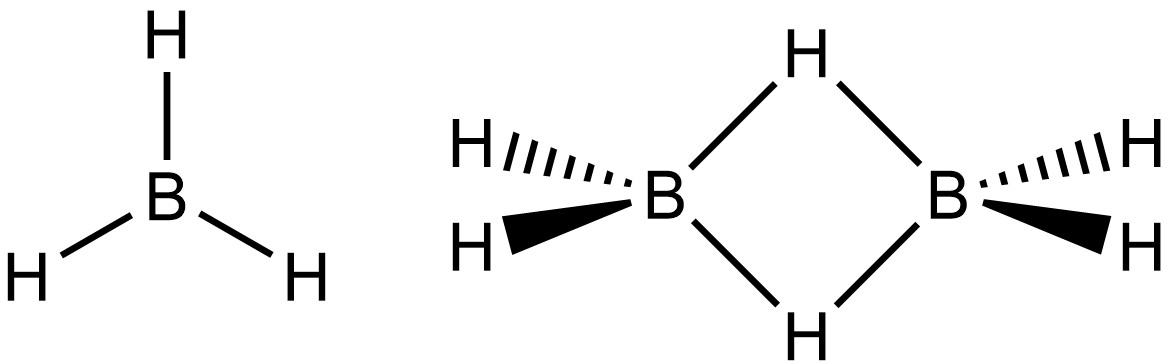
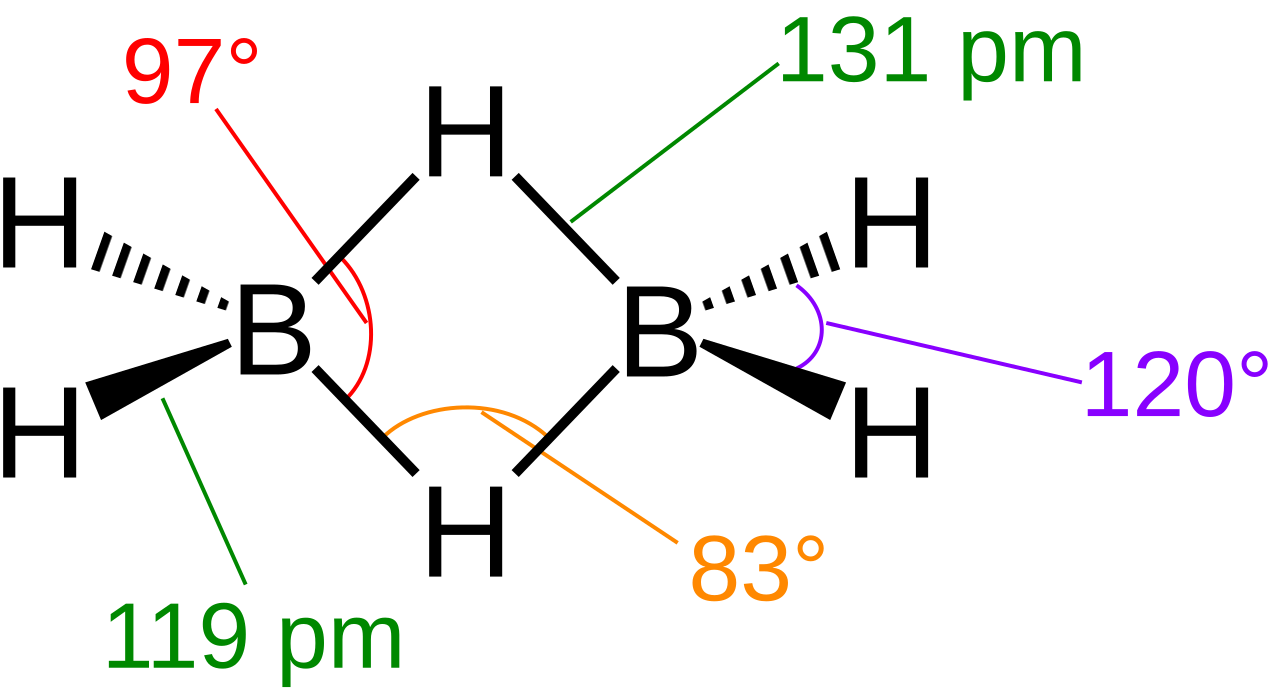
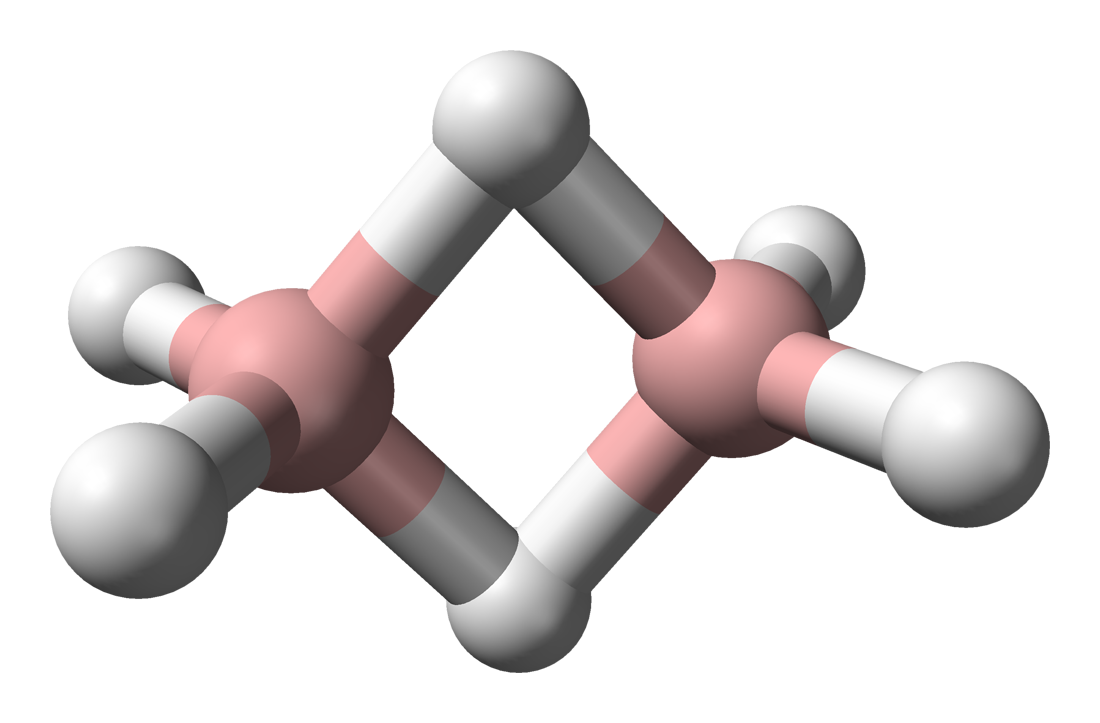
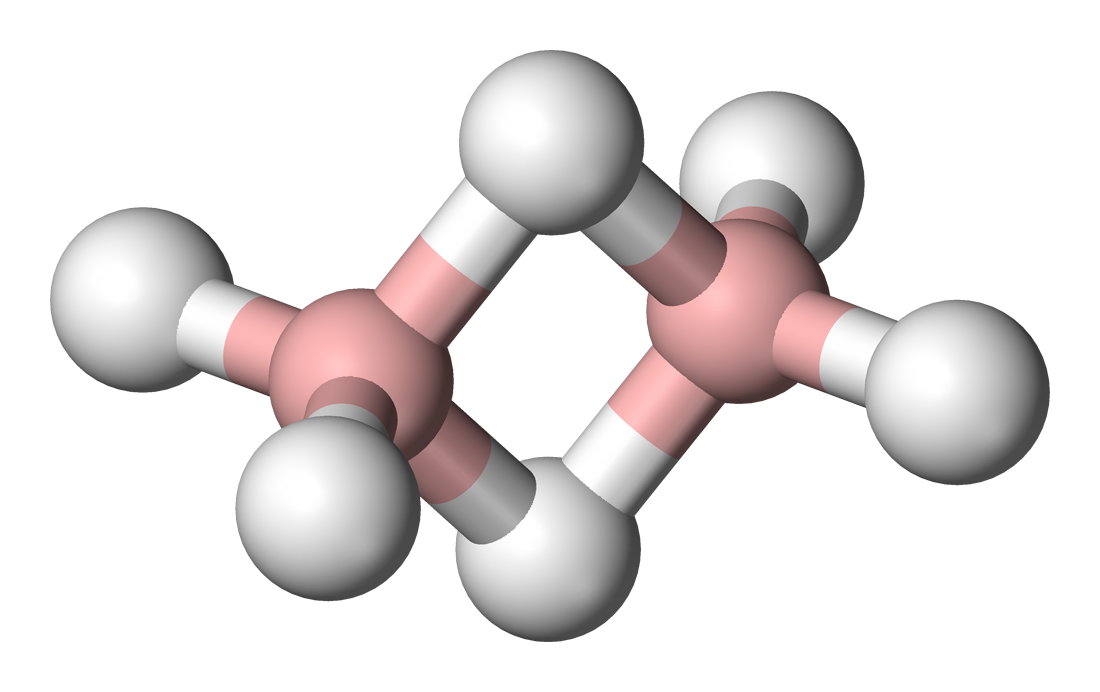
The molecule has D₂h symmetry. Four hydrogen atoms are in terminal positions, and two act as bridges between the boron atoms. The B–H bonds in the bridge are longer (1.33 Å) and weaker than the terminal B–H bonds (1.19 Å). This difference in strength shows up in the infrared spectrum, where the bridge bonds absorb at about 2100 cm⁻¹ and the terminal bonds at about 2500 cm⁻¹. According to molecular orbital theory, the terminal B–H bonds are standard two-center, two-electron covalent bonds. The bonding in the B₂H₂ ring is different: each boron uses two electrons for its terminal bonds and has one valence electron left, while each bridging hydrogen contributes one electron. The ring is held together by four electrons forming two three-center, two-electron bonds, sometimes called banana bonds. Diborane is isoelectronic with C₂H₆²⁺, which would come from diprotonating ethane. Among other group 13 elements, gallium forms a similar compound, digallane (Ga₂H₆). Aluminium forms a polymeric hydride, (AlH₃)ₙ, but unstable Al₂H₆ has been isolated in solid hydrogen and has the same structure as diborane.
Many synthesis routes for diborane have been developed. Most involve reacting hydride donors with boron halides or alkoxides. Industrially, diborane is made by reducing BF₃ with sodium hydride, lithium hydride, or lithium aluminium hydride: 8 BF₃ + 6 LiH → B₂H₆ + 6 LiBF₄. The lithium hydride must be very finely powdered to prevent a passivating layer of lithium tetrafluoroborate from forming. Adding a small amount of diborane product can generate lithium borohydride, which reacts with BF₃ to produce more diborane, making the reaction autocatalytic. Two laboratory methods start from boron trichloride with lithium aluminium hydride, or from boron trifluoride ether solution with sodium borohydride; both give yields up to 30%: 4 BCl₃ + 3 LiAlH₄ → 2 B₂H₆ + 3 LiAlCl₄; 4 BF₃ + 3 NaBH₄ → 2 B₂H₆ + 3 NaBF₄. Heating tin(II) chloride with NaBH₄ reduces the tin to metal and forms diborane: SnCl₂ + 2 NaBH₄ → 2 NaCl + Sn + B₂H₆ + H₂.
- Formula
- B2H6
- Molar mass
- 27.67 g/mol
- Appearance
- colorless gas
- Odor
- repulsively sweet
- Hazards
- highly toxic, pyrophoric
- Structure
- D2h symmetry with two 3-center 2-electron bonds
Lore & Background
Diborane was first synthesised in the 19th century by hydrolysis of metal borides, but it was never analysed. From 1912 to 1936, Alfred Stock undertook research that led to methods for the synthesis and handling of the highly reactive, volatile, and often toxic boron hydrides. He proposed the first ethane-like structure of diborane. Electron diffraction measurements by S. H. Bauer initially appeared to support his proposed structure.
In 1943, H. Christopher Longuet-Higgins, while still an undergraduate at Oxford, was the first to explain the structure and bonding of the boron hydrides. The article reporting the work, written with his tutor R. P. Bell, also reviews the history of the subject beginning with the work of Dilthey. Shortly afterwards, the theoretical work of Longuet-Higgins was confirmed in an infrared study of diborane by Price. The structure was re-confirmed by electron-diffraction measurement in 1951 by K. Hedberg and V. Schomaker.
William Nunn Lipscomb Jr. further confirmed the molecular structure of boranes using X-ray crystallography in the 1950s and developed theories to explain their bonding. The 1976 Nobel Prize in Chemistry was awarded to Lipscomb for his studies on the structure of boranes illuminating problems of chemical bonding.
Reader's Guide
Diborane is a central compound in boron chemistry, notable for its unusual bonding involving 3-center 2-electron bonds, often called 'banana bonds'. This bonding model, first explained by Longuet-Higgins, resolved the apparent electron deficiency of the molecule and opened the field of borane cluster chemistry. Diborane is isoelectronic with C2H2+6, which would arise from the diprotonation of ethylene. Its structure has D2h symmetry, with four terminal B–H bonds (1.19 Å) and two longer bridging B–H bonds (1.33 Å). The compound is highly reactive: it is pyrophoric in air, reacts violently with water to produce hydrogen and boric acid, and forms adducts with Lewis bases such as ammonia and dimethyl sulfide. Diborane is a key reagent in organic synthesis, particularly for hydroboration of alkenes to form trialkylboranes, and as a reducing agent complementary to lithium aluminium hydride. It has been tested as a rocket propellant due to the exothermicity of its combustion, though incomplete combustion in rocket engines produces boron monoxide and boron trioxide, which deposit on chamber walls and reduce efficiency. The industrial synthesis involves reduction of BF3 by hydride donors such as lithium hydride, and multiple laboratory methods exist, including reactions of boron trichloride with lithium aluminium hydride or boron trifluoride with sodium borohydride.
Did You Know?
- The B2H2 ring is held together by two 3-center 2-electron bonds, sometimes called 'banana bonds'.
- The 1976 Nobel Prize in Chemistry was awarded to William Nunn Lipscomb Jr. for his studies on the structure of boranes.
Electronic Architecture and the Banana Bond
Diborane's molecular geometry possesses D2h symmetry, with four hydrogen atoms occupying terminal positions and two additional hydrogens bridging the two boron centers. The terminal B–H bonds measure 1.19 Å, while the bridging B–H bonds stretch to 1.33 Å, a difference that mirrors their relative strengths. Infrared spectroscopy confirms this hierarchy, with vibrational bands appearing near 2500 and 2100 cm⁻¹ respectively. The terminal connections are straightforward two-center, two-electron covalent bonds, but the bridging arrangement defies conventional valence models. Each boron atom commits two of its valence electrons to its terminal hydrogens, leaving a single electron available for further bonding. The two bridging hydrogens contribute one electron apiece, and together these four electrons sustain the B2H2 ring through two three-center, two-electron interactions—colloquially termed banana bonds. Diborane is isoelectronic with the diprotonated form of ethylene, and analogous compounds exist for gallium in the form of digallane, as well as for aluminium, whose Al2H6 has been isolated in solid hydrogen and is isostructural with diborane.
From Laboratory Bench to Industrial Scale
Decades of investigation have yielded a diverse toolkit for preparing diborane. The dominant industrial route reduces boron trifluoride with a metal hydride such as lithium hydride, sodium hydride, or lithium aluminium hydride, producing diborane alongside lithium tetrafluoroborate. A practical subtlety: the lithium hydride must be ground to a very fine powder, otherwise a passivating layer of lithium tetrafluoroborate coats the reactant and stalls the reaction. Alternatively, seeding the mixture with a trace of diborane generates lithium borohydride in situ, which then attacks more BF3, rendering the process autocatalytic. In the laboratory, two common procedures—reacting boron trichloride with lithium aluminium hydride, or treating a boron trifluoride ether solution with sodium borohydride—each deliver roughly thirty percent yield. Older, simpler methods involve protonating borohydride salts with a non-oxidizing acid like phosphoric or dilute sulfuric acid, or oxidizing sodium borohydride with iodine. A tin(II) chloride and sodium borohydride combination also furnishes diborane while reducing the tin to its elemental form.
A Molecule That Fears Nothing
Diborane is a pyrophoric, colorless gas with a deceptively sweet smell, and its reactivity is as dramatic as its toxicity. Contact with oxygen triggers a violent exothermic oxidation to boron trioxide and water, releasing roughly 2035 kJ per mole of diborane. Water is equally hostile: the gas decomposes explosively into boric acid and hydrogen, and alcohols such as methanol undergo a similar hydrolytic cleavage to yield trimethylborate. Beyond these destructive encounters, diborane displays a pronounced Lewis acidity, forming stable adducts with bases like tetrahydrofuran, dimethyl sulfide, and ammonia. The ammonia adduct, known as DADB, is accompanied by small amounts of ammonia borane depending on conditions. In organic chemistry, its most celebrated role is hydroboration: alkenes add across the B–H bonds to produce trialkylboranes that can be elaborated into alcohols and other functional groups. Pyrolysis near 200 °C fragments diborane into hydrogen and boron hydride clusters, a route that first delivered pentaborane and launched an entire field of cluster chemistry.
Pioneers, Practicality, and a Lasting Legacy
Although diborane was first generated in the nineteenth century through hydrolysis of metal borides, the product went unanalysed and the discovery faded from view. The compound's true scientific career began with Alfred Stock, whose sustained work between 1912 and 1936 established the synthetic and handling methods for the entire family of boron hydrides—molecules that are volatile, highly reactive, and often poisonous. Stock's groundwork made it possible to study diborane's unusual bonding and to exploit its chemistry systematically. In modern organic synthesis, diborane and its derivatives remain central reagents. It serves as a reducing agent whose selectivity complements that of lithium aluminium hydride: carboxylic acids are cleanly reduced to alcohols, while ketones react only slowly. Its hydroboration capability, though now often supplanted by the safer borane-dimethyl sulfide adduct, was foundational. Even pyrolysis, once a curiosity, opened the door to borane cluster research. From Stock's laboratory to contemporary reagent shelves, diborane's story is one of persistent scientific fascination.
Gallery

Frequently Asked Questions
Who is Diborane?
Diborane is a tiny, colorless inorganic gas with the formula B₂H₆ and a molar mass of roughly 27.67 g/mol. It carries a deceptively sweet yet repulsive odor and is both highly toxic and pyrophoric, meaning it can ignite on its own the moment it meets air.
What makes Diborane's 'body structure' so unusual?
Instead of a straightforward chain of two-atom bonds, Diborane holds two hydrogen atoms in bridging positions between the boron centers, forming two 3-center 2-electron bonds that stitch the framework together. Those bridging B–H links measure about 1.33 Å and are weaker than the four terminal B–H bonds at roughly 1.19 Å, giving the whole molecule its D₂h symmetry.
What are Diborane's 'powers' in the lab?
Its pyrophoric character lets it flash-ignite in ordinary air, making any handling procedure a high-stakes affair. On the useful side, several chemical derivatives of Diborane serve as versatile reagents in organic and inorganic synthesis.
Why is Diborane considered a 'legend' in boron chemistry?
As the simplest and most fundamental boron hydride, it forced chemists to confront electron-deficient bonding—six valence electrons shared across more than six atomic centers. That puzzle made it a landmark case for developing the concept of multi-center bonding in inorganic chemistry.
What's the 'vibe' of encountering Diborane in the real world?
You'd notice a completely transparent, colorless gas with a cloyingly sweet smell that actually signals serious danger. The combination of extreme toxicity, spontaneous flammability, and that misleadingly pleasant odor makes it one of the most treacherous small molecules you can meet in the inorganic world.
More in Inorganic Compounds & Materials 1-20
Spotted an error? Know more?
Reader corrections go straight into our review queue. Suggest an edit · How this site is sourced