
Electrical injury
Damage from electric current; can cause burns, fibrillation, or death.

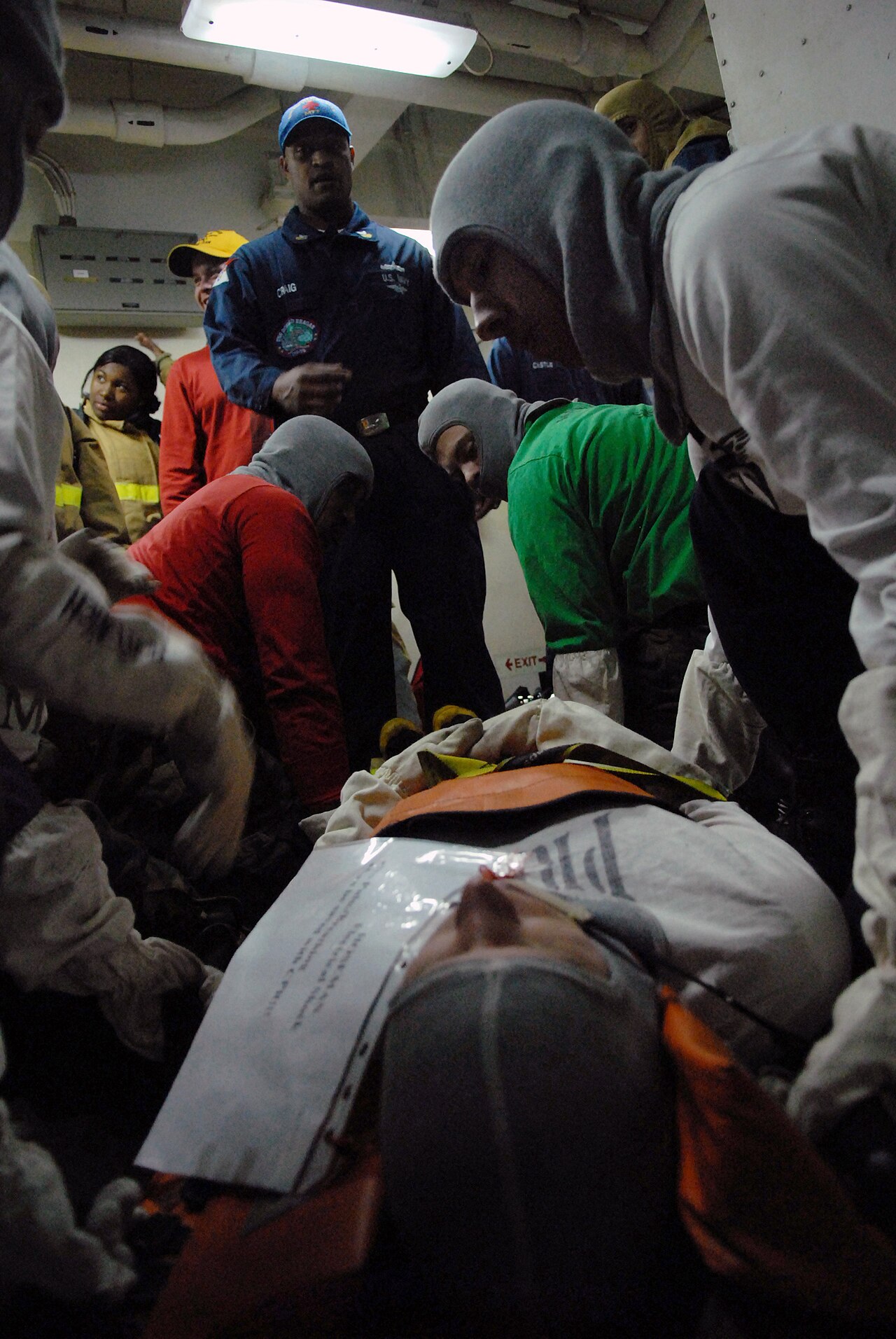
U.S. Navy photo by Mass Communication Specialist 3rd Class Rosalie Garcia · Public domain
When a person makes direct contact with an electric current, the skin or internal organs can be damaged. This is known as an electrical injury or electric shock. How severe the damage is depends on how concentrated the current is, how much resistance the tissues offer, and how long the contact lasts. A very weak current might not be felt at all or might cause just a faint tingle. A stronger shock can lead to painful muscle spasms strong enough to dislocate joints or break bones. The loss of muscle control can prevent a person from letting go of the source; if this happens at a height, like on a power line, they may be thrown off. Even a harmless current can startle someone, causing injury from jerking away or falling. Larger currents can damage tissue and may trigger ventricular fibrillation or cardiac arrest. When an electric shock results in death, it is usually called electrocution.
The injury happens when a body part contacts electricity and enough current passes through the tissues. The most common cause is touching live wiring or devices. With high voltages, such as on a power transmission tower, direct contact isn't always needed because the voltage can jump across an air gap to the device. For household current shocks, if the person has no symptoms, no underlying heart problems, and is not pregnant, further tests are not needed. Otherwise, doctors may perform an electrocardiogram, blood tests to check the heart, and urine tests for signs of muscle breakdown. Treatment can include resuscitation, pain medication, wound care, and monitoring the heart's rhythm. In the United States, electrical injuries affect more than 30,000 people each year and cause about 1,000 deaths.
Burns occur because resistance causes heating, which can be extensive and deep. When electricity hits the hand, it can cause involuntary muscle contraction, making it hard to let go of the wire and increasing the risk of serious burns. Voltages between 500 and 1000 volts tend to cause internal burns because the source provides a large amount of energy. Damage from current happens through tissue heating or electroporation. In many high-energy electrical traumas, the deeper tissues along a limb can reach damaging temperatures within a few seconds due to Joule heating.
- Field
- Medicine, Electrical Safety
- Known for
- Damage from electric current; ventricular fibrillation; let-go threshold; arc-flash hazards
- Affected per year us
- More than 30,000 people
- Annual deaths us
- About 1,000
Lore & Background
Electric injury occurs upon contact of a body part with electricity that causes a sufficient current to pass through the person's tissues. Contact with energized wiring or devices is the most common cause. In cases of exposure to high voltages, such as on a power transmission tower, direct contact may not be necessary as the voltage may 'jump' the air gap to the electrical device. Heating due to resistance can cause extensive and deep burns. Voltage levels of 500 to 1000 volts tend to cause internal burns due to the large energy available from the source.
Reader's Guide
Electrical injuries affect more than 30,000 people a year in the United States and result in about 1,000 deaths. Management may involve resuscitation, pain medications, wound management, and heart rhythm monitoring. Following an electrical injury from household current, if a person has no symptoms, no underlying heart problems, and is not pregnant, further testing is not required. Otherwise an electrocardiogram, blood work to check the heart, and urine testing for signs of muscle breakdown may be performed. The neurologic symptoms of electrical injury may occur immediately, which traditionally have a higher likelihood for healing, though they may also be delayed by days to years. The delayed neurologic consequences of electrical injury have a worse prognosis. There are a variety of psychiatric effects that may occur as a result of electrical injuries, including depression, anxiety spectrum disorders, moodiness, memory loss, decreased attention span, and difficulty learning.
Did You Know?
- A domestic power supply voltage (110 or 230 V), 50 or 60 Hz AC through the chest for longer than one second may induce ventricular fibrillation at currents around 50–100 mA; 30 mA is the typical let-go threshold.
- OSHA data indicates that 50–70% of electrical injuries involve burns from arcing faults, not 80%.
The Physics of Harm: How Current Travels Through the Body
An electrical injury unfolds the moment a body part bridges a circuit, allowing current to thread through living tissue. The severity of that damage is governed by three interlocking variables: current density, tissue resistance, and contact duration. A trickle of current below a certain threshold may register as nothing more than a faint tingle, yet even that harmless level can jolt a person into a sudden flinch, sending them tumbling from a ladder. At higher intensities, muscles seize in violent spasms capable of dislocating joints or fracturing bones. Perhaps most dangerously, the loss of voluntary muscle control can trap a victim's hand around a live wire, and if that contact happens atop a transmission tower, the convulsion may hurl the person into the air. In extreme high-voltage settings the electricity need not touch the body at all; the voltage is powerful enough to arc across the air gap and strike from a distance. In everyday scenarios, however, the most frequent route of exposure remains direct contact with energized wiring or household devices.
The Heart Under Siege: Ventricular Fibrillation and Cardiac Arrest
The heart is extraordinarily vulnerable to electrical disruption. Research has established that alternating current at domestic frequencies—fifty or sixty hertz—can trigger ventricular fibrillation at currents as low as thirty milliamperes when the path crosses the chest for more than one second. Direct current demands a higher threshold, roughly ninety to one hundred thirty milliamperes over the same interval, yet if the current has a direct conduit to the myocardium, such as through a cardiac catheter, even fractions of a millampere suffice to throw the heart into chaos. Once fibrillation takes hold, every cardiac muscle fiber quivers independently rather than contracting in the coordinated wave needed to pump blood, and without immediate defibrillation the result is almost invariably fatal. The precise mechanism behind these arrhythmias remains incompletely mapped, but tissue biopsies have revealed patchy areas of myocardial fibrosis enriched in sodium-potassium pumps, suggesting that transient, localized shifts in ion transport and membrane potential are the proximate trigger. A useful contrast is the everyday electrostatic zap from a doorknob: currents can spike to sixty amperes, yet because the pulse lasts only a few nanoseconds, the total charge transferred is far too small to disturb the heart.
Deep Tissue Destruction: Burns and Electroporation
When current forces its way through tissue, the resistance of that tissue converts electrical energy into heat, and the resulting thermal damage can be far more extensive than the visible wound suggests. In the hand, the current triggers an involuntary grip: the fingers clamp shut around the wire, and the victim cannot voluntarily release, prolonging exposure and deepening the burn. At voltage levels between five hundred and one thousand volts, the energy available from the source is sufficient to produce serious internal burns along the current's path. The physics is straightforward—energy scales with duration multiplied by the square of voltage divided by resistance, or equivalently with the square of current multiplied by resistance—and in high-energy trauma the Joule heating in deeper tissues along an extremity can reach destructive temperatures within mere seconds. Beyond pure thermal injury, the electrical field itself can disrupt cell membranes through a process called electroporation, creating pores in lipid bilayers that compromise cell integrity. The combined effect of heating and membrane disruption means that even a small entry point on the skin can mask catastrophic damage to muscles, nerves, and vessels buried far beneath the surface.
The Invisible Wounds: Neurological and Psychological Sequelae
Even when a person survives an electrical shock, the aftermath can extend far beyond the initial burn. At the site where current entered the body, peripheral neuropathy may develop, and while neurological symptoms that appear immediately carry a comparatively better chance of recovery, delayed manifestations—surfacing days, months, or even years later—carry a significantly worse prognosis. If the current's path traverses the head, loss of consciousness is nearly instantaneous at sufficient intensity, a principle well documented in the animal-husbandry practice of electric stunning. When ventricular fibrillation intervenes, the brain's blood supply collapses, producing cerebral hypoxia and its cascade of neurological deficits. The psychological toll is equally profound and can occur regardless of whether the head was in the current's path. Survivors report depression laced with guilt and diminished self-worth, anxiety-spectrum disorders including posttraumatic stress disorder and a persistent fear of electricity, and a lowered threshold for frustration that colors daily interactions. These mental-health sequelae, though less visible than a burn scar, can persist long after the physical wounds have healed.
Gallery

Frequently Asked Questions
Who is Electrical injury?
Electrical injury, commonly called electric shock, is the tissue damage that results when a person's body becomes part of a live electrical circuit. It can affect the skin, muscles, and internal organs, with severity shaped by current strength, tissue resistance, and how long contact lasts.
What are Electrical injury's powers/role?
It can force muscles into violent, uncontrolled contractions strong enough to dislocate joints or snap bones, and it can drive the heart into ventricular fibrillation. In its most dangerous form, the loss of grip prevents a victim from releasing the source of the current, especially if they are working at height.
Why is Electrical injury important?
More than 30,000 people in the United States suffer an electrical injury each year, and roughly 1,000 of those cases are fatal. It remains a leading concern in occupational-safety guidelines and household electrical-safety education.
What are Electrical injury's weaknesses?
Its destructive potential is limited by the body's own electrical resistance and by the duration of contact. A very low-amperage current may produce nothing beyond a faint tingle, and quick disconnection sharply reduces the extent of tissue damage.
More in Injuries 1-24
Spotted an error? Know more?
Reader corrections go straight into our review queue. Suggest an edit · How this site is sourced