Indigenous peoples
Indigenous peoples are diverse groups with ancestral ties to traditional territories.

Indigenous peoples are groups that identify themselves as distinct from the dominant society in a country, maintain a deep connection to their ancestral lands, and have historically faced subjugation and discrimination. However, no single definition of the term is universally accepted. Their global population is estimated between 250 million and 600 million, comprising roughly 5,000 distinct groups living in every inhabited continent and climate zone. In most cases, they are a minority within their own traditional territories or states and have been dominated by other groups, particularly non-Indigenous peoples.
The word "indigenous" comes from the Latin *indigena*, meaning "sprung from the land, native," which itself derives from Old Latin *indu* ("in, within") and *gignere* ("to beget, produce"). Europeans first used the term to distinguish the native peoples of the Americas from enslaved Africans, with the earliest known use by Sir Thomas Browne in 1646. By the 1970s, the term had become a way to link the struggles of colonized groups across borders and also emerged as a legal category in international and national law. The plural "peoples" reflects the cultural diversity among these groups. The United Nations Working Group on Indigenous Populations first met on 9 August 1982, a date now observed as the International Day of the World's Indigenous Peoples.
No UN agency has adopted a formal definition of Indigenous peoples, as a single definition is seen as either too broad or too narrow. The International Labour Organization’s 1989 Convention on Indigenous and Tribal Peoples (No. 169) covers peoples descended from those who inhabited a country or region at the time of conquest, colonization, or the establishment of present borders, who retain some or all of their own social, economic, cultural, or political institutions. It also covers "tribal peoples" whose social, cultural, and economic conditions set them apart and whose status is governed by their own customs or special laws. Self-identification is a fundamental criterion for coverage. The 2007 UN Declaration on the Rights of Indigenous Peoples does not define them but affirms their right to self-determination, including determining their own identity. The Inter-American Commission on Human Rights also declines to provide a definition.
- Population estimate
- 250 million to 600 million
- Number of distinct peoples
- approximately 5,000
- Geographic spread
- every inhabited climate zone and continent
- First known use of term
- 1646 by Sir Thomas Browne
- Key international instruments
- ILO Convention 169 (1989), UN Declaration on the Rights of Indigenous Peoples (2007)
- First un meeting
- 9 August 1982 (Working Group on Indigenous Populations)
Lore & Background
The term 'indigenous' was first used by Europeans to differentiate the Indigenous peoples of the Americas from enslaved Africans. The first known use was by Sir Thomas Browne in 1646. In the 1970s, the term was used as a way of linking the experiences, issues, and struggles of groups of colonized people across international borders. At this time 'indigenous people(s)' also began to be used to describe a legal category in Indigenous law created in international and national legislation. The use of the plural 'peoples' recognizes the cultural differences between various Indigenous peoples. The first meeting of the United Nations Working Group on Indigenous Populations was on 9 August 1982, and this date is now celebrated as the International Day of the World's Indigenous Peoples.
Reader's Guide
Indigenous peoples continue to face threats to their sovereignty, economic well-being, languages, cultural heritage, and access to the resources on which their cultures depend. In the 21st century, Indigenous groups and advocates have highlighted numerous apparent violations of the rights of Indigenous peoples. The rights of Indigenous peoples are outlined in national legislation, treaties and international law. The 1989 International Labour Organization (ILO) Convention on Indigenous and Tribal Peoples protects Indigenous peoples from discrimination and specifies their rights to development, customary laws, lands, territories and resources, employment, education and health. In 2007, the United Nations adopted a Declaration on the Rights of Indigenous Peoples including their rights to self-determination and to protect their cultures, identities, languages, ceremonies, and access to employment, health, education and natural resources. No universal definition of Indigenous peoples has been adopted by a UN agency, as a single definition would be either over- or under-inclusive. Self-identification is a fundamental criterion for determining the groups to which international conventions apply.
Did You Know?
- The term 'indigenous' is derived from the Latin word 'indigena', meaning 'sprung from the land, native'.
- The first known use of 'indigenous' to refer to a group of people was by Sir Thomas Browne in 1646.
- The International Day of the World's Indigenous Peoples is celebrated on 9 August, the date of the first UN Working Group on Indigenous Populations meeting in 1982.
The Elusive Pre-Columbian Census
The question of how many Indigenous people inhabited the Americas before 1492 remains one of history's most contested puzzles. Because the surviving evidence is fragmentary, scholars have been forced to extrapolate from small data points, producing estimates that span an extraordinary range—from as few as 8 million to as many as 112 million. In 1976, geographer William Denevan attempted to synthesize existing figures into a "consensus count" of roughly 54 million, and his 1992 revision placed the total near 53.9 million, with regional breakdowns including approximately 17.2 million in Mexico, 15.7 million in the Andes, and 8.6 million in lowland South America. A 2019 study based on atmospheric CO2 levels suggested the pre-Columbian population exceeded 60 million but had fallen to just 6 million by 1600, though other researchers have challenged that conclusion. Meanwhile, a 2020 genetic study proposed that earlier Caribbean population figures may have been inflated by a factor of ten. The sheer breadth of these estimates underscores how much uncertainty still surrounds this foundational question.
A Catastrophe of Multiple Origins
The collapse of Indigenous populations following European contact was driven by a convergence of devastating forces rather than a single cause. Eurasian diseases—smallpox, influenza, pneumonic plagues—struck communities with no prior immunity, and in regions like 16th-century Mexico, waves of illness killed between 50 and 80 percent of the population. Direct violence through warfare, forced removal, and the broader disruption of established societies compounded the toll. Yet scholars continue to dispute the relative weight of each factor. Some modern researchers frame the catastrophe as genocide, arguing that deliberate, systematic European actions were the primary driver of the demographic collapse. Others maintain that incidental exposure to previously unknown pathogens accounts for the majority of deaths. This interpretive divide reflects not only differences in evidence but also deeper disagreements about intent, agency, and the moral architecture of colonial history. The debate remains unresolved, with each side pointing to different aspects of the historical record.
Regional Trajectories of Loss and Recovery
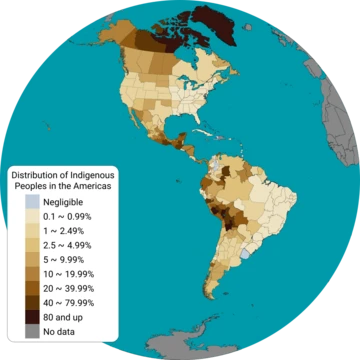
The demographic story of Indigenous peoples in the Americas is not uniform; it varies sharply by region and era. In what is now Brazil, the population fell from a pre-Cabraline high of an estimated four million to roughly 300,000, though a DNA study indicates over 60 million Brazilians carry at least one Native South American ancestor. In Mexico, the population of present-day territory dropped to approximately one million in the last three decades of the 16th century, yet the Maya population today is estimated at around six million—roughly comparable to late-15th-century figures. In Canada, early European-Indigenous interactions were relatively peaceful, but repeated outbreaks of measles, influenza, and smallpox, combined with other contact effects, produced population declines of 25 to 80 percent. By 1871, an official enumeration counted only 102,358 Indigenous individuals within Canada's borders. Yet from 2006 to 2016, the Indigenous population grew by 42.5 percent—four times the national rate—reaching 1,400,685 people, or 4.3 percent of the total population, according to the 2011 census.
When Numbers Become Ideology
The population debate has never been purely academic; it has carried deep ideological weight. Low estimates, such as Alfred Kroeber's 1939 figure of just 8.4 million inhabitants across the entire western hemisphere, have been linked to European notions of cultural and racial superiority that still influenced fields like anthropology well into the 20th century. When scholars minimized the scale of pre-colonial Indigenous civilizations, they inadvertently reinforced narratives of European exceptionalism and the supposed "emptiness" of the land awaiting settlement. Conversely, higher estimates—like historian David Stannard's claim that the total extermination and near-extermination of Indigenous peoples claimed close to 100 million lives—carry their own moral and political implications, framing the colonial encounter in terms of deliberate destruction. The population question thus functions as a proxy for larger arguments about who inhabited the Americas, what was lost, and who bears responsibility. Resolving it requires not only better data but also a reckoning with the biases that have shaped its framing for generations.
Frequently Asked Questions
Who are Indigenous peoples?
Indigenous peoples are communities that see themselves as distinct from the mainstream society of their country and maintain a profound bond with their ancestral territories. They are not a single monolithic group but rather thousands of unique cultures spread across the globe.
How many Indigenous peoples exist worldwide?
Estimates place the global Indigenous population somewhere between 250 million and 600 million individuals. These people belong to roughly 5,000 distinct groups, making them one of the most culturally diverse segments of humanity.
Where do Indigenous peoples live?
Indigenous communities can be found in every inhabited continent and in virtually every climate zone on Earth, from arctic tundra to tropical rainforests. In most of their traditional homelands, they remain a numerical minority compared to the dominant population.
When was the term 'Indigenous peoples' first used?
The earliest known recorded use of the term dates back to 1646, when the English physician Sir Thomas Browne employed it in writing. No single universal definition of the phrase has ever been agreed upon by all nations or scholars.
What major international legal protections exist for Indigenous peoples?
Two landmark instruments stand out: ILO Convention 169, adopted in 1989, and the UN Declaration on the Rights of Indigenous Peoples, passed in 2007. The UN also convened its first dedicated Working Group on Indigenous Populations on 9 August 1982, marking a turning point in formal international engagement.
More in Indigenous Peoples Of The World 1-24
Spotted an error? Know more?
Reader corrections go straight into our review queue. Suggest an edit · How this site is sourced