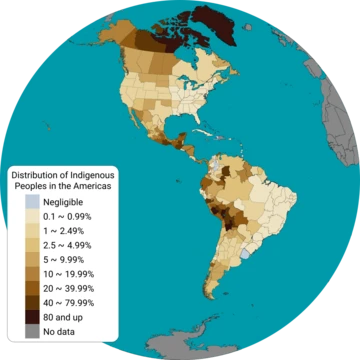
Indigenous peoples in Canada
Indigenous peoples are foundational to Canada's history and identity.

Indigenous peoples in Canada, also known as Aboriginal Canadians, comprise the Inuit, Métis, and First Nations. They represent roughly 5% of the overall population and include over 600 recognized First Nations governments or bands with distinctive cultures, languages, music and arts. Their history includes some of the earliest known sites of human habitation in Canada, such as Old Crow Flats and Bluefish Caves, and their societies prior to European colonization featured permanent settlements, agriculture, civic and ceremonial architecture, complex societal hierarchies, and trading networks.
Quick Facts
- Group
- Indigenous peoples in Canada · fr · Peuples autochtones au Canada
- Population
- 1,807,250 (2021 census) / 5.0% of the Canadian population
- Languages
- Indigenous languages, Indigenous English, Canadian English and Canadian French
- Religions
- Christianity (mainly Roman Catholicism and Anglican), Traditional Indigenous beliefs, Inuit religion, Mythologies of the Indigenous peoples of the Americas
- Related-C
- Native Americans in the United States, Greenlandic Inuit, Indigenous peoples of the Americas
Facts from the source article.
Lore & Background
Indigenous cultures in Canada prior to European colonization included permanent settlements, agriculture, civic and ceremonial architecture, complex societal hierarchies, and trading networks. Métis nations of mixed ancestry originated in the mid-17th century when First Nations women married European fur traders, primarily French settlers. First Nations and Métis peoples played a critical part in the development of European colonies in Canada, particularly for their role in assisting Europeans during the North American fur trade.
Reader's Guide
Various Aboriginal laws, treaties, and legislation have been enacted between European immigrants and Indigenous groups across Canada. The impact of settler colonialism in Canada can be seen in its culture, history, politics, laws, and legislatures. Historically, this included assimilationist policies affecting Indigenous languages, traditions, religion and the degradation of Indigenous communities that has contemporarily been described by some, including academics and politicians, as a cultural genocide, or genocide. The modern Indigenous right to self-government provides for Indigenous self-government in Canada and the management of cultural, political, health and economic responsibilities within Indigenous communities. National Indigenous Peoples Day recognizes the vast cultures and contributions of Indigenous peoples to the history of Canada. First Nations, Inuit, and Métis peoples of all backgrounds have become prominent figures in Canada and have helped shape the Canadian cultural identity.
Did You Know?
- The term 'Aboriginal' is a legal term used in Section 35 of the Constitution Act, 1982, encompassing all Indigenous peoples living in Canada.
- The Indian Act sets the legal term 'Indian' and specifically excludes reference to Inuit as per section 4 of the act.
- The term 'Eskimo' has pejorative connotations in Canada and Greenland; Indigenous peoples in Canada have replaced it with 'Inuit', while in Greenland the preferred term is 'Kalaallit'.
- Two court cases clarified that Inuit, Métis, and non-status First Nations are all covered by the term 'Indians' in the Constitution Act, 1867: Reference Re Eskimos (1939) and Daniels v. Canada (2013).
Armed Resistance Against Imperial Conquest
The Indigenous peoples of eastern Siberia mounted repeated and increasingly sophisticated challenges to Russian colonial authority. In Kamchatka, the Itelmen rose up three times during the early eighteenth century—first in 1706 armed with nothing but stone implements, then in 1731 and 1741 wielding gunpowder weapons they had acquired. The Koryaks proved equally tenacious, sustaining a prolonged armed struggle with bows and firearms from 1745 through 1756. The Chukchi resistance was perhaps the most dramatic: after Russian Cossack forces under Major Dmitry Pavlutsky carried out mass killings and the enslavement of Chukchi women and children in 1730–1731, the Chukchi fought back with renewed ferocity. Empress Elizabeth's 1742 decree called for the total eradication of the Chukchi and Koryaks, yet the campaign ended inconclusively when the Chukchi killed Pavlutsky and severed his head. In the 1740s, multiple groups—Koryaks, Chukchi, Itelmens, and Yukaghirs—coordinated to expel Russian forces, culminating in the 1746 assault on Nizhnekamchatsk fort, where the Russian garrison was utterly destroyed.
Catastrophic Population Collapse
The human cost of Russian expansion across Siberia was staggering. By the early 1600s, Indigenous populations in the region stood at roughly 160,000. Within decades of the 1697 annexation of Kamchatka, approximately 100,000 out of 150,000 Itelmen and Koryak individuals perished, victims of smallpox, deliberate mass killings by Cossack mercenaries, and waves of collective suicide. Across the broader eighteenth and nineteenth centuries, ninety percent of the Kamchadal population and half of the Vogul people were eliminated. The driving economic force behind much of this slaughter was the fur trade, which incentivized the destruction of both wildlife and the human communities that managed it. By 1882, the Russian writer Nikolai Yadrintsev could identify around twelve entire ethnic groups that had been wiped out so completely that only scattered artifacts in museum collections testified to their former existence. The 1897 census recorded 822,000 Indigenous Siberians, a figure that would not climb past 1.6 million until the 2010 census.
The Amur Frontier and the Qing Shield
In the seventeenth century, the Amur region became a flashpoint between Russian Cossack expansion and the tributary networks of the Qing dynasty. Indigenous communities along the Amur, who had long served as tributaries to the Qing court, encountered Russian colonizers they called 'red-beards' and, drawing on Buddhist mythology, named them luocha or rakshasa—demonic beings. The fear and hostility these invaders inspired was not merely cultural; the Cossacks ruthlessly subjugated Amur tribes, and the resulting conflicts drew in broader geopolitical forces. In 1658, a combined force of Qing soldiers and Korean musketeers defeated the Cossack incursions, effectively barring Russian penetration into the inner reaches of the Amur basin for several decades. This episode illustrates how Indigenous Siberian communities were not passive victims but active participants in a multi-polar struggle, leveraging their tributary relationships to repel one imperial power while navigating the pressures of another. The Amur conflicts also highlight how the fur-driven colonial project repeatedly collided with established Asian political orders.
Survival, Resilience, and Shifting Demographics
Today, Indigenous peoples constitute roughly five percent of Siberia's total population, numbering between 1.6 and 1.8 million. Census figures show a slow but steady increase: from 1,608,000 in 2010 to 1,635,000 in 2021. Yet the demographic landscape is deeply uneven. In most of Siberia, ethnic Russians and other Slavs form the majority, including in Buryatia and the Altai Republic, where they outnumber the Buryat and Altai native populations. The notable exceptions are Tuva and Sakha, where Tuvan and Yakut peoples respectively remain the dominant ethnic groups. Linguistic survival has been far more precarious than population recovery. The Ainu language, once spoken across Sakhalin, Hokkaido, the Kuril Islands, Kamchatka, and the Amur region, is now on the verge of extinction, with the last native speakers concentrated in Hokkaido and Kamchatka. Despite these losses, some Siberian Indigenous groups maintain close genetic ties to Indigenous peoples of the Americas, a reminder that the region's human history stretches far beyond the boundaries of any single nation-state.
Frequently Asked Questions
Who are Indigenous peoples in Canada?
Indigenous peoples in Canada—also called Aboriginal Canadians—are the original inhabitants of the land, encompassing three distinct groups: the Inuit, the Métis, and the First Nations. Together they make up roughly 5% of the country's total population.
How many First Nations governments or bands are recognized in Canada?
There are more than 600 recognized First Nations governments or bands across the country. Each carries its own distinctive culture, language, music, and artistic traditions.
How far back does Indigenous habitation in Canada go?
Some of the earliest known evidence of human presence in Canada comes from sites like Old Crow Flats and Bluefish Caves, stretching Indigenous history back tens of thousands of years. Long before European contact, these societies had built permanent settlements, practiced agriculture, and developed complex civic and ceremonial architecture.
What is the constitutional legal term used for Indigenous peoples in Canada?
The Canadian Constitution uses the term 'Aboriginal peoples of Canada,' which explicitly includes Indian (First Nations), Inuit, and Métis peoples. This legal framing underpins their recognized rights and distinct status within the country.
Why are Indigenous peoples considered foundational to Canada's identity?
Indigenous peoples shaped the land, its trade networks, and its societal structures long before colonization, and their cultures remain a living, central part of Canadian identity. Their history and ongoing contributions are woven into the very fabric of what it means to be Canadian.
More in Indigenous Peoples Of The World 1-24
Spotted an error? Know more?
Reader corrections go straight into our review queue. Suggest an edit · How this site is sourced