Indigenous peoples of Mexico
Original foundation of Mexico's pluricultural nation.

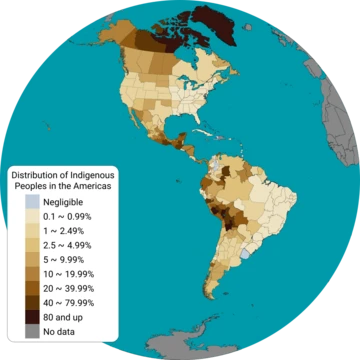
Indigenous peoples of Mexico, also known as Native Mexicans, are communities that trace their roots to populations existing in what is now Mexico before the arrival of Europeans. They are recognized in the second article of the Mexican Constitution, which defines Mexico as a pluricultural nation and grants Indigenous peoples rights to self-determination, preservation of languages and cultures, and application of their normative systems. The Indigenous population is distributed throughout Mexico, with concentrations in the Sierra Madre del Sur, the Yucatán Peninsula, and other regions, and is especially numerous in Oaxaca and Yucatán.
Quick Facts
- Group
- Native Mexicans
- Native Name
- es · Mexicanos nativos
- Regions
- Yucatán, Oaxaca, Chiapas, Quintana Roo, Campeche, Veracruz, Guerrero, Hidalgo, Puebla, Michoacán
- Languages
- Nahuatl, Yucatec Maya, Tzotzil, Mixtec, Zapotec, Otomi, Huichol, Totonac and another 54 living languages along the Mexican territory, as well as Spanish
- Religions
- Christianity (predominantly Roman Catholic, with Amerindian religious elements, including Mesoamerican religion)
- Related
- Mestizo Mexicans / Other indigenous peoples of the Americas
Facts from the source article.
Lore & Background
The prehispanic civilizations of Mexico are divided into Mesoamerica, where complex civilizations like the Olmec, Teotihuacan, Maya, Zapotec, Mixtec, and Purépecha flourished, and Aridoamerica, the arid north where the Mogollon culture built urban centers such as Casas Grandes. Trade networks connected these regions with the American Southwest, sharing knowledge and artifacts. By the time of Spanish arrival, the Aztec Empire loosely joined many Mesoamerican peoples, with its capital Tenochtitlan reaching an estimated 350,000 inhabitants.
Reader's Guide
The Indigenous peoples of Mexico are significant as the original foundation of the nation, recognized constitutionally as a pluricultural society. Their survival and adaptation through the colonial era—despite population decline from European diseases, war, and forced labor—demonstrate resilience. The encomienda system exploited their labor, but Indigenous communities maintained internal governance and written traditions in languages like Nahuatl, Mixtec, and Yucatec Maya. Today, the definition of 'Indigenous' varies: narrow linguistic criteria count only speakers of Indigenous languages, while broader self-identification includes those who maintain cultural background without speaking the language. This discrepancy has led activists to call the narrow census definition 'statistical genocide.' The 2020 census recorded over 23 million self-identified Indigenous people, though genetic studies show most Mexicans have partial Indigenous heritage. Their legacy includes 89 recognized national languages and ongoing rights to self-determination, cultural preservation, and legal autonomy.
Did You Know?
- The Mexican census does not classify individuals by race, using cultural-ethnicity of communities that preserve Indigenous languages, traditions, beliefs, and cultures.
- Genetic studies have found that most Mexicans are of partial Indigenous heritage.
- The Law of Linguistic Rights recognizes 89 Indigenous languages as national languages, with the same validity as Spanish in territories where they are spoken.
- The states with the largest Indigenous population are Oaxaca and Yucatán, both having Indigenous majorities.
Demographic Reckoning and Identity Reclamation
The numbers tracing the Indigenous Colombian experience reveal a dramatic arc of loss and partial recovery. Before Spanish contact, an estimated six million people inhabited the territory. By the time of independence, that figure had collapsed to roughly 600,000, representing 80% of a total population of 750,000. The twentieth century witnessed further erosion: from 17.8% of the population in 1852 to just 6.3% by 1912, and down to 1% in 1993. Yet a remarkable reversal has followed. The 1991 constitution extended meaningful legal protections to Indigenous communities, and government recognition programs helped push the registered proportion to 3.4% by 2005 and 4.4% by 2018. A Latinobarómetro survey that same year revealed that 10.4% of respondents voluntarily identified as Indigenous, suggesting official tallies still undercount. Current estimates place the share near 9.5%, making Colombia the seventh-highest in the Americas by that metric. Perhaps most striking, a genetic study found that the average Colombian carries 47% Amerindian ancestry—the single largest component—underscoring how deeply Indigenous heritage runs through the entire nation's biological fabric.
Ancient Roots and Civilizational Flourishing
The human story in Colombia stretches back thousands of years. While some theories push habitation to 43,000 BC, the prevailing archaeological consensus places the earliest arrivals around 15,000 BC. Anthropologist Tom Dillehay, drawing on evidence from rock shelters, situates the first hunter-gatherer communities at roughly 10,000 BC, concentrated along the Caribbean coastline and the Andean highland slopes. The site of Tibitó, just north of present-day Bogotá, is among the oldest widely accepted occupation sites, dating to approximately 9,790 BC. By 9,000 BC, significant numbers of foragers had settled the highlands, and permanent village life emerged in the north by 2,000 BC. From the first millennium BC onward, a remarkable array of cultures—including the Muisca, Quimbaya, Tairona, Calima, Zenú, Tierradentro, San Agustín, Tolima, and Urabá—developed sophisticated skills in agriculture, mining, and metalwork. Many organized themselves into cacicazgos, a pyramidal political structure led by caciques. The Muisca, who had retreated to Cundinamarca and Boyacá after Carib raids, built well-ordered provinces governed by communal land laws and two supreme leaders, while the Tairona thrived across the Caribbean lowlands and the Sierra Nevada de Santa Marta.
Conquest, Collapse, and the Politics of Erasure
The Spanish arrival in 1509 confronted a vibrant, heterogeneous population of roughly six million people spread across several hundred tribes, many speaking mutually unintelligible dialects. The demographic catastrophe that followed was swift and severe: within a generation, the total population had crashed to 750,000, of whom 600,000 were Indigenous. Independence brought a modest recovery to 1.327 million, but the Native share had already slipped to 53%. The new republican elites, operating under liberal ideologies, actively dismantled the collective land tenure that the Spanish monarchy had once recognized. Their policies pressed Indigenous communities into forced assimilation into a mainstream national culture, and the registered proportion of Natives in the census fell from 17.8% in 1852 to 6.3% in 1912, then to 1% by 1993. In the highland agricultural chiefdoms, colonial institutions had already been engineered to secure Spanish control over Native labor, and the post-independence state inherited and intensified those mechanisms of subordination. The result was a century-and-a-half in which Indigenous identity was systematically suppressed, its visibility in official statistics reduced to a near-invisible fraction of the national population.
Contemporary Struggles and Geographic Footprint
Today, Indigenous Colombians belong to 115 recognized tribal nations, with their communities concentrated in specific regions. Approximately two-thirds of registered Indigenous people reside in just five departments: La Guajira, Cauca, Nariño, Córdoba, and Sucre. The sparsely populated Amazon basin alone is home to more than seventy distinct ethnic groups, reflecting the extraordinary cultural diversity within a single country. Colombia's Indigenous share of roughly 9.5% ranks it seventh in the Americas, behind Bolivia, Chile, Ecuador, Guatemala, Peru, and Panama. Yet this presence continues to face severe threats. Both historically and in the present era, Indigenous communities have endured violence and oppression that ranges from the theft of ancestral lands to outright massacres. The targeting of Indigenous activists and politicians for assassination has been a persistent and devastating pattern. These communities, who constitute the largest genetic component of the Colombian population at 47% Amerindian ancestry, remain at the front lines of a struggle for territorial sovereignty, political representation, and the right to exist as distinct peoples within a nation that has long sought to absorb them.
Frequently Asked Questions
Who are the Indigenous peoples of Mexico?
They are the communities whose lineages stretch back to the original inhabitants of the Mexican land before European contact, and they are constitutionally recognized as the original foundation of the nation's pluricultural identity.
What rights do Indigenous peoples of Mexico hold under the law?
Article Two of the Mexican Constitution formally guarantees them self-determination, protection of their languages and cultural practices, and the authority to apply their own normative systems within the national legal framework.
How large is the Indigenous population in Mexico?
The 2020 census recorded roughly 23.2 million people who self-identified as Indigenous, while about 11.1 million lived in households where an Indigenous language was the primary tongue spoken.
Where are Indigenous communities concentrated in Mexico?
They are distributed across the entire country, but notable density appears in the Sierra Madre del Sur region, the Yucatán Peninsula, and several other areas with deep historical roots.
Why are Indigenous peoples of Mexico considered central to the nation's identity?
Their constitutional recognition makes Mexico explicitly a pluricultural state, ensuring that the law acknowledges multiple living cultural systems rather than treating any single tradition as the sole national narrative.
More in Indigenous Peoples Of The World 1-24
Spotted an error? Know more?
Reader corrections go straight into our review queue. Suggest an edit · How this site is sourced