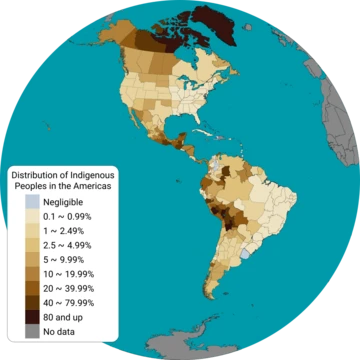
Indigenous peoples of South America
Descendants of first South Americans, diverse in culture and subsistence.

The first peoples of South America are the descendants of the continent’s original inhabitants, who lived there before Europeans or Africans arrived. In Spanish, they are called *pueblos indígenas* or *pueblos nativos*. In Argentina, the term *aborigen* is used, while Colombia commonly uses *pueblos aborígenes*. In the Guianas, the English term *Amerindian* is frequent. People of mixed European and Indigenous ancestry are known as *mestizos* in Spanish and *mestiços* in Portuguese; those of mixed African and Indigenous ancestry are called *zambos*.
These populations are thought to have come from Asia via the Bering Land Bridge into North America and then moved south, or possibly from Polynesia across the Pacific. The oldest widely accepted evidence of human presence in South America is at the Monte Verde site in southern Chile, dating back 14,000 years. Their descendants became the Indigenous peoples of the continent.
Before Spanish colonization, many of these groups were hunter-gatherers—and many still are, especially in the Amazon rainforest. Others, particularly in the Andes, practiced advanced farming, used irrigation, and kept domesticated animals like llamas and alpacas.
Today, Bolivia is the only South American country where Indigenous people form the majority, with 62% of Bolivians identifying as members of an Indigenous group. The Indigenous peoples of South America include those in Argentina, Bolivia, Brazil, Chile, Colombia, Ecuador, French Guiana, Guyana, Paraguay, Peru, Suriname, Uruguay, and Venezuela.
Quick Facts
- Pop
- 18 million
Facts from the source article.
Lore & Background
It is believed that the first human populations of South America either arrived from Asia into North America via the Bering Land Bridge and migrated southwards, or alternatively from Polynesia across the Pacific. The earliest generally accepted archaeological evidence for human habitation in South America dates to 14,000 years ago and is located at the Monte Verde site in southern Chile. The descendants of these first inhabitants would become the Indigenous populations of South America.
Reader's Guide
Before the Spanish colonization of the Americas, many of the Indigenous peoples of South America were hunter-gatherers, and indeed many still are, especially in the Amazon rainforest. Others, especially the Andean cultures, practised sophisticated agriculture, utilized advanced irrigation, and kept domesticated livestock such as llamas and alpacas. The only South American country that presently has a majority-Indigenous population is Bolivia, with 62% of Bolivians identifying as a member of an Indigenous group. Their significance lies in their deep history as the original inhabitants of the continent, their diverse cultural and subsistence practices, and their continued presence across all South American countries, including Argentina, Bolivia, Brazil, Chile, Colombia, Ecuador, French Guiana, Guyana, Paraguay, Peru, Suriname, Uruguay, and Venezuela. Their legacy is preserved in their languages, traditions, and ongoing struggles for recognition and rights.
Did You Know?
- The only South American country with a majority-Indigenous population is Bolivia, where 62% of Bolivians identify as a member of an Indigenous group.
- In Spanish, Indigenous peoples are referred to as pueblos indígenas or pueblos nativos; the term aborigen is used in Argentina, and pueblos aborígenes is commonly used in Colombia.
- Latin Americans of mixed European and Indigenous descent are usually referred to as mestizos (Spanish) and mestiços (Portuguese), while those of mixed African and Indigenous ancestry are referred to as zambos.
Ancient Roots and the Dawn of Civilization
Genetic and anthropological research points to a remarkable story of arrival: the ancestors of Peru's Indigenous peoples were descendants of migrants who left North Asia and crossed the Bering Strait in at least three separate waves. The earliest of these groups is theorized to have made the crossing at the close of the last glacial period, roughly 24,000 BCE, during the Upper Paleolithic. By the tenth millennium BC, members of that first wave are believed to have reached the territory of modern Peru, likely entering the Amazon basin from the northwest. From these early settlements grew one of humanity's most extraordinary achievements. The Norte Chico civilization, situated about one hundred miles north of Lima, stands as the oldest known civilization in the Americas and one of only six places on Earth where agriculture and organized government arose independently. Around the thirtieth century BC, its inhabitants established trade networks linking coastal fishermen with inland cotton growers and raised monumental pyramids. Across the broader pre-Columbian landscape, communities spoke a rich array of languages—Quechua, Aymara, Jivaroan, Tsimané, Tallán, Culli, Quingnam, Muchik, and Puquina—each carrying its own social structures and cultural traditions.
The Inca Empire and the Amazonian Mosaic
By the year 1500, an estimated two thousand distinct nations and tribes inhabited what is now Peru, each shaped by its particular landscape. To the east of the Andes, in the vast Amazon basin, most communities lived as semi-nomadic groups whose daily survival depended on hunting, fishing, gathering wild plants, and practicing slash-and-burn agriculture. To the west and in the high Andes, the picture was dramatically different. The Inca Empire had consolidated a complex, hierarchical civilization that produced major cities, grand temples, and monumental architecture built with a level of stone-masonry skill that still commands admiration. Indigenous cultures had been developing in this territory for thousands of years before the Spanish appeared in 1532. Yet the very expansion and consolidation of the Inca state, followed after 1533 by the Spanish Empire, proved devastating to many of those smaller nations. A significant portion of the two thousand groups that existed at the turn of the sixteenth century simply disappeared, absorbed or destroyed by the successive imperial powers that claimed the land. The result was a landscape of profound loss, even as the surviving cultures carried forward traditions that would endure in transformed ways.
Epidemic, Displacement, and Enduring Identity
The arrival of Spanish soldiers in 1532 unleashed a catastrophe that no amount of military resistance could have prevented. Eurasian infectious diseases, chronic among the foreigners, spread rapidly through Indigenous communities that had developed no natural immunity. Crucially, these epidemics often raced ahead of direct European contact, carried along existing trading routes by Indigenous peoples themselves, so that entire regions fell ill years before a single soldier set foot in their territory. The mortality was staggering, and the social fabric of countless communities was shattered. In the twenty-first century, the demographic legacy is visible in the 2025 census: of Peru's 34,157,732 residents, 6,783,697 identify as Indigenous, roughly 20.7 percent of the total, with 92.3 percent of them Andean and 7.3 percent Amazonian. Mestizos, of mixed Indigenous and European descent, now form the largest single component of the population. Still, every Indigenous group—from the Urarina to the deeply isolated Matsés, Matis, and Korubo of the remote Amazon—has been touched by European-Peruvian influence, adopting firearms and manufactured trade goods. Yet many continue to actively defend their traditional practices and cultural identities against full assimilation.
Marriage, Mestizaje, and the Woven Tapestry of Peruvian Identity
Before the Spanish Inquisition reshaped social norms, Andean communities practiced trial marriages lasting several years, during which both partners retained the freedom to dissolve the union and return home. Gender roles were understood as complementary: a community's economic survival depended on the combined labor of both sexes. Women, typically married around sixteen, tended children and livestock, gathered food, cooked, and wove, while men took on more physically demanding work. The Spanish conquest layered new unions atop these traditions. From the earliest colonial years, soldiers and colonists married Indigenous women, with Spanish officers often taking wives from the Inca elite. These marriages produced the mestizo population—of Indigenous and European ancestry, Spanish-speaking, generally Roman Catholic—that today forms the majority culture. In the late nineteenth century, thousands of predominantly male Chinese laborers arrived in northern Peruvian plantations. Faced with a stark demographic imbalance, many married Indigenous Peruvian women, sometimes in mass communal ceremonies arranged by matchmakers who recruited young women from Andean villages. Chinese men reportedly preferred these unions over relationships with African Peruvian women. Scholars in the late twentieth and twenty-first centuries have devoted serious attention to these cross-cultural marriages and the distinctive identities their descendants forged.
Frequently Asked Questions
Who are the Indigenous peoples of South America?
They are the descendants of the original inhabitants who lived on the South American continent before any European or African arrival. The group is incredibly diverse, spanning many distinct cultures, languages, and ways of life across the continent.
What is the earliest evidence of human presence tied to South American Indigenous peoples?
The Monte Verde archaeological site in southern Chile provides the oldest known evidence, dating to roughly 14,000 years ago. This finding anchors the deep pre-Columbian timeline for the continent's first peoples.
What different names are used for Indigenous peoples across South America?
In Spanish-speaking countries they are commonly called pueblos indígenas or pueblos nativos, while Argentina uses aborigen and Colombia favors pueblos aborígenes. In the English-speaking Guianas, the term Amerindian is the most frequent label.
How did Indigenous South American communities sustain themselves?
Subsistence ranged widely, from nomadic hunter-gatherer bands to settled agriculturalists. Andean cultures, for example, developed sophisticated irrigation systems and domesticated llamas and alpacas as a cornerstone of their economy.
Which South American country has the highest proportion of Indigenous population?
Bolivia stands out, with Indigenous peoples making up about 62 percent of its total population. This makes it the only country on the continent where Indigenous groups form a clear majority.
More in Indigenous Peoples Of The World 1-24
Spotted an error? Know more?
Reader corrections go straight into our review queue. Suggest an edit · How this site is sourced