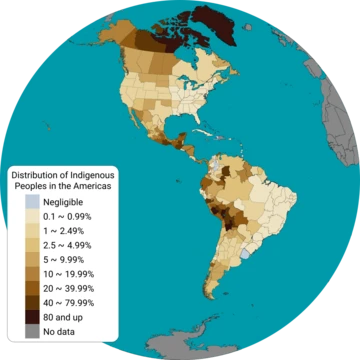
Indigenous peoples of the Americas
Native peoples of the Americas with diverse cultures and languages.

The peoples native to the Americas—often referred to as Indians, Amerindians, or Natives—are those whose ancestors lived in North or South America (including Central America and the Caribbean) before European contact. They now reside across the entire hemisphere. While they are usually minorities in their home countries, they form the majority in Greenland and nearly half the population in Bolivia and Guatemala.
In the 21st century, at least 1,000 distinct Indigenous languages are still spoken. Several—such as Quechua, Arawak, Aymara, Guaraní, Nahuatl, and various Mayan languages—have millions of speakers and are recognized as official languages in Bolivia, Peru, Paraguay, and Greenland.
Whether living in cities or rural areas, Indigenous peoples often continue many of their traditional practices, including religion, social structures, and ways of obtaining food. These cultures have changed over time, keeping old customs while adapting to modern life. Some groups remain largely isolated from outside influence, and a few are still classified as uncontacted.
The Americas are also home to millions of people of mixed Indigenous, European, and sometimes African or Asian ancestry. In Spanish-speaking countries, these individuals have historically been called mestizos. In many Latin American nations—especially Central America, Mexico, Peru, Bolivia, Ecuador, Colombia, Venezuela, Chile, and Paraguay—people with partial Indigenous heritage make up a majority or a large part of the population. In most Spanish-speaking countries, mestizos outnumber those who identify solely as Indigenous. However, because Indigenous identity is based on cultural affiliation and kinship rather than race or ancestry, mestizos are usually not counted as Indigenous unless they speak an Indigenous language or identify with a specific Indigenous culture. Moreover, many people of fully Indigenous descent who no longer follow traditional ways or speak an Indigenous language have been classified—or have classified themselves—as mestizo due to assimilation into the dominant Hispanic culture. In recent years, the number of people identifying as Indigenous has risen as individuals reclaim their heritage amid growing Indigenous-led movements for self-determination and social justice.
Historically, Indigenous peoples had a wide range of social, governmental, and subsistence systems.
Quick Facts
- Group
- Indigenous peoples of the Americas
- Population
- +60 million
Facts from the source article.
Lore & Background
The Indigenous peoples of the Americas have inhabited the Western Hemisphere since pre-Columbian times. Their ancestors arrived in multiple migrations, with Arctic peoples such as the Aleuts, Inuit, and Yupik entering later and sharing genetic and cultural ties with Siberian Indigenous peoples. Over centuries, these groups developed a wide range of societal structures, from hunter-gatherer bands to complex empires with monumental architecture, organized cities, and advanced knowledge in fields like mathematics, astronomy, and medicine.
Today, Indigenous peoples maintain aspects of their cultural practices, including religion, social organization, and subsistence, while adapting to modern needs. Some groups remain relatively isolated, with some still classified as uncontacted. The term 'Indian' originated with Christopher Columbus, who mistakenly believed he had reached the East Indies. This label implied a unity not originally accepted by the diverse groups themselves, though it has since been embraced or tolerated by many over the last two centuries.
Reader's Guide
The Indigenous peoples of the Americas are significant for their enduring presence and cultural diversity across the hemisphere. They speak at least 1,000 distinct languages, some with millions of speakers and official recognition in countries like Bolivia, Peru, Paraguay, and Greenland. Their historical contributions include complex societal systems, engineering, architecture, and agriculture. The term 'Indian' remains controversial, with preferences varying by region and community; in Canada, 'First Nations' is used, while 'Native Americans' and 'Alaska Natives' are common in the United States. Many individuals of mixed descent, historically called mestizos, outnumber Indigenous peoples in most Spanish-speaking countries, but Indigenous identity is defined by cultural identification and kinship rather than ancestry. In recent years, self-identified Indigenous populations have grown as individuals reclaim heritage amid movements for self-determination and social justice. The legacy of these peoples is reflected in ongoing efforts to preserve languages, traditions, and rights.
Did You Know?
- There are at least 1,000 different Indigenous languages of the Americas still in use in the 21st century.
- Some Indigenous groups remain relatively isolated from Western culture, with some still classified as uncontacted peoples.
- The term 'Indian' originated with Christopher Columbus, who thought he had arrived in the East Indies.
- The Métis people of Canada are distinct from the mestizos of Hispanic America.
Identity, Self-Definition, and Legal Recognition
The concept of indigenous identity in the Philippines is layered and contested. The Tagalog term katutubo serves as a broad, inclusive label for any person of indigenous origin, cutting across the 110 distinct ethnolinguistic groups that make up the archipelago's native populations. Yet formal legal recognition comes through a more precise lens: the Indigenous Peoples' Rights Act of 1997 defines indigenous peoples and indigenous cultural communities as groups identified through both self-ascription and external ascription, who have continuously inhabited communally bounded territories since time immemorial. Crucially, the law acknowledges that historical differentiation from the majority can arise not only from geographic isolation but also from active resistance to the political, social, and cultural inroads of colonization and non-indigenous religions. The definition further extends to peoples displaced from their ancestral domains or resettled outside them, recognizing that indigeneity is not erased by forced movement. This legal framework captures a reality where identity is simultaneously rooted in place, language, and customs, and shaped by centuries of colonial pressure.
Artistic Creativity and Material Culture
The tribal groups of the Philippines are widely recognized for a high degree of creativity that extends far beyond the purely functional. Utilitarian objects such as bowls, baskets, clothing, weapons, and even spoons were routinely embellished with intricate designs, reflecting a cultural ethos in which beauty and purpose are inseparable. Carved wooden figures, woven textiles, pottery, and finely crafted weapons stand as enduring testaments to this artistic tradition. In the Cordillera highlands, groups like the Ifugao, Bontoc, Kalinga, Tinguian, Kankanaey, and Ibaloi spent many centuries constructing the famous rice terraces, a feat that demanded not only agricultural knowledge but also a deep aesthetic relationship with the landscape. Meanwhile, mountain peoples such as the Isnag of Apayao, the Gaddang straddling the Kalinga-Isabela border, and the Ilongot of the Caraballo Mountains developed parallel traditions of hunting, gathering, farming, and headhunting, each group embedding its own cultural expression into daily survival. The result is a material culture as diverse as the archipelago's geography.
Regional Diversity and Linguistic Richness
The Philippines' indigenous populations are distributed across three broad geographic corridors, each with its own constellation of groups. In the north, the Cordillera Administrative Region shelters numerous Igorot subgroups including Bontoc, Balangao, Ibaloi, Ifugao, Isneg, Kalinga, Kankanaey, Tinguian, Karao, and Kalanguya, alongside the Ivatan of Batanes and scattered Aeta communities in Zambales, Tarlac, and Bataan. Central Philippines hosts upland groups like the Mangyan of Mindoro, while Eastern Visayas is home to indigenous migrants from Mindanao, particularly Mamanwa, Manobo, and Bajau peoples, many of whom speak regional lowland languages like Waray-Waray and Cebuano to facilitate trade. In the south, the Lumad umbrella encompasses the Manobo, Talaandig, Higaonon, Bagobo, Mandaya, Mansaka, Subanon, Mamanwa, B'laan, Teduray, and Tboli, among others. Linguistically, the Komisyon sa Wikang Filipino recognizes 135 local indigenous Austronesian languages, of which only Tagalog serves as a vehicular language while the remaining 134 function as vernacular tongues.
Resilience, Isolation, and the Shadow of Displacement
Throughout the colonial era, the indigenous peoples of the Philippines maintained a degree of partial isolation or independence that allowed them to retain much of their pre-colonial culture and practices. The Kalinga of Luzon, for instance, have remained notably isolated from lowland influence even into the modern period. Yet this resilience coexists with a painful history of marginalization. The Negrito populations, who once dominated the highlands throughout the islands for thousands of years, have been reduced to small, widely scattered communities, primarily along the eastern mountain ranges. In Mindanao, groups like the Bukidnon had intermarried with lowlanders for nearly a century, blurring the boundaries between indigenous and non-indigenous identity. The Indigenous Peoples' Rights Act explicitly acknowledges that some communities have been displaced from their traditional domains or resettled outside their ancestral lands, yet they retain some or all of their own social, economic, cultural, and political institutions. This duality of persistence alongside displacement defines the contemporary experience of the archipelago's 14 to 17 million indigenous persons.
Frequently Asked Questions
Who are the Indigenous peoples of the Americas?
They are the original inhabitants of North, South, Central America, and the Caribbean whose ancestors were already present before any European arrival. The term covers an enormous diversity of nations and communities spread across the entire Western Hemisphere.
How many Indigenous languages are still spoken in the Americas today?
At least 1,000 distinct Indigenous languages remain in active use in the 21st century. Major ones such as Quechua, Guaraní, Nahuatl, Aymara, and several Mayan languages each count millions of speakers.
Where do Indigenous peoples of the Americas live now?
They reside throughout the entire hemisphere, from Greenland down to the southern tip of South America. While they are typically a minority within their respective countries, they make up the majority in Greenland and nearly half the population in Bolivia and Guatemala.
What are Indigenous peoples of the Americas known for?
They are recognized for an extraordinary breadth of cultural expression, engineering, astronomical knowledge, medicine, and agricultural innovation. Their historical systems spanned hunter-gatherer bands, aquaculture communities, and large-scale civilizations that built cities, states, and empires.
What kinds of societies did Indigenous peoples in the Americas develop before European contact?
Their social structures ranged from small foraging groups to complex agricultural civilizations with urban centers and imperial governance. Aquaculture and diverse farming systems were also central to many of these communities well before any outside influence arrived.
More in Indigenous Peoples Of The World 1-24
Spotted an error? Know more?
Reader corrections go straight into our review queue. Suggest an edit · How this site is sourced