Maharashtrian cuisine
Cuisine of the Marathi people from Maharashtra, India.
Last updated
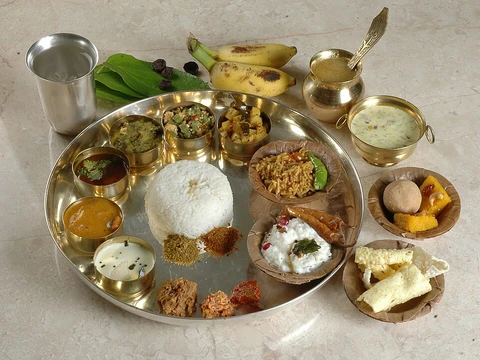
Maharashtrian or Marathi cuisine is the cuisine of the Marathi people from the Indian state of Maharashtra. It has distinctive attributes while sharing much with other Indian cuisines, and traditionally Maharashtrians have considered their food to be more austere than others. The cuisine includes mild and spicy dishes, with staples such as wheat, rice, jowar, bajri, vegetables, lentils and fruit, and peanuts and cashews often served with vegetables.
Quick Facts
- State
- Maharashtra
- Staple grains (deccan plateau)
- millets
- jwari
- bajri
- Staple grain (coastal konkan)
- rice
- Festival date (makar sankranti)
- January 14
- Festival month (holi)
- Falgun (March or April)
- Festival month (khandoba festival)
- Mārgashirsh
Facts from the source article.
Regular meals and staple dishes
The Marathi people from different regions have produced a diverse cuisine due to vast area with distinct geographical differences and food availability, with diversity extending to the family level as each family uses its own unique combination of spices and ingredients. The staple diet for most people is mostly lacto-vegetarian, though many communities such as brahmins and varkari sect members only follow that diet. On the Desh (Deccan Plateau), the traditional staple food is usually bhakri, spiced cooked vegetables, dal and rice, with bhakri being a flatbread made from sorghum (jowar) or bajri.
North Maharashtrians and urbanites prefer roti or chapati, a plain wheat bread. In the coastal Konkan region, rice is the traditional staple food, and wet coconut and coconut milk are used in many dishes. Marathi communities indigenous to Mumbai and North Konkan have their own distinct cuisine, while in South Konkan near Malvan, Malvani cuisine developed, which is predominantly non-vegetarian. In the Vidarbha region, little coconut is used in daily preparations but dry coconut and peanuts are used in dishes such as spicy savjis, as well as in mutton and chicken dishes.
Staple dishes are based on a variety of flatbreads and rice, with flatbreads including wheat-based ghadichi poli or round chapati, and bhakri made from grains such as ragi, millet, bajra or jwari. Traditionally, the staple grains of the inland Deccan Plateau have been millets, jwari and bajri, which grow well in this dry and drought-prone region. The staple meal of the rural poor was traditionally as simple as bajra bhakri accompanied by just a raw onion, a dry chutney, or a gram flour preparation called jhunka, which with bhakri has become a popular street food.
Methods and equipment
Open stove cooking is the most commonly used cooking method, with the traditional three-stone chulha largely replaced by kerosene or gas stoves. Phodani, often translated as tempering, is a technique where spices such as mustard seeds, cumin seeds, turmeric, and sometimes minced ginger and garlic are fried briefly in oil or ghee to enhance flavours, and may be the first or last step in making a bhaaji, aamti or curry. Simmering is used for most curries and bhaajis to cook meat or vegetables.
Deep frying is used for fritters such as onion bhaji or sweet fried dumplings (karanji). Pan frying uses minimal oil and is used for delicate items such as fish. A tawa, usually a concave metal pan, is used on an open stove for making unleavened flatbreads such as ghadichi poli, chapatis or bhakris. Steaming is mainly used for specialties such as ukadiche modak or aluchya wadya.
Roasting involves roasting eggplant over open fire prior to mashing for vangyache bharit. Pressure cooking is used extensively to shorten cooking time for lentils, meat and rice.
Baking is seldom used at home, with bread buns or pav used in popular street foods such as vadapav baked by commercial bakers. Sun drying is used for papad and related products called papdya and kurdaya, which keep for many months. Fermentation is used mainly for making dahi (yogurt) or home-made butter from cream-enriched milk.
Special dishes
A number of dishes are made for religious occasions, dinner parties, or as restaurant items or street food. Meat dishes include taambda rassa, a hot spicy curry with red gravy from Kolhapur; pandhara rassa, a goat curry from Kolhapur with white coconut-milk-based gravy; popati, a chicken dish with eggs and val papdi from the Raigad district; Malvani chicken; and kombdi vade, deep-fried flatbread made from spicy rice and urid flour served with chicken curry.
Seafood is a staple for many communities from the Konkan region, with popular dishes including prawn pullao rice, stuffed crabs, crab masala, Malvani fish curries, kolambi masala, stuffed pomfret, Bombay duck fry, prawns fry, bangada curry, dry rawas (rawasche sukhe), fried surmai, and fish koliwada. Various vegetable curries or gravies are eaten with rice, such as amti, a lentil or bean curry made mainly from toor dal or other lentils, sometimes with vegetables added; kadhi, made from buttermilk yoghurt and chickpea flour; solkadhi, a cold soup from coconut milk, garlic, cilantro, and kokam; saar, thin broth-like soups from various dals or vegetables; and amsulache saar made with kokam.
Chutneys and preserves include those based on raw mango, mint, tamarind, cilantro, panchamrit, garlic, and mirachicha thecha, as well as dry chutneys based on oil seeds such as flax seed, peanut, sesame, coconut and karale. Metkut is a dry preparation based on a blend of dry roasted legumes and spices. Lon'che (pickle) is prepared using a base of salt, oil and spices, with vegetables and fruits such as unripe mango, lemons, aonla, green chillies and bhokar. Muramba is made with unripe mangoes, spices, and sugar.
Special occasions and festivals
On Makar Sankranti, which usually falls on January 14, Maharashtrians exchange tilgul, sweets made of jaggery and sesame seeds, along with the customary salutation tilgul ghya aani god bola. Tilgul Poli or gulpoli are the main sweet preparations, a wheat-based flatbread filled with sesame seeds and jaggery. Marathi Hindu people fast on this day, with fasting food including chutney prepared with pulp of the kavath fruit (wood apple). As part of Holi, celebrated on the full moon evening in the month of Falgun (March or April), a bonfire is lit, and people make puran poli as a ritual offering to the holy fire.
The day after the bonfire night is called Dhulivandan, and Marathi people celebrate with colors on the fifth day after the bonfire on Rangpanchami. On Gudi Padwa, most people make puran poli, a sweet bread stuffed with chana dal, while some have puri with potato (batatyachi bhaaji) and bhaji, and shrikhand is also popular. Modak, said to be the favorite food of Ganesh, is offered in twenty-one pieces on Ganesh Chaturthi and other minor Ganesh-related events.
For Diwali, family members have a ritual bath before dawn and then sit down for a breakfast of fried sweets and savory snacks called Diwali Faral, which are offered to visitors and exchanged with neighbors. Typical sweet preparations include ladu, anarse, shankarpali and karanjya, while popular savory treats include chakli, shev and chiwda. Many Maharashtrian communities observe the Khandoba Festival or Champa Shashthi in the month of Mārgashirsh, with households performing Ghatasthapana of Khandoba.
The sixth day of the festival is called Champa Sashthi, and it is customary for many families not to consume onions, garlic and eggplant during the Chaturmas period, resuming consumption with ritual preparation of vangyache bharit (baingan bharta) with rodga.
More in Indian Cuisine by State Or Union Territory
Sources
Compiled from Wikipedia and the sources listed below. Text from Wikipedia is available under CC BY-SA 4.0; this entry is adapted from it.
- Wikipedia: Maharashtrian cuisine (CC BY-SA 4.0).
Spotted an error? Know more?
Reader corrections go straight into our review queue. Suggest an edit · How this site is sourced