Kashmiri cuisine
A meat-heavy cuisine shaped by cold winters and diverse cultural influences.
Last updated
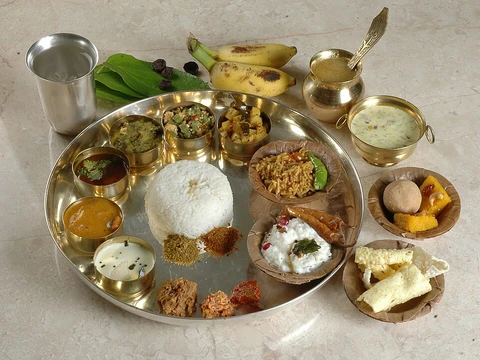
Kashmiri cuisine is the traditional culinary practice of the Kashmiri people, with rice as a staple food since ancient times. The region is notable for having the highest per capita mutton consumption in the Indian Subcontinent, with lamb or sheep preferred by Pandits and goats by Muslims. Bread is generally not part of meals, being reserved for tea times in the morning, afternoon, and evening.
Quick Facts
- Staple food
- Rice
- Preferred meat (pandits)
- Lamb or sheep
- Preferred meat (muslims)
- Goats
Facts from the source article.
History
This blending occurred through historical contacts from the Mahabharata period, the Iranian invasion of Kashmir by Darius in 516 BC, the Mauryans who established Srinagara, the Kushan Empire, and the invasion by Timur in 1398. The region's cold climate and long winters led to widespread use of slow-cooked dishes, dried vegetables, and preserved ingredients. The term kabab is Arabic in origin, korma has Turkish roots, and rogan josh, yakhaen, ab gosht, riste, and goshtabh stem from Persian sources.
A legend holds that the Kashmir valley was once a vast mountain lake, with soil containing remains of freshwater fish, fossil-oysters, and black shells of water chestnut found embedded in earth at a height of 457 metres above the valley floor. The process of amalgamation with the outer world began with the importation of primitive snake and fire worship from Iran. Since Paleolithic times, serpents were worshipped and buried with insects as provisions for the afterlife, and grains were splashed at shrines and graves.
Investigations at the Overa valley of Pahalgam have revealed Paleolithic stone tools, including single-edged blades used for preying on animals.
Ingredients and seasoning
Kashmiri cuisine uses mutton (meat of mature sheep) or goat's meat, along with chicken, fish, and game. More than 75% of the sheep population are cross breeds called Kashmir Merino, providing both meat and wool. The Bakkarwal goats belong to the rare Kaghani breed, prized as one of the world's best for meat. Beef is consumed in towns and villages for its affordability, and in some villages, beef-eaters are huddled separately from those served mutton during wazwan feasts.
There is a class divide between those who eat kat maaz (mutton), considered elite, and those who eat bad maaz (beef), considered lower-class. The largest rabbit breeding farm in North India is in Wussan village of Baramulla district, and rabbit meat is becoming popular as a substitute for sheep and goat meat, especially among people with cardiac problems. The local Kashmir Aenz is the first and only recognised domestic geese breed in India, with goose rearing dating back to ancient times.
Geese pickles are made in affluent families for winter use. Trout eggs were sent from the UK in 1899 but perished; a second consignment arrived from Scotland the next year. Rainbow and brown trout adapted well to the valley, while indigenous snow trout (alegaad) continues to flourish. Anantnag district was declared the 'Trout District of India', with 137 private fish farms.
Specialties by season
Spring is a season of rejuvenation after winter, with picnics planned around food. The countryside features white and pink blossoms of almond, peach, and cherry, along with bright-yellow mustard blooms. Pear blossoms appear in thick clusters, and apricot blossoms are white with a pink or reddish hue, growing from late spring through early summer. Beans are a spring vegetable, and cherries are a fruit of late spring and summer.
Coriander is a cool herb whose season predominates between spring and summer, while garlic is found mainly in spring through fall. Melons are grown in spring and summer, and tender spring-time haakh (collard greens) are called kaanul. The lotus stem (nadur) harvesting season starts in September. The samovar bubbles with saffron and cardamom, and cookie-shaped kandi kulchas made of flour, butter, sugar, and poppy seeds are dipped into tea.
Dandelion leaves (haand) are foraged on foot. Paddy is cut with sickles and stacked to dry, chestnuts are roasted, and bulbous garlic and red potatoes are prominent. Saffron fields bloom in Pampore, and maize and walnut trees are harvested. Apples from Sopore and Shopian are transported across the country.
Cooking methods
Haakh leaves are braised in lots of water, kept submerged with a wooden spatula. Mustard oil, used extensively, imparts extra flavour. Much of Kashmiri cooking relies on a fragrant meat stock or court-bouillon, with the main skill of a wazwan lying in preparing this stock from onions and shallots. Freshly shaped meatballs (rista and goshtabeh) are poached in lamb stock flavoured with cinnamon and black cardamom.
Whole spices—clove, cardamom, cinnamon, bay leaves—must be tempered in oil; frying too little leaves the dish lifeless, while a second too much brings bitterness. Hot ghee or mustard oil is poured on top and garnished with fried praan (shallots) paste and saffron extract. Sliced onions are caramelised, fried until golden brown, and pureed with minimal water. Yoghurt must be a fatty, thick emulsion, with dried mint added at the end.
Some dishes are coloured by saffron extract or mawal (dried cockscomb flower), and Kashmiri chilli is sometimes added in excess for red colour. Tomato is incorrectly used as a substitute when mawal and rattanjot are unavailable; no authentic version cooked in Kashmir has tomatoes. Smoking mustard oil is a treatment known as durust. In dum pukht cooking, the vessel in the shab deg is sealed with dough and cooked over a simmering fire through the winter night.
Goshtabeh and rista are rarely found outside the valley because their texture requires freshly slaughtered sheep pounded before rigor mortis sets, with air incorporated by folding while beating. Dandelion stalks (haand) must be blanched four times to remove bitterness.
Did You Know?
- Kashmiris do not use the word 'Kashmiri Chai'; the most popular drink is a pinkish salted tea called 'noon chai', made with black tea, milk, salt, and bicarbonate of soda.
- During Ramadan, the menu includes khajur ka laddoo (date balls), babribyol (basil seeds), kulfi, phirin, seemni, fruit chaat, fruit custard, kateer, and noon chai.
- Tibetan exiles in Kashmir run popular momo (beef dumplings) shops and Tibetan restaurants near the Hari Parbat fort, offering dishes like Cantonese chicken and kumloo wonton.
More in Indian Cuisine by State Or Union Territory
Sources
Compiled from Wikipedia and the sources listed below. Text from Wikipedia is available under CC BY-SA 4.0; this entry is adapted from it.
- Wikipedia: Kashmiri cuisine (CC BY-SA 4.0).
- Word definitions: the Codexery glossary, each quoted from its Wikipedia article.
Spotted an error? Know more?
Reader corrections go straight into our review queue. Suggest an edit · How this site is sourced