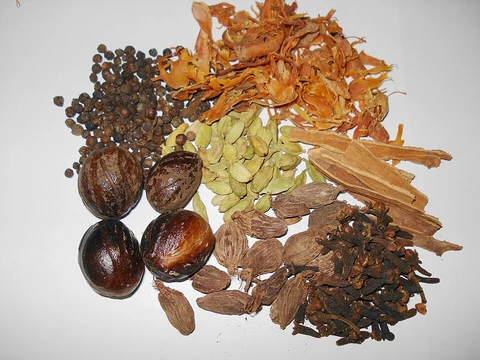
Garam masala
A ground spice blend from the Indian Subcontinent.
Garam masala is a blend of ground spices that originated in the Indian subcontinent, with the name translating to "warm spices" from Hindi.[1][2]
Quick Facts
- Origin
- Indian Subcontinent
- Cuisines
- Indian
- Pakistani
- Nepalese
- Bangladeshi
- Common ingredients
- cardamom
- cinnamon
- cumin
- cloves
- bay leaves
- star anise
- peppercorns
- Regional variation
- differs regionally; none considered more authentic than another
Facts from the source article.
Key facts and history
A typical Indian version contains fennel, Indian bay leaves, black and white peppercorns, cloves, cinnamon or cassia, mace, black and green cardamom, cumin, coriander seeds, and red chili powder.[3] The composition varies regionally and by personal taste, with no single recipe considered more authentic than another.[4] Some recipes call for spices to be ground with water, vinegar, or other liquids to make a paste.[5] Regional variations determine the exact spice mixture in garam masala, yet it frequently features cardamom, cinnamon, cumin, cloves, bay leaves, star anise, and peppercorns.[6]
Nuts, onions, garlic, star anise, asafoetida, chili, stone flower, or cubeb appear in certain recipes.[4] In West Bengal, Odisha, Assam, and Bangladesh, the blend may be limited to just cardamom, cinnamon, and clove.[4] Ground cinnamon or cassia, cardamom, cloves, and black pepper form the typical composition of the Burmese masala spice blend.[7] Marinades, pickles, stews, and curries are among the many dishes that incorporate garam masala.[6]
What the cited sources add
A 2022 Bon Appétit article by Gurjar describes garam masala as a warm, heady spice blend that powers much South Asian cooking, and notes that Bengali garam masala may consist only of cinnamon, cardamom, and clove.[2] The same article states that for best application, garam masala needs to be cooked and should not be sprinkled raw over cucumbers or dips.[2] A 2023 Taste of Home article explains that garam masala softens but does not fade during cooking, making it suitable for long-simmering pot roasts and stews.[8] That article also notes that garam masala can be a very subtle, aromatic addition or a bold, defined taste depending on the amount used.[8]
A 2015 blog post by Harris provides a recipe for no-cook pickled onions flavored with garam masala, noting that the spice intensity increases after 24 hours.[9]
References
- Wikipedia, "Garam masala" (CC BY-SA 4.0), which cites: "Radhuni Garam Masala - Online Grocery Shopping and Delivery in Bangladesh", Grocery (we also read that source) en.wikipedia.org
- Gurjar, "Garam Masala Is My Love Language", Bon Appétit, 16 May 2022. facts only, no text reused. bonappetit.com
- Wikipedia, "Garam masala" (CC BY-SA 4.0), which cites: Pitre, "Indian Instant Pot® Cookbook: Traditional Indian Dishes Made Easy and Fast", Rockridge Press, 19 September 2017, p. 24 (we also read that source) en.wikipedia.org
- Wikipedia, "Garam masala" (CC BY-SA 4.0), which cites: Rama Rau, "The Cooking of India (Foods of the World)", Time Life Education, 1969 (we also read that source) en.wikipedia.org
- Wikipedia, "Garam masala" (CC BY-SA 4.0), which cites: Bhide, Monica, "Garam Masala: A Taste Worth Acquiring ". npr.org. 27 April 2011 (original not read by us) en.wikipedia.org
- Wikipedia, "Garam masala" (CC BY-SA 4.0), which cites: Gurjar, "Garam Masala Is My Love Language", Bon Appétit, 16 May 2022; "Garam Masala: A Simple Road to Delicious Indian Dishes", The Spruce Eats, 31 May 2024; "14 Flavorful Recipes Using Garam Masala", Taste of Home, 10 November 2023; Harris, "Garam Masala No Cook Pickled Onions", www.thenourishinggourmet.com, 4 January 2015 (we also read that source) en.wikipedia.org
- Wikipedia, "Garam masala" (CC BY-SA 4.0), which cites: "To Myanmar with Love: A Travel Guide for the Connoisseur", ThingsAsian Press, 2009 (we also read that source) en.wikipedia.org
- "14 Flavorful Recipes Using Garam Masala", Taste of Home, 10 November 2023. facts only, no text reused. tasteofhome.com
- Harris, "Garam Masala No Cook Pickled Onions", www.thenourishinggourmet.com, 4 January 2015. facts only, no text reused. thenourishinggourmet.com
Each numbered sentence above was checked against the source it cites before publication. Sentences citing Wikipedia adapt text from the English Wikipedia article Garam masala (contributors), used under CC BY-SA 4.0; this entry is available under the same licence. Other sources were used for facts only; no text or images are copied from them.
Spotted an error? Know more?
Reader corrections go straight into our review queue. Suggest an edit · How this site is sourced