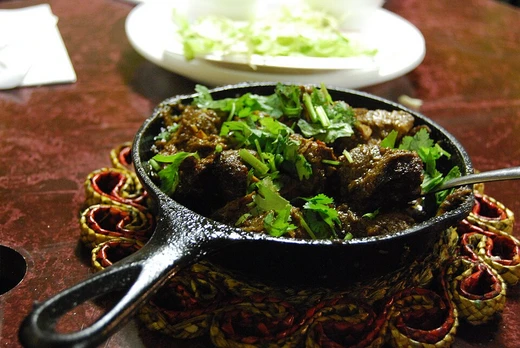
Dal
Dried split pulses central to South Asian cuisine.
Dal refers to dried, split pulses such as lentils, peas, and beans that are a staple food in South Asian countries. These pulses may or may not require soaking before cooking and are also used to describe soups prepared from them. Dal forms an important part of the cuisines of the Indian subcontinent.
Quick Facts
- Region
- Indian subcontinent
- Main ingredients
- Lentils, peas or beans
Facts from the source article.
Use
Dal are often prepared in three forms: unhulled and whole (sabut), unhulled and split (chilka), and hulled and split (dhuli). Hulling improves digestibility and palatability, and significantly increases protein while reducing dietary fibre content. Pulses with outer hulls intact are also popular. Dal is frequently eaten with flatbreads such as rotis or chapatis, or with rice; the rice combination is called dal bhat in Nepali, Gujarati, and other Indian languages. Certain types of dal are fried, salted, and eaten as a dry snack, and savory snacks are made from fried paste of soaked and ground dals with spices and nuts. In South India, dal is called paruppu and is used to make sambar and parippu mixed with charu and rice. Ground chana dal becomes besan, used in dishes like bhaji and Mediterranean farinata.
Common ingredients
Pigeon pea (toor dal) is called thuvaram paruppu in Tamil Nadu, thuvara parippu in Kerala, and is the main ingredient for sambar. In Karnataka it is togari bele, used in bisi bele bath; in Telugu it is kandi pappu for pappu charu; in northern India it is arhar dal. Chana dal is produced by removing the outer layer of black chickpeas and splitting the kernel; it can be done at home by soaking and rubbing. Yellow split peas are prevalent in Indian communities of Guyana, Fiji, Suriname, Jamaica, South Africa, Mauritius, Trinidad and Tobago, and are popular among Indians in the United States; the whole dried pea is called matar or matar dal in India and is the main ingredient in Bengali street food ghugni. Split mung beans (mung dal) are most popular in Bangladesh and West Bengal, and used in Tamil ven pongal; roasted and salted mung bean is a snack. Urad dal (black gram) is primary for idli and dosa, and for East Indian bori; it is rich in protein. Masoor dal is split red lentils; rajma dal is split kidney beans. Mussyang is made from dals of various colours in hilly regions of Nepal. Panchratna dal is a mixture of five varieties; navrangi dal is multicoloured from Himachal Pradesh. Moth bean is used for bikaneri bhujia, misal, and usal. Pulses may be split but not hulled, distinguished by the word chilka.
More in Pakistani Cuisine
Spotted an error? Know more?
Reader corrections go straight into our review queue. Suggest an edit · How this site is sourced