Penalty (ice hockey)
A punishment for rule infractions, enforced by time in the penalty box.

A penalty in ice hockey is a punishment for an infringement of the rules. Most penalties are enforced by sending the offending player to a penalty box for a set number of minutes, during which the player may not participate in play. The offending team may not replace the player on the ice, leaving them short-handed, while the opposing team is said to be on a power play. The statistic used to track penalties is called 'penalty minutes' (PIM), representing the total assessed length of penalties each player or team has accrued.
- First codified rules
- Halifax Rules
- First indoor game year
- 1875
- First montreal rules year
- 1877
- Penalty minutes abbreviation
- PIM
- Minor penalty length
- 2 minutes
- Major penalty length
- 5 minutes
- Misconduct penalty length
- 10 minutes
Lore & Background
The first codified rules of ice hockey, known as the Halifax Rules, were brought to Montreal by James Creighton, who organized the first indoor ice hockey game in 1875. Two years later, the Montreal Gazette documented the first set of 'Montreal Rules', which noted that 'charging from behind, tripping, collaring, kicking or shinning the ball shall not be allowed'. The only penalty outlined by these rules was that play would be stopped, and a 'bully' (faceoff) would take place. Revised rules in 1886 mandated that any player in violation of these rules would be given two warnings, but on a third offence would be removed from the game.
It was not until 1904 that players were ruled off the ice for infractions, with a referee able to assess a two-, three- or five-minute penalty depending on severity. By 1914, all penalties were five minutes in length, reduced to three minutes two years later, and the offending player was given an additional fine. When the National Hockey League (NHL) was founded in 1917, it mandated that a team could not substitute for any player who was assessed a penalty, thus requiring them to play shorthanded for the duration. The penalty was shortened to two minutes for the 1921–22 season, while five- and ten-minute penalties were added two years later.
Both the NHL and the International Ice Hockey Federation (IIHF) recognize common penalty degrees: minor, major, misconduct, game misconduct, and match penalties. A minor penalty is two minutes in length and can end early if the opposing team scores a power play goal. A major penalty is five minutes and cannot end early even if a goal is scored, except in overtime. A misconduct penalty is ten minutes, and the player may be substituted for on the ice.
Reader's Guide
Penalties are a fundamental aspect of ice hockey, shaping the flow and strategy of the game. The article notes that most penalties are enforced by sending the offending player to a penalty box for a set number of minutes, during which the player may not participate in play. The offending team may not replace the player on the ice, leaving them short-handed, while the opposing team is said to be on a power play. The statistic used to track penalties is called 'penalty minutes' (PIM), representing the total assessed length of penalties each player or team has accrued.
The historical development of penalties, as described in the article, shows a progression from simple stoppages of play and warnings to the structured system of timed penalties and shorthanded play. The NHL's 1917 rule mandating no substitution for a penalized player established the modern shorthanded dynamic. The article also details the evolution of penalty lengths, from two-, three-, and five-minute penalties in 1904 to the standardized two-minute minor and five-minute major by the 1921–22 season.
The article further explains the nuances of different penalty types, such as coincidental minors, double or triple minors, and the combination of misconduct with minor penalties. It also notes that starting with the 2019–20 season, NHL referees are required to use on-ice video review for all major (non-fighting) penalties to either confirm the call or reduce the call to a minor penalty. Under IIHF rules, every major penalty carries an automatic game misconduct penalty.
Did You Know?
- The first codified rules of ice hockey were known as the Halifax Rules.
- The NHL changed the rule that teams were shorthanded for the entire length of a minor penalty after the 1955–56 season.
Etymology and Early Heritage
The word "rink" traces back to Scots, where it simply meant "course." Originally the term referred to the playing surface for curling, an entirely different winter sport. In hockey's earliest days, teams took to these curling rinks because purpose-built hockey facilities did not yet exist. Even after dedicated hockey venues were constructed, the name stuck and became the universal term for the ice surface. The physical specifications of the modern rink can be traced to the Victoria Skating Rink in Montreal, which opened in 1862. That facility hosted the first indoor hockey game in 1875, and its ice measured 204 by 80 feet. The distinctive rounded corners that define every hockey rink today are attributed to the design of the Montreal Arena, built in 1898. So the very shape players skate on carries the DNA of 19th-century Montreal infrastructure, a lineage stretching back more than a century and a half.
Two Rink Standards Across the World
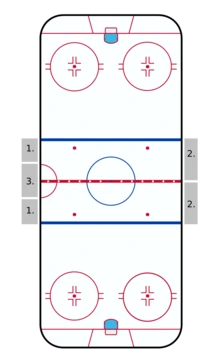
Hockey is played on two distinct rink sizes, each tied to a different governing body and geographic tradition. The North American standard, codified by the NHL, calls for a surface 200 feet long and 85 feet wide, with a 28-foot corner radius. Goal lines sit 11 feet from the end boards, and the blue lines are positioned 75 feet from those boards, leaving them 50 feet apart. The international standard, set by the IIHF for Olympic and European competition, stretches to 60 metres in length with a width ranging from 26 to 30 metres and a corner radius between 7 and 8.5 metres. Here the goal lines are 4 metres from the end boards, and the blue lines are 15 metres apart. The most striking contrast is width: the international surface is up to 13.4 feet wider than its North American counterpart, producing a noticeably different width-to-length ratio that changes how players space themselves and how the game flows.
Painted Geometry: Lines, Spots, and the Goal
The ice surface is a carefully engineered grid of lines and circles that governs virtually every ruling in the game. A thick red centre line splits the rink crosswise and serves as the reference for icing calls; in the NHL it must carry a distinctive patterned marking so it is never mistaken for the solid blue lines. Two blue lines divide the ice into three zones and are the basis for offside determinations. Thin red goal lines at each end mark where a puck must fully cross for a goal to count. Nine faceoff spots are distributed across the surface: two in each defensive zone, two in the neutral zone, and one at centre ice. The centre spot and its surrounding circle are painted blue, 30 feet in diameter with a 12-inch spot at the middle. All other spots are red, two feet across, with two vertical red bars and a red centre band. At each end, the goal frame opens 72 inches wide by 48 inches tall, with a 40-inch-deep footprint, and the entire puck must cross the goal line for a score.
The Trapezoid and the Case for Flow
One of the more debated rule innovations in recent hockey history is the goaltender trapezoid, a restriction that limits where a netminder may handle the puck behind the goal line. The rule was first tested during the 2004–05 AHL season, applied for the first seven weeks of that campaign. It draws a symmetrical trapezoid centred on the goal, with its bases formed by the goal line and the end boards. If a goaltender touches the puck outside that trapezoidal zone, a minor penalty for delay of game is assessed, served by a teammate. The driving motivation was to keep the puck in play longer and sustain offensive pressure, reducing the ability of a skilled puck-handling goalie to simply clear the zone. The rule is nicknamed after Martin Brodeur, the former New Jersey Devils and St. Louis Blues goaltender whose exceptional stick skills made him a prime target for the restriction.
Frequently Asked Questions
What is a penalty in ice hockey?
A penalty is the standard punishment a player receives for breaking a rule during a game. The offending player is sent to the penalty box for a set duration and cannot rejoin play until that time is served.
How long do minor and major penalties last?
A minor penalty carries a two-minute sentence, while a major penalty requires five minutes in the box. These are the two most common durations a referee will assign during play.
What happens to the teams when a penalty is called?
The penalized team must play with one fewer skater on the ice because they cannot substitute for the player serving time. The opposing team is then said to be on a power play, giving them a numerical advantage.
What does PIM mean in hockey statistics?
PIM stands for penalty minutes and tracks the cumulative length of all penalties a player or team has received. It serves as the standard measure of a player's time spent in the box over a season.
Where did the penalty system in hockey first appear?
The earliest codified penalty provisions trace back to the Halifax Rules, which laid the groundwork for structured rule enforcement in the sport. The concept was further refined in the Montreal Rules of 1877 as the game evolved.
More in Ice Hockey Rules and Play 1-18
Spotted an error? Know more?
Reader corrections go straight into our review queue. Suggest an edit · How this site is sourced