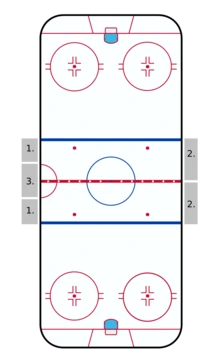
Assist (ice hockey)
Assists are credited to up to two players per goal.

In ice hockey, an assist is a statistic credited to up to two players of the scoring team who shot, passed, deflected, or otherwise touched the puck in a way that enabled a goal, provided no defender plays or possesses the puck in between. Assists are notable because they contribute to a player's total points, and the leader of total points throughout an NHL season is awarded the Art Ross trophy.
- Maximum assists per goal
- 2
- Point value per assist
- 1
- Point value per goal
- 1
- Award for points leader
- Art Ross trophy
- Governing bodies cited
- Hockey Canada, USA Hockey
- Hockey canada rule
- Rule 6.6 Goals and Assists Hockey Canada
- Usa hockey rule reference
- Rule Reference 617(a)
Lore & Background
The awarding of an assist is universal across national rulebooks, though specifics vary. According to the Hockey Canada rulebook, Rule 6.6, each goal and assist counts one point in scoring records, with a maximum of two assists per goal. The USA Hockey Officiating Rulebook specifies that on a rebound shot, only one assist can be given to the player who took the original shot, as long as the goaltender did not gain complete control of the puck. Special cases include give-and-go plays: if a player passes to another who then completes a give-and-go with a different player for a goal, the player who made the pass that set up the goal gets the primary assist, and the player who passed to the eventual goal scorer before the give-and-go gets the secondary assist. Possession can pass between the eventual goal scorer and assist getters an unlimited number of times, and this standard still applies.
Reader's Guide
The assist is a fundamental statistic in ice hockey, directly tied to a player's total points, which are the sum of goals and assists. The article states that neither a primary nor secondary assist is worth more than the other, and neither is worth more or less than a goal. The leader of total points throughout an NHL season receives the Art Ross trophy, underscoring the significance of assists in determining individual achievement. The rule that only one point can be credited to any one player on a goal scored prevents a player from receiving both a goal and an assist for the same goal, or two assists for the same goal. This ensures that assists are distributed among different players. The universal application of assist rules across countries, as noted in the article, highlights its consistent role in scoring records, though specific rulebooks like those of Hockey Canada and USA Hockey provide detailed conditions, such as on rebound shots.
Did You Know?
- A maximum of two assists can be credited on any one goal.
- One player cannot be credited with both a goal and an assist for the same goal scored.
Etymology and Historical Roots
The word "rink" traces back to Scots, where it simply meant a course or track. The term originally described the playing surface for curling, and in hockey's earliest days the sport was largely contested on those same curling venues. Even after purpose-built hockey facilities emerged, the borrowed name stuck, carrying a piece of curling's vocabulary into hockey's permanent lexicon. The physical specifications of the modern rink also carry deep historical roots. The surface dimensions at the Victoria Skating Rink in Montreal, constructed in 1862, measured 204 by 80 feet, and it was on that ice that the first indoor hockey game took place in 1875. The distinctive rounded corners that define every hockey surface today are attributed to the design of the Montreal Arena, which opened in 1898. Together, these early structures established the geometric template that both North American and international leagues still follow, making a pair of nineteenth-century Montreal buildings the quiet architects of every rink in the world.
Two Standards of Ice
Hockey players around the world face two distinct playing surfaces. The international standard, governed by the IIHF, calls for a length of exactly 60 metres and a width ranging from 26 to 30 metres, with corner radii between 7 and 8.5 metres. The North American standard, set by the NHL, specifies 200 by 85 feet, roughly 61 by 25.9 metres, and a corner radius of 28 feet. The most consequential difference lies in width: the international surface can be up to 13.4 feet wider than its North American counterpart, producing a noticeably different width-to-length ratio that changes how space opens up during transitions. Line placements also diverge. Under IIHF rules the blue lines sit 15 metres apart and the goal lines are 4 metres from the end boards. In the NHL, blue lines are 50 feet apart and goal lines rest 11 feet from the boards. These variations mean a player accustomed to the tighter North American box will experience a fundamentally different spatial relationship on Olympic ice.
Painted Geometry: Lines and Faceoff Spots
The ice surface is divided by a precise system of painted lines, each serving a distinct gameplay function. A thick red centre line, which must feature a distinctive interval pattern to differentiate it from the blue lines, splits the rink crosswise and is the reference point for icing calls and, in some leagues, two-line pass violations. Two solid blue lines partition the ice into three zones and determine offside infractions: an attacking player who crosses into the opposing zone ahead of the puck is called offside. Near each end, a thin red goal line spans the full width and serves as the benchmark for both goal validation and icing determinations. Beyond the lines, nine faceoff spots are distributed across the surface—two in each defensive zone, two flanking the neutral zone, and one at centre ice. The centre spot and its surrounding circle are painted blue, measuring 30 feet in diameter with a 12-inch solid dot at the middle. All other spots are red, each a 2-foot circle containing two vertical red bars with a red-painted strip between them. Hash marks near the end-zone spots further delineate legal player positioning during faceoffs.
The Goal, the Crease, and the Brodeur Rule
At each end of the rink, a metal frame holds a cloth net that defines the scoring target. Under NHL specifications the opening measures 72 inches wide by 48 inches tall, with a depth of 40 inches. A goal is only valid when the entire puck has fully crossed the entire goal line. Directly in front of each net sits the crease, a protected zone designed to shield the goaltender from interference. In North American professional play the crease is formed by straight lines extending 4.5 feet perpendicularly from the goal line, connected by a 6-foot-radius arc, and is typically painted blue for visibility. A more recent innovation is the goaltender trapezoid, nicknamed after Martin Brodeur. First tested during the 2004–05 AHL season, the rule restricts where a goaltender may handle the puck behind the goal line, confining them to a symmetrical trapezoid bounded by the goal line and end boards. Violations draw a minor delay-of-game penalty served by a teammate. The rule was crafted to diminish the advantage of elite puck-handling goalies and to keep the puck in play for longer offensive sequences.
Frequently Asked Questions
What is an assist in ice hockey?
An assist is a credit awarded to one or two teammates who helped create a goal by passing, deflecting, or otherwise touching the puck before the scoring shot. The critical condition is that no opposing player touches or gains possession of the puck between the assist touch and the goal.
How many assists can be given on a single goal?
A maximum of two players can receive an assist for any given goal. This two-assist cap is the standard rule cited by both Hockey Canada (Rule 6.6, Goals and Assists) and USA Hockey.
How many points is an assist worth?
Each assist is worth exactly one point, the same value as a goal. A player's season point total is simply the sum of their goals plus their assists.
What NHL award is connected to leading in total points (goals plus assists)?
The Art Ross Trophy is presented to the NHL player who accumulates the most total points over a regular season. Because assists count one-for-one toward that total, they are a major factor in winning the award.
Does a deflection or a loose touch count as an assist?
Yes — any touch, pass, or deflection that directly enables the goal qualifies, as long as no defender plays on the puck afterward. The assist does not have to be a clean, deliberate pass; any contributing touch before the shot is eligible.
More in Ice Hockey Rules and Play 1-18
Spotted an error? Know more?
Reader corrections go straight into our review queue. Suggest an edit · How this site is sourced