Goal (ice hockey)
A goal is scored when the puck fully crosses the goal line.

In ice hockey, a goal is the primary method of scoring, awarding one point to the team attacking the goal scored upon. A goal is scored when the puck entirely crosses the goal line between the two goal posts and below the goal crossbar. The term also refers to the rectangular structure consisting of two vertical goalposts, a horizontal crossbar, and a net attached to the back.
- Goal width
- 72 inches (180 cm)
- Goal height
- 48 inches (120 cm)
- Goal depth
- 40 inches (100 cm)
- Most goals in nhl season
- 92 (Wayne Gretzky)
- Fastest to 50 goals
- 39 games (Wayne Gretzky, 1981–82 season)
- Rocket richard trophy
- awarded to NHL player with most goals
Lore & Background
The ice hockey goal is rectangular, with a front frame made of steel tube painted red. The entire goal is considered inbounds, and it is legal to play the puck behind it. A goal is not allowed under several conditions, including if the puck is sent into the goal from a stick raised above the crossbar, intentionally kicked or batted by an attacking player, enters after deflecting off an official, or if the goaltender is impeded. Additionally, a goal does not count if the scoring team was offside, had too many players on ice, used a broken stick, or if the net was dislodged prior to the puck entering. The NHL abolished the rule disallowing a goal if an attacking player had a skate or stick in the goal crease after the disputed triple-overtime goal in the 1999 Stanley Cup Finals, where Brett Hull scored with his left skate in the crease and the play was not reviewed.
Reader's Guide
The goal is the central objective of ice hockey, with teams striving to score more than their opponent. Forwards are primarily concerned with scoring, while goaltenders and defencemen focus on preventing goals. Credit for a goal goes to the last player on the scoring team to touch the puck before it enters the net, with up to two assists possible. The number of goals scored is a closely watched statistic; the Rocket Richard Trophy is presented annually to the NHL player with the most goals. Wayne Gretzky holds the record for most goals in an NHL season (92) and was fastest to 50 goals (39 games). In recent years, goal scoring has decreased, with some attributing this to larger goaltending equipment and defensive systems like the neutral zone trap. To increase scoring, the AHL and later the NHL adopted rule changes including narrowing the neutral zone, restricting goaltender puck play, and modifying offside rules. Various types of goals are tracked—even strength, power play, shorthanded, empty net, penalty shot, awarded, own goal, overtime, go-ahead, game-tying, and game-winning—but all count equally toward the score.
Did You Know?
- A goal may be awarded if a team pulls its goaltender and commits a foul that would normally trigger a penalty shot.
- Wayne Gretzky scored 92 goals in the 1981–82 season, the most in NHL history.
- A goal does not count if the puck breaks into two or more pieces before entering the goal.
Etymology and Historical Roots
The word "rink" traces back to Scots, where it simply meant "course." The term originally described the playing surface for curling, and when ice hockey first took shape, it was largely played on those same curling surfaces. Even after purpose-built hockey facilities emerged, the name stuck, carrying a linguistic echo of the sport's earliest physical home. The geometric template for modern rinks can be traced to the Victoria Skating Rink in Montreal, constructed in 1862. That venue hosted the first indoor hockey game in 1875, and its ice surface measured 204 by 80 feet. The distinctive rounded corners that define every hockey rink today are attributed to the design of the Montreal Arena, built in 1898. These two Montreal structures essentially established the spatial DNA that every subsequent rink would inherit, whether in North America or across the international stage.
Two Standards, Two Philosophies
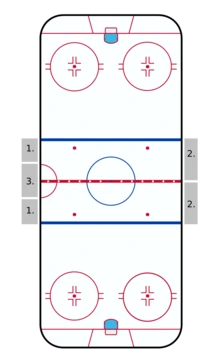
Ice hockey operates under two distinct rink-size specifications, each reflecting the governing body that oversees play. The North American standard, codified by the NHL, produces a surface of 200 by 85 feet with a 28-foot corner radius. Goal lines sit 11 feet from the end boards, and the blue lines are positioned 75 feet from those boards, leaving them 50 feet apart. The international standard, set by the IIHF for Olympic and European competition, calls for a length of 60 metres and a width ranging from 26 to 30 metres, with corner radii between 7 and 8.5 metres. Goal lines must be 4 metres from the end boards, and blue lines are spaced 15 metres apart. The most consequential difference lies in width: the North American rink is roughly 13.4 feet narrower than its international counterpart, producing a noticeably tighter width-to-length ratio that shapes the speed and spatial dynamics of the game.
The Painted Language of the Ice
Every line, circle, and spot on a hockey rink serves a specific regulatory function. The thick centre line, which must feature a distinctive repeating pattern to differentiate it from the solid blue lines, is used to judge icing and, in some leagues, two-line pass violations. The two blue lines partition the ice into three zones and determine offside calls: an attacking player who crosses into the opposing zone before the puck is offside. Thin red goal lines at each end govern both goal decisions and icing calls. Nine faceoff spots are distributed across the surface—two in each defensive zone, two in the neutral zone, and one at centre ice. The centre spot and its surrounding circle are painted blue, with the circle measuring 30 feet in diameter and the spot itself a solid 12-inch disc. All other faceoff spots are red, each 2 feet in diameter, containing two vertical red lines with a red-painted strip between them set against a white background.
The Goal Frame, Crease, and the Trapezoid
At each end of the rink, the goal consists of a metal frame with a cloth net. Under both NHL and IIHF rules, the entire puck must fully cross the goal line for a goal to count. The NHL specifies an opening 72 inches wide by 48 inches tall, with a 40-inch-deep footprint. In front of each net lies the crease, a protected zone ensuring the goaltender can operate without interference. In North American professional play, the crease is formed by straight lines extending 4.5 feet perpendicularly from the goal line, connected by a 6-foot-radius arc, and is typically painted blue for visibility. Behind the goal, the "Martin Brodeur" trapezoid restricts where a goaltender may handle the puck. First trialled during the 2004–05 AHL season, the rule limits puck handling to a symmetrical trapezoid bounded by the goal line and end boards, penalising violations with a minor delay-of-game call. The rule was designed to reduce the impact of elite puck-handling goaltenders and promote sustained offensive pressure.
Frequently Asked Questions
What counts as a goal in ice hockey?
A goal is recorded when the puck completely crosses the goal line between the two posts and beneath the crossbar, awarding one point to the attacking team. This is the fundamental way teams score in the sport.
What are the official dimensions of a hockey goal?
The standard goal measures 72 inches (180 cm) wide by 48 inches (120 cm) tall, with a net extending 40 inches (100 cm) deep behind the posts. These dimensions are consistent across professional and most amateur levels of play.
Who holds the NHL record for most goals in a single season?
Wayne Gretzky set the all-time mark with 92 goals during the 1981–82 season. No other player has ever surpassed that single-season total.
What is the Rocket Richard Trophy?
It is the NHL award given to the player who scores the most goals during a regular season. The trophy is named after legendary Canadian scorer Maurice "Rocket" Richard.
How quickly has a player ever reached 50 goals in an NHL season?
Wayne Gretzky reached the 50-goal milestone in just 39 games during the 1981–82 campaign, the fastest pace in league history. That remarkable run remains the benchmark for offensive dominance.
More in Ice Hockey Rules and Play 1-18
Spotted an error? Know more?
Reader corrections go straight into our review queue. Suggest an edit · How this site is sourced