Horse's neck
IBA-recognized cocktail with brandy, ginger ale, and lemon peel.

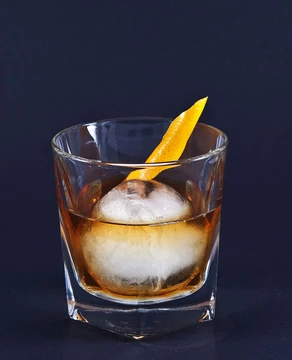
The horse’s neck is an IBA-recognized cocktail, easily spotted by its long, curling strip of lemon rind. The drink combines brandy (or occasionally bourbon) with ginger ale, and a long spiral of lemon peel is draped over the rim of an old fashioned or highball glass. A similar Canadian version, the rye and ginger, uses Canadian whisky and ginger ale instead.
The drink dates back to at least the 1900s, when it was a non-alcoholic mix of ginger ale, ice, and lemon peel. By the 1910s, brandy or bourbon could be added, creating a “horse’s neck with a kick” or a “stiff horse’s neck.” The alcohol-free version lingered in upstate New York into the late 1950s and early 1960s, but eventually faded out. The IBA classifies the drink as a long drink. Franklin Roosevelt occasionally drank the non-alcoholic version; according to the head of his Secret Service detail, the President would order a horse’s neck—ginger ale and lemon peel, no alcohol—when at gatherings with prolonged drinking.
The horse’s neck appears in several films and books. In the 1934 film *The Captain Hates the Sea*, Alison Skipworth’s character demands one, telling the waiter to “be sure to add a big horse.” In the 1935 musical *Top Hat*, Madge (Helen Broderick) gives up trying to order in Italian and simply says “horse’s neck.” In the 1935 film *No Limit*, George Formby’s character accidentally orders one while trying to get a lemonade. In the 1937 novel *Challenge*, Bull-Dog Drummond’s friend Algy Longworth, nursing a hangover, asks his butler for a horse’s neck. The non-alcoholic version is referenced in two 1950 film noirs: *In a Lonely Place*, where a hat-check girl says adding lemon twist to ginger ale is called a horse’s neck, and *Outside the Wall*, where a character lists its two ingredients. The drink became popular in Royal Navy wardrooms in the 1960s, replacing pink gin as the officers’ choice; an early reference appears in the 1957 film *Yangtse Incident*, set in 1949. At naval cocktail parties, stewards served it pre-mixed in jugs alongside gin and tonic, asking “H-N or G&T, sir?” In the 1979 BBC series *Tinker, Tailor, Soldier, Spy*, Alec Guinness’s character George Smiley orders a brandy and ginger ale.
Quick Facts
- Base
- Brandy
- Ingredients
- 4 cL (1 part) Brandy / 12 cL (3 parts) Ginger ale / Dash of Angostura bitter (optional)
- Served
- On the rocks: poured over ice
- Garnish
- Long spiral of lemon zest
- Prep
- Pour brandy and ginger ale directly into highball glass with ice cubes. Stir gently. Garnish with lemon zest. If desired, add dashes of Angostura Bitter.
- Drinkware
- Highball glass
Facts from the source article.
Lore & Background
Dating back to at least the 1900s, the horse's neck was originally a non-alcoholic mixture of ginger ale, ice and lemon peel. By the 1910s, brandy or bourbon would be added for a 'horse's neck with a kick' or a 'stiff horse's neck.' The non-alcoholic version was still served in upstate New York in the late 1950s and early 60s, but eventually it was phased out. Franklin Roosevelt occasionally consumed this drink in its non-alcoholic form; according to the head of FDR's Secret Service personal protection detail, 'Whenever he [the President] was in a gathering where there was prolonged drinking he would ask for a “horse’s neck,” a drink made of ginger ale, lemon peel, and no alcohol.'
The horse's neck appears in numerous films and television series. In the 1934 film The Captain Hates the Sea, Alison Skipworth's character craves a horse's neck. In the 1935 musical film Top Hat, Madge tries to order a drink in Italian but gives up and says 'horse's neck.' The 1935 film No Limit features George Formby accidentally ordering a horse's neck. In the 1937 novel Challenge, Algy Longworth requests a horse's neck as a breakfast cocktail. The non-alcoholic version is referenced in two 1950 film noirs: In a Lonely Place and Outside the Wall. The drink became popular in the wardrooms of the Royal Navy in the 1960s, displacing pink gin as the officers' preferred drink. It appears in the 1979 BBC series Tinker, Tailor, Soldier, Spy, the 1983 series Agatha Christie's Partners in Crime, and the 1988 film Return of the Living Dead Part II.
Reader's Guide
The horse's neck holds significance as a long-standing cocktail recognized by the IBA, notable for its evolution from a non-alcoholic refresher to a spirit-based drink. Its history illustrates changing drinking customs: originally a simple mix of ginger ale and lemon peel, it gained alcoholic versions by the 1910s, yet the non-alcoholic form persisted in upstate New York into the early 1960s. The drink's association with Franklin Roosevelt—who consumed it without alcohol—highlights its use as a discreet non-alcoholic option in social settings. Its frequent appearances in film, television, and literature from the 1930s through the 1980s demonstrate its cultural penetration, from Hollywood comedies to Royal Navy wardrooms. The horse's neck also connects to the broader family of buck cocktails and remains a recognizable, if less common, classic. Its legacy is that of a versatile drink that adapted to both temperance and cocktail eras, maintaining a distinct identity through its signature long lemon peel garnish.
Did You Know?
- Franklin Roosevelt occasionally consumed the horse's neck in its non-alcoholic form.
- In the 1934 film The Captain Hates the Sea, a character says of the drink, '...be sure to add a big horse, Charley.'
More in IBA official cocktails 1-24
Spotted an error? Know more?
Reader corrections go straight into our review queue. Suggest an edit · How this site is sourced