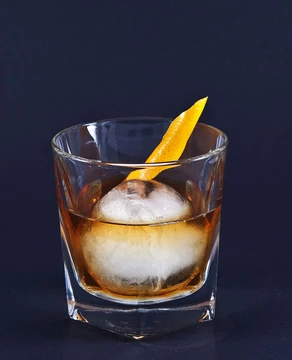
Chartreuse swizzle
Tiki cocktail invented in 2003 by Marcovaldo Dionysos.

BanjoZebra · CC BY 4.0
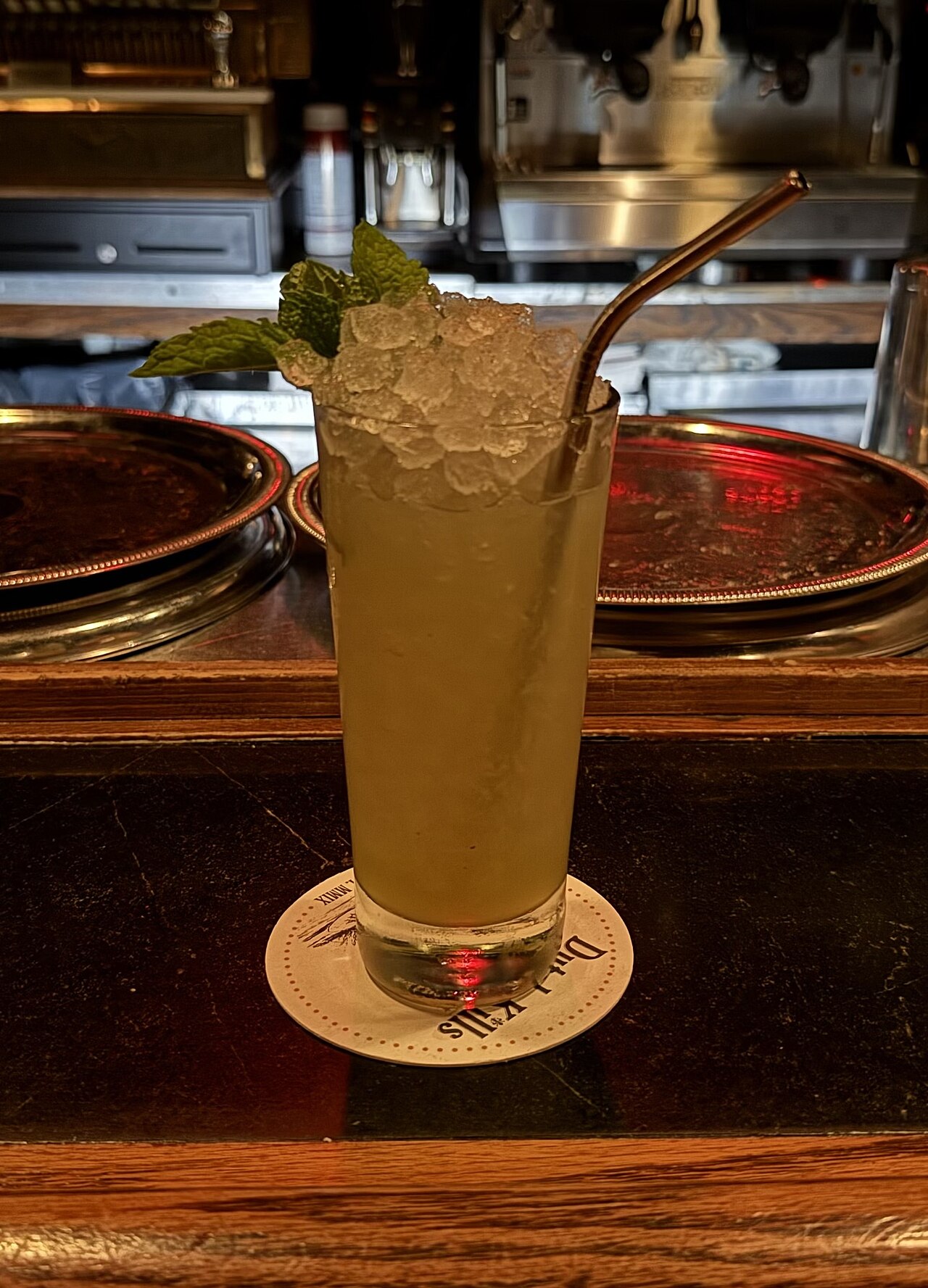
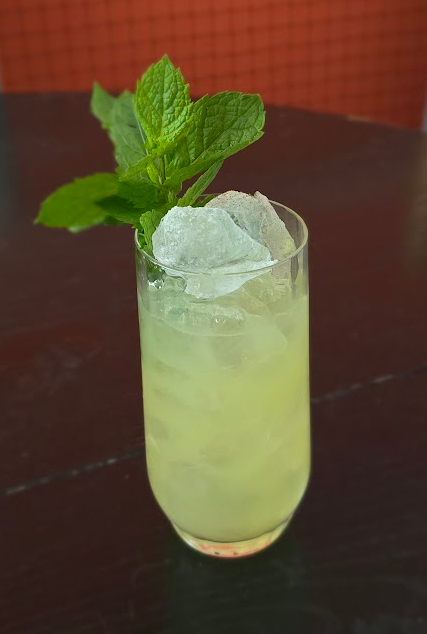
The Chartreuse swizzle, a tiki cocktail, combines green Chartreuse, velvet falernum, pineapple juice, and lime juice. It was created in 2003 by San Francisco bartender Marcovaldo Dionysos at Harry Denton's Starlight Room, and has since become a modern classic. Despite its popularity, the International Bartenders Association has not officially recognized it as a cocktail.
Dionysos invented the drink for a Chartreuse-sponsored competition, which he had entered annually since 1999, placing in the top three for four straight years. Hesitant to compete in 2003, he was encouraged by an organizer to return; his Chartreuse swizzle won first place, earning him a Fuji mountain bike. At the time, Chartreuse was popular among San Francisco bartenders in the craft cocktail movement but rarely used in tiki drinks. Dionysos recalled reading about velvet falernum, then an obscure ingredient, and combined the two into a tropical cocktail. He also drew inspiration from rum-based "swizzle" drinks, which use a swizzle stick for even dilution and a frothy texture.
After the competition, Dionysos added the drink to the menu at Harry Denton's Starlight Room, where it was well-received. It gained national attention in 2008 when it appeared on the menu at Clock Bar, a San Francisco restaurant by celebrity chef Michael Mina. On opening night, Mina asked for a Grey Goose on the rocks, but Dionysos, the bar manager, served him a Chartreuse swizzle instead. The drink won over Mina and the restaurant's beverage manager, soon appearing on menus at Mina's restaurants worldwide, fueling its rapid international rise by 2010. Alongside the Last Word, the Chartreuse swizzle is credited with boosting Chartreuse's popularity and sales in the early 2000s.
In a 2021 Robb Report article, Jason O'Bryan praised it as a "Nobel Prize" candidate for cocktails, calling it "novel to the point of being avant-garde, yet brilliant in its simplicity." He noted Chartreuse was a "crazy choice" for a base spirit, adding that pineapple juice and Chartreuse pair "fabulously" despite the monks who invented Chartreuse in 1737 likely never seeing a pineapple. A Washington Post recipe by Robert Simonson describes the drink as "bright, complex, and startling," with Dionysos attributing its success to its four-ingredient simplicity and the rising popularity of Chartreuse and tiki cocktails.
Quick Facts
- Ingredients
- 45 mL green Chartreuse / 30 mL pineapple juice / 22.5 mL lime juice / 15 mL falernum
- Served
- On the rocks
- Garnish
- Mint leaves · grated nutmeg
- Prep
- Pour ingredients into the glass, add pebble ice, and stir with a swizzle stick or cocktail spoon. Top up with pebble ice and garnish.
- Drinkware
- Collins glass
Facts from the source article.
Lore & Background
San Francisco bartender Marcovaldo Dionysos invented the Chartreuse swizzle in 2003. Dionysos had participated in a Chartreuse-sponsored cocktail competition each year since 1999, placing among the top three finalists for four years in a row. He was hesitant to participate in the 2003 competition until an organizer encouraged him to return; as a result, he devised the Chartreuse swizzle, which went on to win him first place and a Fuji mountain bike as a prize.
Chartreuse had become popular among San Francisco bartenders in the early-2000s craft cocktail movement, but it was uncommonly seen in tiki cocktails. Dionysos had remembered reading about velvet falernum, an obscure ingredient at the time, and was inspired to combine the two ingredients into a tropical cocktail. He also took inspiration from other, typically rum-based 'swizzle' drinks, which are mixed with a swizzle stick to achieve a uniform dilution and slightly frothy texture.
After the Chartreuse swizzle won the competition, Dionysos added the drink to the menu at Harry Denton's Starlight Room, the bar where he worked at the time. There, it was well-received, but it did not attract national attention until 2008, when it was added to the menu at celebrity chef Michael Mina's San Francisco restaurant Clock Bar. On the restaurant's opening night, Mina asked Dionysos, who had been tapped as bar manager, for a Grey Goose on the rocks, but Dionysos instead presented him with a Chartreuse swizzle; the cocktail immediately won over Mina and the restaurant's beverage manager, and it soon appeared on the menu. The cocktail proceeded to appear on menus at Mina's restaurants all around the world, contributing to its rapid international rise by 2010.
Reader's Guide
The Chartreuse swizzle is significant as a modern classic that helped revive interest in Chartreuse as a cocktail ingredient in the early 2000s. Along with the Last Word, it has been credited for a resurgence of popularity and sales for Chartreuse. Its invention by Marcovaldo Dionysos in 2003 for a Chartreuse-sponsored competition marked a turning point in the use of the herbal liqueur in tiki cocktails, a category where it was previously uncommon. The drink's simplicity—just four ingredients—and its tropical profile contributed to its rapid spread, first through San Francisco bars and then internationally after appearing on menus at Michael Mina's restaurants worldwide. The International Bartenders Association recognized it as an official cocktail in 2024, cementing its status. The cocktail's legacy also lies in its role in the craft cocktail movement, demonstrating how a single competition entry can influence bar culture globally.
Did You Know?
- The Chartreuse swizzle won Marcovaldo Dionysos a Fuji mountain bike as a prize in the 2003 Chartreuse-sponsored competition.
- Along with the Last Word, the Chartreuse swizzle has been credited for a resurgence of popularity and sales for Chartreuse in the early 2000s.
The IBA's Century-Long Curation of the Cocktail Canon
The International Bartenders Association undertook a remarkable project in the early 1960s: identifying which mixed drinks had achieved the status of the world's most requested recipes. Development of the list began in 1960, and the inaugural edition was announced the following year, 1961, presenting a curated selection of fifty cocktails. That first publication was far from a final word. The IBA has treated the list as a living document, subjecting it to periodic revisions that reflect shifting global tastes and the emergence of new preparation traditions. By 2026, the canon had more than doubled in size, reaching one hundred and two cocktails. This growth was not merely numerical; it was structural. The association reorganized the collection into three distinct categories, each containing exactly thirty-four entries. The result is a framework that balances historical preservation with contemporary innovation, giving bartenders worldwide a shared vocabulary while acknowledging that the art of mixing drinks continues to evolve across generations and continents.
Three Pillars: The Architecture of the Official List
The IBA's organizational choice to divide its one hundred and two cocktails into three equal groups of thirty-four is a deliberate act of curation that signals how the association views the history of mixed drinks. The first pillar, The Unforgettables, gathers the recipes that have endured across decades and continents without losing their identity. The second, Contemporary Classics, occupies a middle ground: drinks that have become globally recognized but arrived on the scene more recently than the oldest formulas. The third, New Era Drinks, represents the most forward-looking tier, capturing innovations that the IBA judges to have achieved sufficient worldwide demand to warrant official recognition. This tripartite structure, with its strict numerical symmetry, gives the list a sense of architectural balance. It also creates a natural narrative arc for the reader, moving from the oldest and most battle-tested recipes through the mid-century and late-twentieth-century favorites to the freshest additions, all while maintaining the IBA's core criterion that each drink must be among the most requested in the world.
The Unforgettables: A Constellation of Timeless Formulas
The thirty-four entries in The Unforgettables read like a who's-who of bar history, spanning base spirits from gin and rum to rye whiskey, cognac, and brandy. The Dry Martini pairs gin with white vermouth and a simple olive or lemon twist; the Manhattan layers whiskey, sweet vermouth, and bitters; the Daiquiri distills rum, citrus, and sweetener into a deceptively simple trio. Some entries carry remarkable provenance: the Sazerac is a New Orleans signature named after the Sazerac de Forge et Fils cognac that originally anchored it, while the Monkey Gland was created in the 1920s by Harry MacElhone at his Paris bar. The Martinez, widely regarded as the direct ancestor of the Martini, shows how one recipe can spawn a dynasty. Others introduce unexpected elements—the Clover Club's egg white and raspberry syrup, the Ramos Fizz's orange flower water and cream, the Last Word's equal parts of gin, green Chartreuse, maraschino liqueur, and lime juice shaken and strained to a clean, ice-free pour. Together these thirty-four drinks form a foundation that virtually every serious bartender still reaches for.
Contemporary Classics: The Global and the Modern
The Contemporary Classics tier captures cocktails that achieved worldwide popularity in the latter half of the twentieth century and beyond, often carrying the cultural fingerprints of their regions of origin. Brazil's Caipirinha, built on cachaça, sugar, and lime, is explicitly identified as the country's national cocktail. The Cosmopolitan, a vodka-based blend of triple sec, cranberry juice, and lime, became a defining drink of a particular era of bar culture. The Irish coffee layers hot coffee, Irish whiskey, and sugar beneath a cap of cream that the drinker sips through. France's Kir pairs a measure of crème de cassis with white wine, traditionally Bourgogne Aligoté, and earns the name Kir Royal when the wine is upgraded. The Corpse Reviver Number Two, with its equal parts of gin, lemon juice, orange liqueur, and a Lillet-family aperitif finished with a dash of absinthe, shows how pre-war European formulas were resurrected in modern bars. Even the simple Cuba libre—rum, cola, and lime on ice—demonstrates how a handful of ingredients can achieve global ubiquity and earn a place in the IBA's official canon.
Gallery
More in IBA official cocktails 1-24
Spotted an error? Know more?
Reader corrections go straight into our review queue. Suggest an edit · How this site is sourced