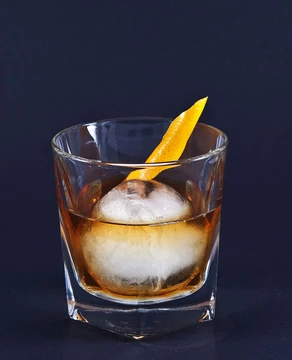
Aviation (cocktail)
A gin sour variation with violet liqueur.

Alfred T. Palmer · Public domain
The Aviation is a gin-based cocktail that also includes maraschino liqueur, crème de violette, and lemon juice, served straight up in a cocktail glass. Its creator was Hugo Ensslin, the head bartender at New York’s Hotel Wallick in the early 1900s. The first known recipe appeared in Ensslin’s 1916 book *Recipes for Mixed Drinks*, which specified two-thirds El Bart gin, one-third lemon juice, and two dashes each of maraschino liqueur and crème de violette. In 1930, Harry Craddock’s *Savoy Cocktail Book* left out the crème de violette, calling for two-thirds dry gin, one-third lemon juice, and two dashes of maraschino. Many later bartenders followed Craddock’s lead, omitting the hard-to-find violet liqueur. Crème Yvette, a spiced violet liqueur, is sometimes used as a substitute for crème de violette.
The Aviation is essentially a variation on the Gin sour, with maraschino serving as the sweetener. Related cocktails include the Water Lily, which replaces maraschino with an orange liqueur like triple sec or Cointreau; the Moonlight, made with gin, lime juice, Cointreau, and crème de violette; and Takumi’s Aviation, created by Japanese bartender Takumi Watanabe and recorded in Gary Regan’s 2017 *The Joy of Mixology*, which uses gin, maraschino liqueur, parfait d’amour, and lemon juice. The Beachcomber is a rum-based version of the sour.
Quick Facts
- Ingredients
- 45 ml gin / 15 ml maraschino Luxardo / 15 ml lemon juice / 1 barspoon crème de violette
- Served
- Straight up: chilled, without ice
- Garnish
- maraschino cherry
- Prep
- Add all ingredients into a cocktail shaker. Shake with cracked ice and strain into a chilled cocktail glass.
- Drinkware
- Cocktail glass
Facts from the source article.
Lore & Background
Hugo Ensslin, head bartender at the Hotel Wallick in New York, created the Aviation in the early twentieth century. The first published recipe appeared in his 1916 Recipes for Mixed Drinks, calling for two thirds El Bart gin, one third lemon juice, two dashes maraschino liqueur, and two dashes crème de violette. Harry Craddock's influential Savoy Cocktail Book (1930) omitted the crème de violette, calling for a mixture of two thirds dry gin, one third lemon juice, and two dashes of maraschino. Many later bartenders followed Craddock's lead, leaving out the difficult-to-find violet liqueur. Some recipes omit the crème de violette entirely. Creme Yvette, a violet liqueur made with additional spices, is sometimes substituted for crème de violette.
Reader's Guide
The Aviation is significant as an early twentieth-century cocktail that showcases the use of floral liqueurs in mixed drinks. Its creation by Hugo Ensslin, a notable head bartender, and its inclusion in his 1916 recipe book mark it as a classic of the pre-Prohibition era. The drink's legacy is shaped by the controversy over its key ingredient: crème de violette. Harry Craddock's 1930 Savoy Cocktail Book omitted this ingredient, leading many bartenders to serve a simpler version. This divergence created two distinct traditions: the original violet-hued cocktail and a paler, more accessible variant. The Aviation also serves as a foundation for related cocktails, such as the Water Lily (substituting orange liqueur for maraschino), the Moonlight (using lime juice and Cointreau), and Takumi's aviation (using parfait d'amour). Its influence extends to rum-based variations like the Beachcomber. The drink remains a touchstone for discussions about authenticity and adaptation in cocktail culture.
Did You Know?
- The first published recipe appeared in Ensslin's 1916 Recipes for Mixed Drinks.
- Harry Craddock's Savoy Cocktail Book (1930) omitted crème de violette from the recipe.
Recipe & Core Composition
The Aviation cocktail is built from four principal components: gin as the base spirit, maraschino liqueur, crème de violette, and lemon juice. This combination places it among the more layered gin-based entries in the IBA canon. What distinguishes the Aviation from many of its contemporaries in the Unforgettables tier is the presence of crème de violette, an ingredient that appears in very few other cocktails on the official list. The drink sits alongside entries such as the Martinez, the Last Word, and the Casino, each of which also features maraschino liqueur, yet the Aviation's inclusion of that violet element gives it a compositional profile that is genuinely singular within the roster. The lemon juice provides the acidic backbone common to most of the category's shaken drinks, while the gin anchors the spirit base in the same way it does for the Dry Martini, the White Lady, and the Clover Club. Together, these four ingredients form a recipe that the IBA has maintained as one of its most requested formulations across multiple revisions of the official list.
IBA Recognition & List History
The Aviation carries the designation of an IBA official cocktail, a status the International Bartenders Association reserves for what it considers the most requested recipes in the bartending trade. The official list traces its origins to a development process that began in 1960, with the inaugural edition announced in 1961 and comprising just 50 cocktails. Since that modest beginning, the list has undergone periodic revisions, expanding to encompass 102 cocktails organized into three categories by 2024 and 2026. The Aviation's continued inclusion across these revisions signals that it has maintained consistent demand and recognition in bars worldwide. Its presence in the list means the recipe has survived more than six decades of changing tastes, evolving ingredient availability, and shifting bar culture while the total number of recognized cocktails more than doubled from the original fifty. This longevity within a curated, authoritative roster underscores the drink's standing as a staple rather than a passing trend.
Standing Among the Unforgettables
As of 2024, the IBA divides its 102 official cocktails into three equal groups of 34: The Unforgettables, Contemporary Classics, and New Era Drinks. The Aviation is classified under The Unforgettables, a grouping that signals its status as a foundational, timeless recipe rather than a modern innovation. Its fellow members in this category include iconic names such as the Manhattan, the Negroni, the Old Fashioned, the Daiquiri, the Sidecar, and the Sazerac, drinks that have anchored bar culture for generations. Being placed in the same tier as these legends underscores the Aviation's enduring relevance in professional bartending. Notably, several of its Unforgettables peers also feature maraschino liqueur, including the Casino, the Martinez, the Last Word, and the Brandy Crusta, suggesting a shared lineage of gin-and-maraschino construction. The Aviation distinguishes itself within that sub-group through its unique combination of crème de violette and lemon juice, giving it a compositional identity that no other member of the category replicates.
The Crème de Violette Variation
One of the most distinctive aspects of the Aviation, as documented in the IBA's official recipe, is the acknowledgment that some versions of the drink omit crème de violette entirely. This makes the Aviation somewhat unique within the IBA's 102-cocktail roster, where most entries list a fixed set of ingredients without noting an accepted alternative. When a bartender chooses to exclude the crème de violette, the resulting drink shifts closer to its maraschino-forward peers such as the Casino or the Martinez, losing the specific aromatic element that originally defined the recipe. The crème de violette is the component that sets the Aviation apart from other gin-and-maraschino combinations in the Unforgettables category, and its optional status means the cocktail exists in a kind of dual identity within the bartending world. In its full form it occupies a singular compositional niche; in its reduced form it blends more readily into the broader family of classic gin sours. Either way, the Aviation retains its prestigious slot in the IBA's most-requested list, a testament to the drink's broad appeal regardless of which version a bartender prepares.
Gallery
More in IBA official cocktails 1-24
Spotted an error? Know more?
Reader corrections go straight into our review queue. Suggest an edit · How this site is sourced