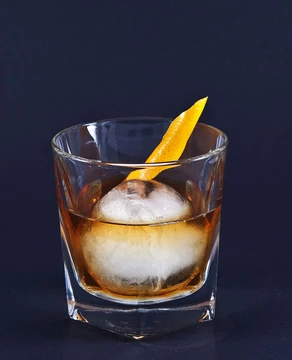
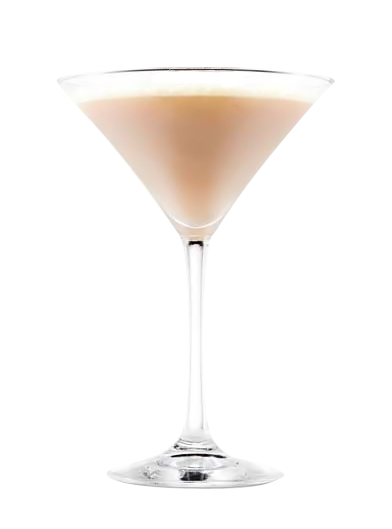
Brandy Alexander
A creamy cognac cocktail with disputed origins.

Rhododendrites · CC BY-SA 4.0
The Brandy Alexander is a brandy-based dessert cocktail made with cognac, crème de cacao, and cream. It became popular during the early 20th century as a variation of an earlier gin-based cocktail called simply an Alexander.
Quick Facts
- Ingredients
- 30 ml Cognac / 30 ml Crème de cacao (brown) / 30 ml fresh cream
- Served
- Straight up: chilled, without ice
- Garnish
- Sprinkle fresh ground nutmeg on top.
- Prep
- Pour all ingredients into cocktail shaker filled with ice cubes. Shake and strain into a chilled cocktail glass.
- Drinkware
- Cocktail glass
Facts from the source article.
Lore & Background
The origins of the Brandy Alexander are uncertain, with several competing stories. Some sources say it was created at the time of the London wedding of Princess Mary and Viscount Lascelles in 1922. Drama critic and Algonquin Round Table member Alexander Woollcott claimed it was named after him, while other sources attribute it to Russian tsar Alexander II. Another account suggests it was named after Troy Alexander, a bartender at Rector's, a New York City restaurant, who created the drink for a dinner celebrating Phoebe Snow, a character in a popular advertising campaign.
Reader's Guide
The Brandy Alexander holds significance as a classic dessert cocktail that has endured for over a century. Its creamy, sweet profile made it a popular after-dinner drink, and its appearance in numerous films and television shows has cemented its place in popular culture. The drink's disputed origins reflect the often-mythologized history of cocktail creation. Its legacy includes inspiring a frozen variant with ice cream and being referenced in literature, such as in Chuck Palahniuk's novel Invisible Monsters, where a character is named after the drink, and in Evelyn Waugh's Brideshead Revisited, where a character orders four 'Alexandra cocktails.' The cocktail's association with both elegance and excess is highlighted by its role in the film Days of Wine and Roses, where it triggers a character's alcoholism, and by John Lennon's 'lost weekend' in 1974, when he was introduced to the drink by Harry Nilsson and later described it as tasting 'like milkshakes.'
Did You Know?
- John Lennon was introduced to the Brandy Alexander on March 12, 1974, by Harry Nilsson during Lennon's 'lost weekend.'
- The drink may have been named after Troy Alexander, a bartender at Rector's in New York City, who created it for a dinner celebrating Phoebe Snow.
- In the 1962 film Days of Wine and Roses, a Brandy Alexander is ordered for a date who dislikes liquor but likes chocolate, leading to her alcoholism.
- The character Brandy Alexander in Chuck Palahniuk's novel Invisible Monsters is named after the drink.
Origins Wrapped in Rumor
The Brandy Alexander's birth story is as layered as the drink itself. What we know with certainty is that it is a dessert cocktail built on cognac, crème de cacao, and cream, and that it rose to prominence in the early twentieth century as a brandy-based spin-off of an older gin-based recipe simply called the Alexander. Beyond that, the trail dissolves into competing legends. Some accounts tie the name to the 1922 London wedding of Princess Mary and Viscount Lascelles. The sharp-tongued drama critic Alexander Woollcott, a fixture of the Algonquin Round Table, insisted the drink bore his own name. Other tellings point to the Russian tsar Alexander II as the eponym. Perhaps the most specific claim credits Troy Alexander, a bartender at Rector's in New York City, who allegedly mixed the drink to provide a white-colored option at a dinner honoring Phoebe Snow, a beloved figure from a popular advertising campaign of the era. Today, the name Alexander on a cocktail menu can refer to either the gin or the brandy version, a small ambiguity that mirrors the drink's murky past.
A Staple of Silver Screen and Small Screen
The Brandy Alexander has an almost uncanny habit of surfacing at pivotal moments in cinema and television. In the 1962 drama Days of Wine and Roses, Jack Lemmon's Joe Clay orders one for Lee Remick's Kirsten after she admits she dislikes liquor but loves chocolate, a gesture that quietly sets her on a downward spiral. The 1970 pilot of The Mary Tyler Moore Show wove the drink into a running gag when the title character requested one during a job interview. In the 1981 film Tattoo, Bruce Dern's character orders a Brandy Alexander on a dinner date, and when Maud Adams remarks he doesn't look the type, he replies that he likes the foam because it reminds him of the ocean. The 1981 television adaptation of Brideshead Revisited features Anthony Blanche ordering four of the cocktails for himself and Jeremy Irons's Charles Ryder, then draining all four in rapid succession after Charles hesitantly sips his. In Mad Men's "Indian Summer," Peggy Olson enjoys one on a date, noting that Joan Holloway usually orders it for her but finds it sweeter. And in the 2008 film Two Lovers, Joaquin Phoenix's Leonard tries to impress Gwyneth Paltrow's Michelle by ordering one, only to defuse the moment by mistaking the stirrer for a straw.
A Name That Writers Keep Reaching For
The cocktail's evocative two-word name has made it a recurring fixture in literature. Chuck Palahniuk named a character in his novel Invisible Monsters directly after the drink, folding its creamy, indulgent connotations into his narrative. Evelyn Waugh's Brideshead Revisited features the flamboyant Anthony Blanche ordering four "Alexandra cocktails" for himself and Charles Ryder, a scene that became so memorable it was echoed decades later when Christian Kracht repeated the four-Brandy-Alexander motif in his 1995 novel Faserland. Kurt Vonnegut deployed the drink in Mother Night, where the protagonist half-jokingly suspects that an overly flattering Herald Tribune profile of his neighbor was "written by a pansy full of Brandy Alexanders." Across these very different authors and eras, the cocktail functions as shorthand for excess, theatricality, or a particular kind of cloying sweetness that signals a character's temperament or a scene's tone. Its presence on the page, much like its presence in a glass, is always about more than the liquid itself.
The Lost Weekend and the Milkshake Comparison
One of the most vivid anecdotes attached to the Brandy Alexander involves John Lennon. On March 12, 1974, during what became known as his "lost weekend," Harry Nilsson introduced Lennon to the drink. The evening escalated when the pair began heckling the Smothers Brothers at a performance, and Lennon was subsequently ejected, allegedly assaulting a waitress in the process. Yet Lennon's lasting memory of the night was sensory rather than chaotic: he later described the cocktails as tasting "like milkshakes," a comparison that captures the drink's rich, creamy, dessert-like character perfectly. That same quality of indulgence is what distinguishes the Brandy Alexander from a straightforward spirit-and-liqueur mix. The combination of cognac, crème de cacao, and cream produces a velvety, sweet profile, and bartenders can push the dessert angle further by adding ice cream to create what is known as a frozen Brandy Alexander. The drink's recognition as a classic is underscored by its inclusion among IBA Official Cocktails, cementing its place in the broader canon of mixology even as its origins remain delightfully uncertain.
Gallery

More in IBA official cocktails 1-24
Spotted an error? Know more?
Reader corrections go straight into our review queue. Suggest an edit · How this site is sourced